
Specifying the incorrect motor enclosure for regenerative blowers frequently leads to premature winding failures and costly, unscheduled downtime in demanding dynamic compression applications. Typically, system designers rely on standard NEMA classifications and basic off-the-shelf datasheet parameters to guide their integration choices.
However, selecting the optimal enclosure design grants unparalleled system longevity and mitigates thermal risks under continuous duty. This optimization is contingent upon a strict stipulation: operators must precisely align environmental ingress risks with the motor's thermal dissipation limits. For instance, in dusty pneumatic conveying or high-humidity wastewater aeration plants, this enclosure choice directly dictates system survival.
In this article, we will evaluate Totally Enclosed Fan Cooled (TEFC) versus Open Drip Proof (ODP) motors. We will compare their sealing capabilities, cooling efficiencies, and total lifecycle costs to help you select the ideal configuration for your dynamic compression application.
| Factor | Summary |
|---|---|
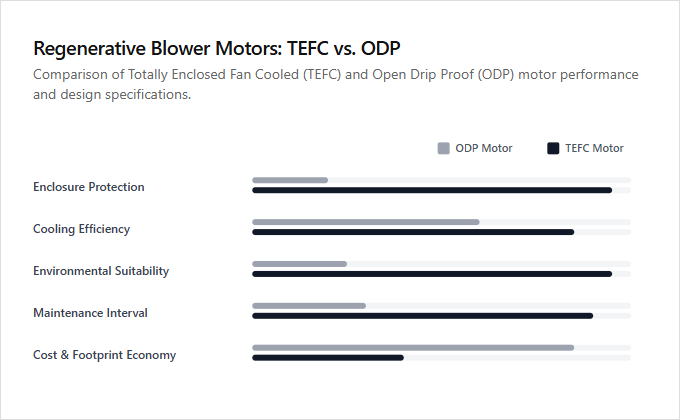
| Enclosure Protection | TEFC motors feature a completely sealed frame to prevent the ingress of dust and moisture, whereas ODP motors have open ventilation slots that expose the internal stator windings. |
| Cooling Mechanism | TEFC units utilize an external shaft-mounted fan to blow air over the frame, while ODP motors pull ambient air directly through the internal rotor assembly for cooling. |
| Environmental Suitability | ODP motors are restricted to clean, dry indoor environments to avoid electrical shorts, whereas TEFC motors are ideal for harsh, debris-heavy pneumatic conveying applications. |
| Maintenance Requirements | Due to their open design, ODP motors require frequent maintenance to clear particulate buildup, whereas TEFC motors offer superior longevity with minimal maintenance due to their sealed IP-rated housing. |
| Cost and Footprint | ODP motors typically offer a lower initial capital expenditure and smaller physical footprint, whereas TEFC motors provide a higher total cost of ownership offset by extreme ruggedness. |
TEFC vs. ODP: Superior IP55 Ingress Protection
Regenerative blowers rely heavily on their electric motors to sustain continuous, high-volume airflow. When selecting a blower, the choice between a Totally Enclosed Fan Cooled (TEFC) motor and an Open Drip-Proof (ODP) motor is critical for operational longevity. TEFC motors provide superior IP55 ingress protection, effectively sealing internal components against heavy moisture and fine particulate matter. In contrast, ODP motors carry a lower IP22 rating, leaving them vulnerable to airborne contaminants and liquid ingress due to their open ventilation design.
The enclosed structure of the TEFC motor prevents winding contamination and premature failure in demanding environments. Industrial operators managing dusty woodworking shops or outdoor wastewater facilities require the robust protection of TEFC blowers, while technicians operating in pristine, climate-controlled laboratory environments can safely utilize cost-effective ODP models.
ODP Motor Winding Contamination from Discharge Heat
When selecting a regenerative blower, the choice between Totally Enclosed Fan Cooled (TEFC) and Open Drip-Proof (ODP) motors directly impacts operational longevity. ODP motors utilize direct convection cooling through open vents, making them highly susceptible to winding contamination from dynamic compression discharge heat. This intake of heated, potentially particulate-laden air accelerates insulation degradation and increases the risk of premature electrical failure in demanding environments.
TEFC motors mitigate these risks by isolating the internal components from the ambient airstream, utilizing an external fan to dissipate heat across a sealed frame. This protective barrier ensures consistent performance under harsh operating conditions. Industrial operators facing dusty, high-temperature environments require the robust protection of TEFC motors, whereas facility managers operating in clean, climate-controlled spaces can safely utilize ODP models.
TEFC Enclosures Prevent Dust-Induced Stator Breakdown
When selecting a regenerative blower, the choice between Totally Enclosed Fan Cooled (TEFC) and Open Drip Proof (ODP) motors directly impacts operational longevity. TEFC enclosures completely isolate the internal components from the surrounding atmosphere. This design prevents abrasive dust and particulate matter from entering the housing, protecting the stator windings from dielectric breakdown during demanding, continuous S1 duty cycles.
ODP motors rely on ambient air flowing directly through the motor interior for cooling. While thermally efficient in pristine environments, this open airflow exposes critical electrical insulation to airborne contaminants, accelerating wear under continuous operating conditions.
Industrial operators managing dusty woodworking or pneumatic conveying systems require the rugged protection of TEFC-driven blowers, whereas utility engineers operating in clean, climate-controlled facilities benefit from the cost-effective performance of ODP configurations.
Low-Cost Outdoor ODP Blower Motors Suffer Rapid Wear
When selecting a regenerative blower, the choice between Totally Enclosed Fan Cooled (TEFC) and Open Drip Proof (ODP) motors impacts both longevity and budget. ODP motors feature open vents that allow direct airflow, providing efficient cooling at a lower manufacturing cost. This open design exposes internal components to moisture and debris in outdoor setups, causing rapid bearing degradation.
TEFC motors enclose all internal components, protecting them from environmental contaminants. This design ensures prolonged operational life in harsh or wet conditions despite a higher initial cost. Budget-conscious operators managing clean, indoor facilities are ideal candidates for ODP models, whereas field engineers and industrial professionals requiring reliable outdoor performance are best suited for TEFC configurations.
TEFC Motor Fan Cooling Manages Blower Heat
Regenerative blowers generate significant thermodynamic compression during continuous operation, which elevates ambient temperatures around the motor. Totally Enclosed Fan Cooled (TEFC) motors effectively manage this heat using an external, shaft-mounted fan that blows cooling air over the sealed motor frame. This design protects internal components from both high operating temperatures and airborne contaminants.
Conversely, Open Drip-Proof (ODP) motors allow ambient air to flow directly through internal windings for cooling, offering less protection against moisture and debris. Heavy-duty industrial operators working in dusty, demanding environments require the durability of TEFC-driven blowers, while facility managers overseeing clean, temperature-controlled indoor utility rooms are best suited for cost-effective ODP models.
ODP Motors: Low Windage but Vulnerable to Humidity
When selecting a regenerative blower, the choice between Totally Enclosed Fan Cooled (TEFC) and Open Drip-Proof (ODP) motors impacts operational longevity. ODP motors feature open ventilation, exhibiting lower windage losses during operation. However, this open design lacks the robust environmental sealing required to protect internal components in high-humidity blower applications.
TEFC motors utilize a fully enclosed frame that prevents moisture and debris from entering the system. Although TEFC units incur slightly higher windage losses from their external cooling fans, they offer superior reliability in harsh conditions. Plant managers operating in clean, climate-controlled indoor facilities should select ODP motors, while field operators managing outdoor or high-moisture installations require the durable protection of TEFC motors.
Class F Insulation for High-Stress TEFC Blowers
In regenerative blower applications, selecting between Totally Enclosed Fan Cooled (TEFC) and Open Drip-Proof (ODP) motors directly impacts system longevity and performance. TEFC motors are specifically engineered for harsh, demanding environments by sealing internal components from airborne contaminants. Crucially, TEFC frames utilize Class F insulation systems to withstand the high thermal stress of high-backpressure blower operations, preventing winding degradation during periods of maximum pressure load.
In contrast, ODP motors allow ambient air to flow directly through the windings for cooling, offering a cost-effective alternative but leaving the motor vulnerable to dust and moisture. TEFC configurations are best suited for industrial operators managing heavy-duty, high-pressure processes in dusty environments, whereas ODP configurations are ideal for facility managers seeking economical solutions in clean, well-ventilated indoor utility rooms.
Leave a comment