
Metal fabrication professionals often struggle with bottlenecked production throughput and premature tool burnout during intensive, high-velocity material removal-a frustrating challenge where choosing the wrong grinder can quickly stall critical fabrication timelines.
Typically, facilities attempt to resolve these inefficiencies through standard equipment budgets, relying on traditional procurement sources to replace failing tools on a 1:1 basis. However, strategically optimizing your tool selection grants your shop an immediate boost in continuous duty-cycle efficiency while significantly lowering operator fatigue.
This upgrade comes with the stipulation that raw grinding power must be carefully balanced against your facility's existing infrastructure, such as compressed air capacity versus electrical grid stability. In demanding applications like heavy-duty ship hull weld preparation or thick steel plate beveling, making the right choice is vital to ensuring operational safety and tool longevity.
Below, we provide a comparative analysis of pneumatic and electric grinders, evaluating their torque consistency, power-to-weight ratios, and total cost of ownership to help you select the ideal tool for your high-velocity operations.
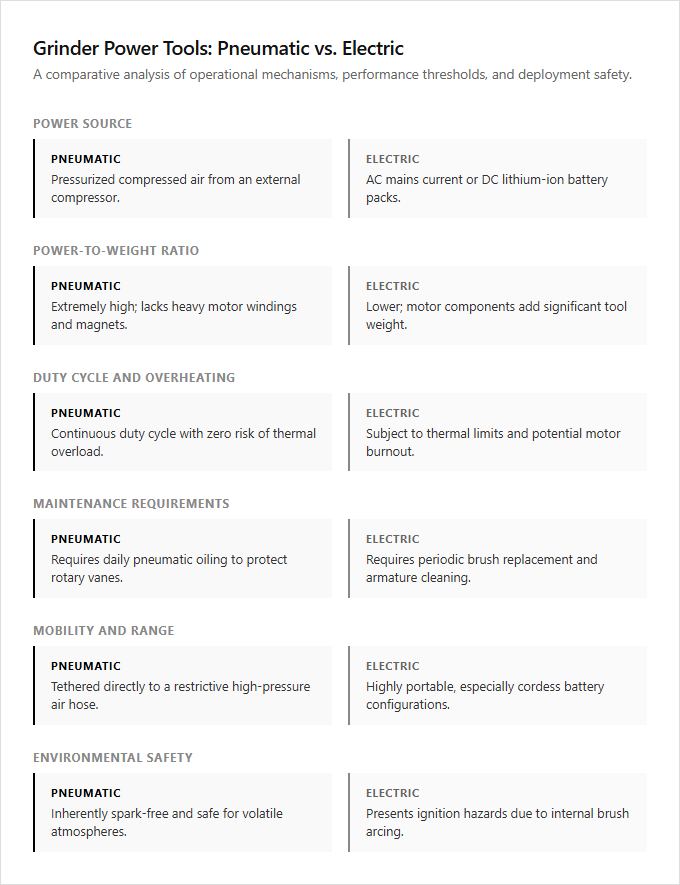
| Factor | Summary |
|---|---|
| Power Source | Pneumatic grinders run on pressurized compressed air generated by an external compressor, while electric grinders utilize alternating current (AC) or direct current (DC) from batteries. |
| Power-to-Weight Ratio | Pneumatic grinders possess a much higher power-to-weight ratio because they lack the heavy copper windings and magnets found in electric motors. |
| Duty Cycle and Overheating | Pneumatic grinders have a continuous duty cycle with zero risk of thermal overload, whereas electric grinders can experience motor burnout under sustained heavy loads. |
| Maintenance Requirements | Pneumatic tools require daily pneumatic oil lubrication to protect internal rotary vanes, whereas electric tools eventually need carbon brush replacement and armature cleaning. |
| Mobility and Range | Electric grinders provide excellent portability via lithium-ion battery packs, whereas pneumatic grinders are tethered to a restrictive air hose connected to a compressor. |
| Environmental Safety | Pneumatic grinders are inherently spark-free and safe for volatile environments, while electric grinders present an ignition hazard due to brush arcing within the motor. |
Pneumatic Vane vs. Electric Motors: Power-to-Weight Ratio
Pneumatic grinders utilize compact vane motors driven by compressed air, yielding an exceptional power-to-weight ratio. Because these tools lack heavy internal copper windings and armature cores, they remain remarkably lightweight and cool during prolonged operation. This design minimizes operator fatigue while delivering high rotational power within a compact frame.
In contrast, electric grinders rely on dense copper windings and steel laminations to generate torque. While this construction provides reliable, self-contained power directly from an electrical outlet, the physical mass of the motor assembly inevitably limits its power-to-weight efficiency compared to air-powered alternatives.
Pneumatic models are ideal for industrial fabricators requiring continuous, high-duty production, whereas electric grinders are best suited for mobile contractors needing portable, immediate utility without a dedicated air compressor system.
Pneumatic Duty Cycle vs. Electric Thermal Overload
Selecting the right grinder requires understanding how power delivery affects performance under constant load. Pneumatic grinders excel in high-intensity environments due to their ability to run at a continuous 100% duty cycle. As compressed air expands through the tool, it naturally cools the internal components, allowing for uninterrupted operation without the risk of overheating.
In contrast, electric grinders rely on electric motors that generate internal heat during prolonged use. Without adequate cooling periods, these units are susceptible to thermal overload, which can damage the motor windings and shorten the tool's lifespan. Industrial fabricators requiring non-stop heavy production benefit most from pneumatic models, whereas maintenance technicians needing portable, intermittent power are better served by electric alternatives.
Closed-Loop Speed Control for Optimal SFPM
Pneumatic grinders are valued for their high power-to-weight ratio, but they often experience drop-offs in Surface Feet Per Minute (SFPM) under heavy loads due to air pressure fluctuations. In contrast, modern electric grinders utilize electronic closed-loop speed feedback systems to maintain optimal SFPM. This technology constantly monitors the motor's RPM and dynamically adjusts power input, ensuring consistent grinding efficiency and preventing abrasive wheel degradation under load.
While pneumatic units excel in continuous-duty industrial environments with established air infrastructure, electric models with speed feedback offer superior precision and energy efficiency. Industrial fabricators requiring constant speed control for precise material removal benefit most from advanced electric grinders, whereas heavy-duty shipyard operators prioritizing tool longevity in harsh environments typically favor pneumatic systems.
High-Volume Air Consumption (SCFM)
When comparing pneumatic and electric grinders, air consumption is a critical operational factor. Pneumatic grinders require a continuous, high-volume air supply measured in Standard Cubic Feet per Minute (SCFM) to maintain peak performance. A typical industrial air grinder can demand between 15 to 30 SCFM at 90 PSI, necessitating a heavy-duty air compressor system. If the compressor cannot meet these high SCFM requirements, the tool experiences a significant drop in torque and rotational speed under load.
Electric grinders, by contrast, draw power directly from standard electrical outlets or batteries, eliminating the need for complex pneumatic infrastructure. They offer consistent power output without the overhead of air lines, though they are generally heavier than their air-driven counterparts. Industrial fabricators with permanent workshop compressor setups benefit most from the lightweight durability of pneumatic grinders, while mobile contractors and DIY enthusiasts are better suited to the plug-and-play portability of electric models.
Conductive Dust Risks: Electric vs. Pneumatic Tools
When operating in environments with metal shavings or carbon fibers, electric grinders pose a safety risk due to conductive dust ingress. The cooling vents required for electric motors allow fine, conductive particles to enter the housing and accumulate within the carbon brush cavities. This accumulation can bridge electrical gaps, leading to short circuits, motor burnout, or operator shock hazards.
Pneumatic grinders mitigate this hazard through their sealed housing design. Powered by compressed air, these tools do not require ventilation slots, preventing the entry of hazardous particulate matter. The constant positive internal air pressure also naturally expels external contaminants. Industrial fabrication specialists working with highly conductive metals benefit most from the safety of pneumatic systems, while general contractors requiring mobility on diverse job sites are better served by electric alternatives.
Torque and Speed Decay Under High Feed Force
Electric grinders maintain highly stable rotational velocity under moderate loads due to their constant electrical supply. Under high mechanical feed force, they experience a sharp stall torque drop; exceeding the motor's critical torque threshold triggers thermal overload protection, causing an abrupt halt to prevent permanent winding damage.
Pneumatic grinders exhibit a progressive rotational velocity decay as feed force increases. The air motor yields to external resistance, slowing down gradually without sudden shutdown and recovering its operating speed instantly once the mechanical load is reduced.
Heavy-duty industrial operators requiring continuous, stall-tolerant performance in hazardous environments are best suited for pneumatic grinders, while workshop technicians seeking precise speed control under moderate, predictable loads will benefit most from electric models.
Mechanical vs. Electronic Safety Compliance
Pneumatic and electric grinders employ distinct engineering mechanisms to ensure safety compliance during heavy-duty material removal. Pneumatic grinders utilize mechanical over-speed governors, which physically restrict airflow to prevent the grinding wheel from exceeding its rated RPM, even during sudden load drops. In contrast, electric grinders rely on electronic current-limiting overload protection, continuously monitoring thermal and electrical draw to shut down or throttle the motor before dangerous conditions arise.
Both safety systems effectively mitigate risk, yet they align with different operational demands. Heavy industrial fabricators in spark-sensitive or continuous-use environments are best suited for pneumatic grinders, whereas field contractors and maintenance technicians requiring portable, highly adaptable tools will find electric alternatives more appropriate.
Leave a comment