
Achieving a flawless, swirl-free finish in professional paint correction is often hindered by tool fatigue, heat buildup, and inconsistent power delivery. Detailers frequently struggle to balance the relentless physical demands of multi-stage correction cycles with the absolute precision required for soft clear coats.
While traditional shop setups often rely on standard electrical grid access or pre-existing equipment budgets to dictate machinery choices, selecting the optimal drive mechanism grants operators a distinct competitive advantage in torque consistency and thermal management. However, this operational upgrade is contingent on the stipulation that your facility can support either the heavy CFM airflow required for air-driven tools or the dedicated electrical circuits needed for high-amp electric units.
High-volume studios employing industry benchmarks like the electric Rupes LHR15 MarkIII or pneumatic Dynabrade dual-action polishers prove that matching tool utility to shop infrastructure directly dictates daily throughput.
Below, we examine the critical distinctions between pneumatic and electric dual-action polishers, analyzing their power-to-weight ratios, maintenance lifecycles, and long-term return on investment to help you determine the ideal fit for your bay.
| Factor | Summary |
|---|---|
| Power Source | Pneumatic polishers rely on compressed air delivered by an external air compressor, whereas electric polishers utilize alternating current from a grid or direct current from a lithium-ion battery pack. |
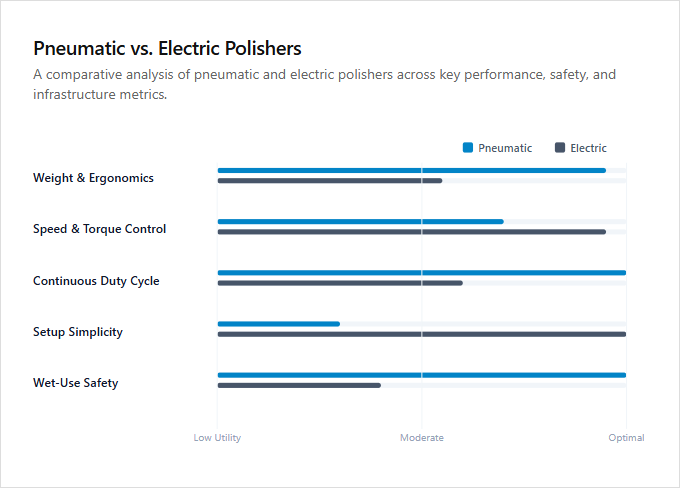
| Weight and Ergonomics | Pneumatic polishers boast a superior power-to-weight ratio because they lack a heavy internal electric motor, which significantly reduces operator fatigue during extended paint correction procedures. |
| Speed and Torque Regulation | Electric dual-action polishers often feature electronic speed stabilizers to maintain constant torque under load, while pneumatic units regulate rotational speed through air flow control valves. |
| Duty Cycle and Overheating | Pneumatic polishers offer a continuous duty cycle with zero risk of thermal overload, whereas electric polishers can experience armature overheating during prolonged, high-load compounding. |
| Infrastructure Requirements | Electric polishers require only a standard electrical outlet, while pneumatic polishers necessitate a high-volume air compressor system with dedicated moisture separators and regulators. |
| Wet-Use Safety | Pneumatic polishers are inherently safer for wet sanding applications because they eliminate the risk of electric shock associated with corded electric power tools. |
SCFM volumetric flow rate versus electrical amperage draw
Selecting the ideal professional polisher requires evaluating the power delivery system, specifically comparing pneumatic air volume consumption to electric current draw. Pneumatic polishers depend on a consistent Standard Cubic Feet per Minute (SCFM) flow rate, typically requiring 4 to 15 SCFM at 90 PSI to maintain optimal pad rotation. This constant volumetric flow ensures continuous, high-speed operation without the risk of motor burnout under heavy loads.
Electric polishers are rated by electrical amperage draw, generally ranging from 5 to 12 amps. This metric dictates the tool's torque capacity and resistance to stalling when plugged directly into standard electrical outlets. High-volume industrial collision repair facilities utilize pneumatic polishers for continuous duty cycles, while mobile detailers and home hobbyists favor the plug-and-play accessibility of high-amperage electric polishers.
Rotary vane air motor power-to-weight ratio versus electric armature mass
Pneumatic polishers utilize a rotary vane air motor, delivering an exceptional power-to-weight ratio. Because the drive mechanism lacks heavy copper windings and steel laminations, the tool remains remarkably light and compact. This low-mass design minimizes operator fatigue during extended operation and prevents heat buildup in the handpiece, as expanding exhaust air naturally cools the tool during operation.
In contrast, electric polishers rely on an armature with significant physical mass to generate torque. While this rotating mass provides excellent momentum and consistent speed under load, the substantial weight of the copper and steel motor assembly increases physical strain during vertical or overhead polishing tasks.
Pneumatic systems are ideal for high-production collision repair technicians working near centralized air lines, whereas electric models best serve mobile detailers and DIY enthusiasts who require plug-and-play portability across various locations.
Adiabatic expansion cooling effect versus electric motor thermal dissipation
Pneumatic polishers utilize compressed air, which undergoes adiabatic expansion as it flows through the tool. This thermodynamic process naturally cools the tool body during operation, allowing for continuous, heavy-duty use without the risk of overheating. The self-cooling mechanism ensures consistent performance and tool longevity in demanding environments.
Electric polishers rely on electromagnetic motors that inherently generate heat. Thermal dissipation in these tools depends on internal cooling fans and ventilation, which can struggle under prolonged, high-load conditions. Pneumatic models are ideal for high-volume, stationary collision shops requiring continuous-duty cycles, while electric models are best suited for mobile detailers and enthusiasts who value portability and plug-and-play convenience.
Pneumatic throttle valve modulation versus electronic feedback speed control
Pneumatic polishers utilize manual throttle valve modulation to regulate speed, offering the operator immediate analog control. By varying the physical trigger squeeze, users minutely adjust airflow and pad rotation on the fly. This mechanical system is highly resilient and thrives in continuous, wet, or hazardous production environments without the risk of electrical shock or motor burnout.
Conversely, electric polishers rely on sophisticated electronic feedback speed control. Internal circuitry monitors the load on the motor and automatically adjusts power to maintain a consistent RPM, even under heavy downward pressure. Pneumatic polishers are ideal for high-volume industrial fabricators seeking lightweight durability, while electric models best suit mobile detailers and refinishers requiring consistent, automated precision across various paint types.
Counterweight balance calibration for orbital throw eccentricity
Pneumatic and electric orbital polishers manage orbital throw eccentricity through distinct engineering approaches to counterweight balance calibration. In pneumatic systems, the absence of a heavy electric motor allows for a lightweight, highly precise counterweight that directly offsets the physical throw of the pad, resulting in minimal tool vibration. Conversely, electric polishers must calibrate heavier counterweights to counteract both the eccentric throw and the rotational inertia of the motor armature, requiring robust internal dampening to maintain user comfort.
While pneumatic tools offer fixed, ultra-precise balance calibration under consistent air pressure, electric models often utilize sophisticated electronic speed stabilization to maintain their balance harmonics under varying loads. Pneumatic polishers suit high-volume collision centers with robust air infrastructure seeking low-fatigue precision, whereas electric polishers are ideal for mobile detailers and hobbyists requiring versatile, plug-and-play operation across diverse environments.
In-line lubrication requirements versus electric carbon brush wear
Pneumatic polishers offer an exceptional power-to-weight ratio but demand strict maintenance discipline to ensure tool longevity. These air-driven tools rely on consistent in-line lubrication, requiring operators to integrate an automatic oiler system or perform manual daily oiling to prevent internal vane wear and moisture-induced corrosion.
Electric polishers eliminate the need for air compressors and lubrication lines but introduce wear components in the form of carbon brushes. Over extended operation, these brushes frictionally degrade against the motor's commutator, necessitating routine inspection and periodic replacement to prevent motor arcing and maintain electrical efficiency.
Pneumatic models are best suited for high-volume industrial environments with established air infrastructure, while electric units are ideal for mobile detailers and independent operators requiring immediate portability and minimal setup.
Pneumatic PSI delivery stalling threshold versus electric gear-driven torque consistency
Pneumatic polishers rely on continuous compressed air delivery, where performance is directly tied to maintaining specific PSI and CFM levels. Under heavy loads, if the air supply drops below the required threshold, these tools reach a stalling limit. This stall threshold acts as a physical safety mechanism, stopping pad rotation under excessive pressure to prevent paint burn-through.
In contrast, electric polishers utilize gear-driven motors that deliver consistent torque regardless of downward pressure. This mechanical connection ensures uniform correction speed across varying surfaces, though it requires greater operator vigilance to avoid surface damage. High-volume collision centers equipped with large air compressors benefit most from the lightweight safety of pneumatic systems, whereas mobile detailers and independent restorers require the plug-and-play, high-torque consistency of electric polishers.
Leave a comment