
Contractors and DIYers alike frequently face the frustration of ruined oscillating blades, stalled plunge cuts, and scorched workpieces mid-project. Often, we rely on the standard, budget-friendly carbon steel blades that serve as the default resource in basic tool kits. However, stepping up to professional-grade accessories grants you an immediate boost in cutting speed and tool longevity.
The crucial stipulation, of course, is that blade survival depends entirely on matching the cutting edge to the material's density. For example, plunging through embedded framing nails, copper pipes, or abrasive plaster requires a completely different alloy than simple drywall. To help you optimize your toolkit, this article provides an analytical comparison of Bi-Metal and Carbide blades, detailing their durability, cost efficiency, and performance thresholds in demanding plunge-cutting scenarios.
| Factor | Summary |
|---|---|
| Material Composition | Bi-metal blades combine high-speed steel teeth with a flexible carbon steel backing, whereas carbide blades utilize tungsten carbide teeth welded to the body for extreme hardness. |
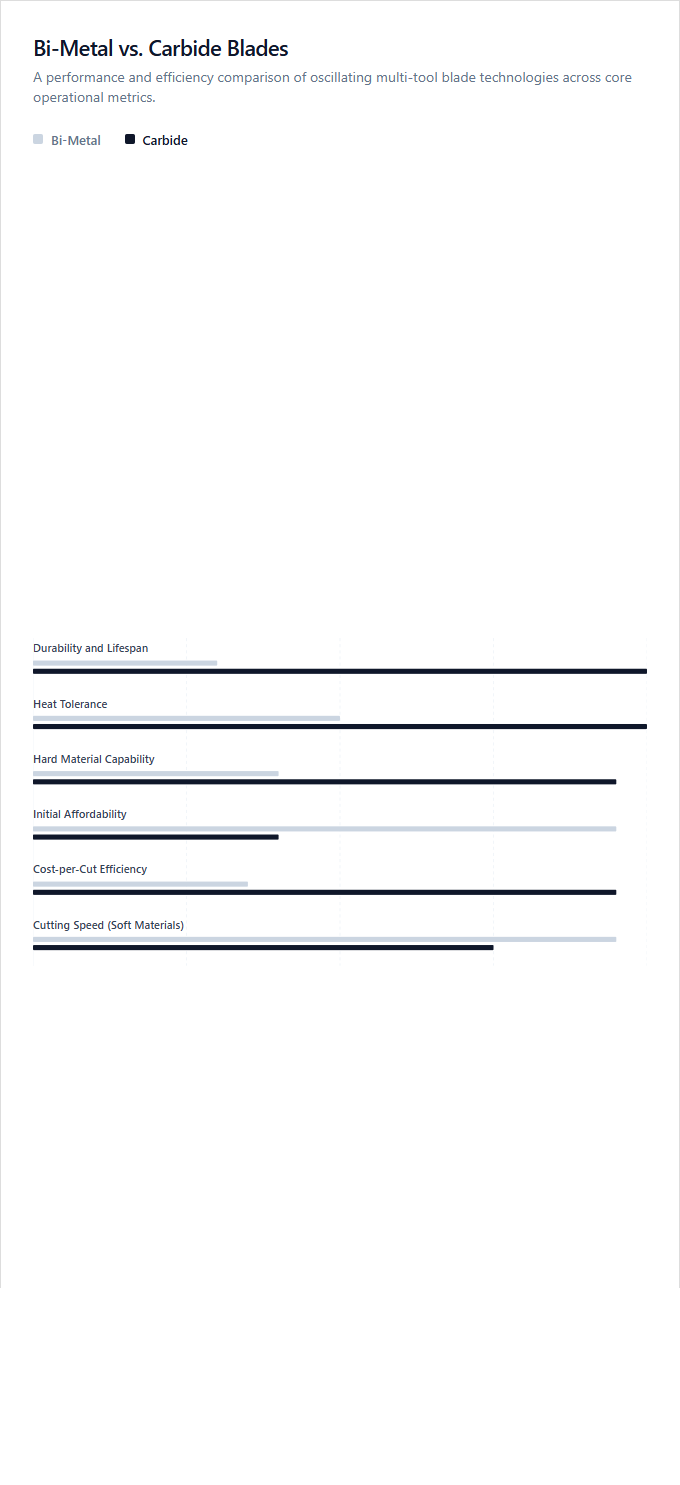
| Durability and Lifespan | Carbide blades offer vastly superior wear resistance, often lasting up to thirty times longer than bi-metal blades when cutting through hardened fasteners and dense materials. |
| Heat Tolerance | Carbide exhibits exceptional thermal stability, allowing it to withstand high friction and operating temperatures during continuous plunge cutting without losing its tempered hardness. |
| Target Applications | While bi-metal is highly effective for non-ferrous metals and clean wood, carbide excels at cutting abrasive materials like fiber cement, tile grout, and stainless steel screws. |
| Cost-per-Cut Efficiency | Although carbide blades require a higher initial capital expenditure, they provide a much lower cost-per-cut over their operational lifetime due to decreased consumable replacement frequency. |
| Cutting Speed and Dynamics | Bi-metal blades typically feature a higher teeth-per-inch configuration for rapid wood cutting, while carbide teeth rely on specialized geometry to maintain high material removal rates during aggressive oscillation. |
Carbide Teeth: Superior Hardness Over Bi-Metal
When selecting oscillating multi-tool blades, understanding the metallurgical differences between bi-metal and carbide options is essential for maximizing job site efficiency. The primary distinction lies in their material composition and resistance to wear. Carbide teeth possess significantly higher Rockwell hardness compared to high-speed steel bi-metal edges. This extreme hardness allows carbide blades to maintain sharp cutting edges and resist thermal degradation, even when subjected to highly abrasive materials and intense friction.
Bi-metal blades offer excellent flexibility and cost-effectiveness for standard wood and soft metal applications, though they wear down rapidly when encountering hardened fasteners. Carbide-tipped blades provide a much longer service life during demanding demolition tasks involving stainless steel, masonry, or fiber cement. Bi-metal blades are ideal for DIY enthusiasts tackling occasional household remodeling, whereas carbide blades are best suited for professional contractors requiring maximum durability for heavy-duty, repetitive metal cutting.
Bend-Resistant Bi-Metal Blades for Deep Plunge Cuts
When choosing oscillating multi-tool accessories, the decision between bi-metal and carbide options depends on the mechanical demands of the task. Bi-metal blades feature a flexible carbon steel body bonded to high-speed steel teeth, offering greater structural elasticity to withstand lateral bending stress during deep plunge cuts. This flexibility prevents the blade from snapping when subjected to deflection within a deep joint.
Carbide blades utilize hardened teeth to deliver exceptional wear resistance when cutting dense materials. While they lack the flexural tolerance of bi-metal, they excel at maintaining sharp edges through hardened fasteners and masonry. Bi-metal blades are ideal for woodworkers needing resilient, flexible cutting for deep framing adjustments, whereas carbide blades are best suited for demolition specialists requiring maximum durability through hardened steel and masonry.
Heat-Resistant Carbide Blades for High Oscillations
When selecting oscillating multi-tool blades, the choice between bi-metal and carbide options directly impacts cutting efficiency and tool longevity. Bi-metal blades perform reliably in standard wood and soft metal applications, but carbide-tipped blades excel under demanding conditions. Carbide-tipped blades maintain superior thermal stability and resist heat-induced tooth degradation at high oscillations per minute. This exceptional thermal resistance prevents the teeth from softening during high-friction operations, ensuring the blade retains its structural integrity.
Standard bi-metal teeth wear down rapidly when encountering hardened fasteners or abrasive materials. Carbide blades sustain their cutting edge far longer, maintaining consistent performance through stainless steel, plaster, and cement board. Bi-metal blades are ideal for DIY enthusiasts tackling general woodworking and light home remodeling, while carbide blades are best suited for professional contractors requiring maximum durability for heavy-duty demolition and masonry work.
Bi-Metal Blades: Faster, Cleaner Wood and Metal Cuts
Selecting the right oscillating tool blade depends heavily on the materials being cut and the desired finish. Bi-metal blades excel in versatility, offering a significantly faster material removal rate and a cleaner kerf when cutting wood and non-ferrous metals. The flexibility of bi-metal construction allows for smooth, precise plunge cuts, making them highly efficient for standard remodeling tasks.
Carbide blades are engineered to withstand extreme heat and highly abrasive materials, such as hardened screws, tile grout, and fiber cement. While carbide provides unmatched durability in hardened metals, it lacks the rapid wood-cutting speed of bi-metal options. Bi-metal blades are ideal for general contractors and DIYers focused on clean wood and soft metal demolition, whereas carbide blades are best suited for specialized tradespeople encountering hardened fasteners and masonry.
Carbide Blades: Exceptional Wear Resistance in Hardened Steel
When selecting oscillating tool blades, the choice between bi-metal and carbide depends on the materials being cut. Bi-metal blades offer versatility for standard wood and non-hardened metal applications, providing a balance of flexibility and durability. In contrast, carbide blades excel in highly demanding environments. Carbide blades exhibit exceptional abrasive wear resistance when encountering hardened screws and stainless steel, maintaining their cutting edge far longer under high-friction conditions.
The structural density of carbide allows it to withstand extreme heat without dulling. Bi-metal options are ideal for DIY enthusiasts and general contractors performing standard residential remodeling, whereas carbide blades are best suited for heavy-duty demolition specialists and industrial tradespeople who regularly cut through hardened fasteners and masonry.
Electron-Beam Welding in Bi-Metal Manufacturing
Selecting the right oscillating multi-tool blade depends on understanding their metallurgical differences. Bi-metal blades rely on a sophisticated manufacturing process where electron-beam welding fuses high-speed steel teeth to a highly flexible carbon steel backing. This engineered combination yields a blade that resists shattering under stress while maintaining a sharp, reliable cutting edge through wood, plastics, and non-ferrous metals.
Carbide blades feature high-density carbide teeth welded directly to the steel body. While less flexible than their bi-metal counterparts, carbide offers extreme heat resistance and unmatched longevity when cutting through hardened screws, stainless steel, and abrasive masonry. Bi-metal blades are ideal for general contractors requiring cost-effective versatility for everyday remodeling, whereas carbide blades best serve heavy-duty specialists tackling rigid, high-strength materials on demolition sites.
Carbide Blades: Lower Cost-Per-Cut, Longer Lifespan
When selecting oscillating multi-tool blades, the choice between bi-metal and carbide-tipped options directly impacts both project efficiency and long-term expenses. While bi-metal blades offer a lower initial purchase price, carbide-tipped blades deliver a significantly lower cost-per-cut ratio over their extended operational lifespan. Carbide's extreme hardness allows it to withstand high-heat applications and highly abrasive materials without losing its edge, frequently outlasting standard bi-metal alternatives by up to thirty times.
This extreme durability makes carbide the superior choice for demanding tasks involving hardened screws, stainless steel, and masonry, whereas bi-metal blades remain highly effective for softer materials like wood, plastic, and non-hardened nails. Regular DIY enthusiasts undertaking light home remodeling find bi-metal blades highly practical, while professional contractors facing frequent, heavy-duty demolition require the resilience of carbide.
Leave a comment