

Contractors and masonry professionals often struggle with rapid diamond blade degradation and hazardous airborne dust, leading to costly project delays and compliance fines. While standard equipment procurement budgets typically account for routine tool replacement, blindly purchasing any standard power cutter can rapidly deplete capital if the tool is misaligned with site conditions.
Identifying the precise tool grants operators unmatched cutting speed, dramatically extended blade life, and seamless OSHA dust compliance. Stipulation: Achieving these results depends heavily on operators adhering to specified RPM limits and safety protocols. For example, deploying a Husqvarna K 770 power cutter with a premium dry-vacuum attachment demonstrates how the right configuration maximizes productivity on dry masonry jobs.
Below, we break down the critical operational differences between wet and dry concrete saws, evaluate diamond blade selection, and outline a clear framework for your next equipment investment.
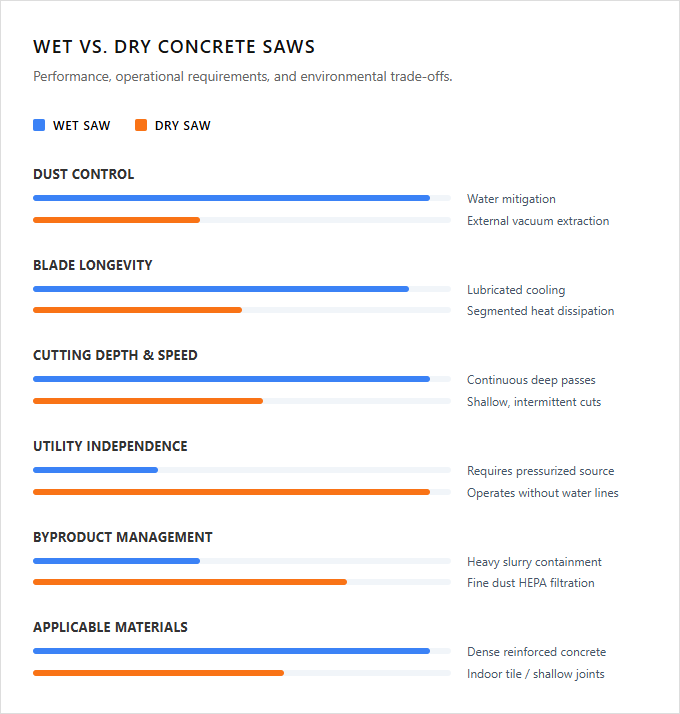
| Factor | Summary |
|---|---|
| Dust Control | Wet saws utilize an integrated water delivery system to mitigate hazardous respirable crystalline silica dust, whereas dry saws require external dust extraction vacuums to capture airborne particulates. |
| Blade Longevity | Wet cutting constantly lubricates the diamond matrix blade to reduce friction and thermal stress, while dry cutting relies on specialized segmented blades designed to dissipate heat without liquid coolant. |
| Cutting Depth and Speed | Wet saws can perform continuous deep-cut passes because the water prevents overheating, whereas dry saws are limited to shallow, intermittent plunge cuts to protect the blade core from warping. |
| Utility Requirements | Wet concrete saws require a constant connection to a pressurized water source, whereas dry concrete saws operate independently of water lines, offering greater portability on remote job sites. |
| Byproduct Cleanup | Wet sawing produces a heavy concrete slurry that requires specialized containment and wet-vacuum disposal, while dry cutting yields fine dust that must be managed using certified HEPA filtration systems. |
| Applicable Materials | Wet saws are ideal for dense, reinforced concrete and masonry where high friction is generated, whereas dry saws are best suited for indoor tile, brick, or shallow joints where water runoff is prohibited. |
Wet Saws: Controlling Silica Dust with Water
When selecting concrete cutting equipment, the choice between wet and dry saws depends largely on job site safety regulations and the specific working environment. Wet concrete saws utilize a constant water-feed system to achieve effective dust suppression of hazardous respirable crystalline silica. This continuous stream of water binds fine dust particles at the point of cutting, preventing them from becoming airborne to protect operator health while simultaneously cooling the blade to extend its operational lifespan.
In contrast, dry concrete saws rely on integrated vacuum systems or high-flow dust extractors to manage debris, making them highly effective for indoor projects where water accumulation is problematic. Industrial contractors undertaking heavy-duty outdoor structural projects benefit most from the superior dust control of wet saws, while utility technicians requiring quick, portable cuts in finished indoor spaces are better suited for dry saws.
Laser-Welded Diamond Blades for Dry Saws
Selecting between a wet and dry concrete saw depends on the workspace environment and material requirements. Wet saws utilize a continuous stream of water to cool the blade and suppress hazardous silica dust during operation.
Dry cutting systems operate without water, placing immense thermal demands on the equipment. To handle this, dry saws require specialized laser-welded diamond blades designed to withstand high thermal stress without liquid coolant, preventing segment detachment and ensuring safety.
Wet models are highly suited for indoor contractors prioritizing dust containment and deep cuts, whereas dry saws are best for outdoor operators requiring maximum portability and rapid, shallow adjustments.
How Water Flow Prevents Diamond Blade Damage
When selecting between a wet and dry concrete saw, understanding heat management is critical for tool longevity and safety. Wet concrete saws utilize a continuous water flow to cool the blade during operation. This constant thermal regulation prevents blade warping and avoids the catastrophic segment loss of the diamond matrix, which can occur under extreme, dry friction.
Dry concrete saws rely on airflow for cooling, requiring intermittent cuts to prevent overheating. While dry saws offer greater portability, they generate significant dust and experience faster blade wear. Professional contractors requiring deep, indoor dustless cuts typically opt for wet saws, whereas DIY homeowners or utility workers needing quick, outdoor cuts in remote areas favor dry saws.
Dry Cutting: Shallow Passes Prevent Core Overheating
Selecting the appropriate concrete saw depends heavily on the project environment and the chosen cutting method. Wet concrete saws utilize a continuous water flow to cool the blade and suppress hazardous crystalline silica dust, making them ideal for deep, continuous cuts. Dry concrete saws offer greater portability and do not require a constant water source, but they demand a specific technique to protect the equipment.
Because dry saws lack liquid cooling, operators must modify their cutting technique. Dry cutting operations must use intermittent shallow passes to prevent overheating of the steel core, allowing air to cool the blade between cuts. Industrial contractors managing large-scale indoor projects typically favor wet saws for continuous operation, while utility workers and renovators requiring quick, mobile cuts on outdoor sites are better suited for dry saws.
GFCI Protection for Electric Wet Concrete Cutters
When selecting between wet and dry concrete saws, understanding the operational environment and safety requirements is essential. Wet concrete saws utilize water to suppress hazardous silica dust and cool the blade, which introduces unique electrical considerations. Because water conducts electricity, electric wet power cutters must always be integrated with a Ground Fault Circuit Interrupter (GFCI). This safety device monitors the current flow and instantly shuts off power if a leak is detected, effectively mitigating severe electrocution hazards during wet-cutting procedures.
Dry concrete saws operate without water, relying instead on integrated vacuum systems for dust containment and specialized heat-resistant blades. This setup eliminates the risk of electrical shorting from water, making dry saws simpler to deploy in indoor environments where slurry cleanup is problematic. Wet saws are best suited for professional contractors performing heavy-duty, deep outdoor demolition, while dry saws are ideal for indoor renovation technicians and DIY users requiring quick, mess-free cutting.
Wet Cutting: Precise Kerfs with Reduced Spalling
Selecting the appropriate concrete saw depends heavily on the required finish and the specific working environment. Wet concrete saws utilize a continuous flow of water to cool the blade and suppress hazardous silica dust. This constant lubrication allows the blade to slice smoothly through the material, producing a highly precise kerf with significantly reduced spalling along the cut edges for a clean, professional joint.
Dry concrete saws rely instead on airflow for cooling and are designed for outdoor areas where water runoff is impractical. While dry cutting typically yields a rougher finish with more edge chipping, it offers greater portability and faster setup times. Wet saws are ideal for indoor contractors requiring pristine, dust-free results, whereas dry saws best serve utility workers needing quick, intermittent cuts on rugged job sites.
How Softer Metal Bonds Keep Dry Blades Sharp
Choosing between a wet and dry concrete saw depends on your project environment and dust management needs. Wet saws use water to cool the blade, whereas dry saws operate without liquid. To prevent overheating during dry operation, dry blades utilize a softer metal matrix bond. This design allows the matrix to shed rapidly, ensuring the continuous self-sharpening of the diamond grits as they cut through masonry.
While wet cutting provides cleaner, deep cuts, dry cutting offers unmatched portability for quick jobs. Wet saws are suited for professional indoor contractors requiring strict dust elimination, while dry saws are ideal for utility workers and DIYers performing fast, outdoor maintenance.
Leave a comment