
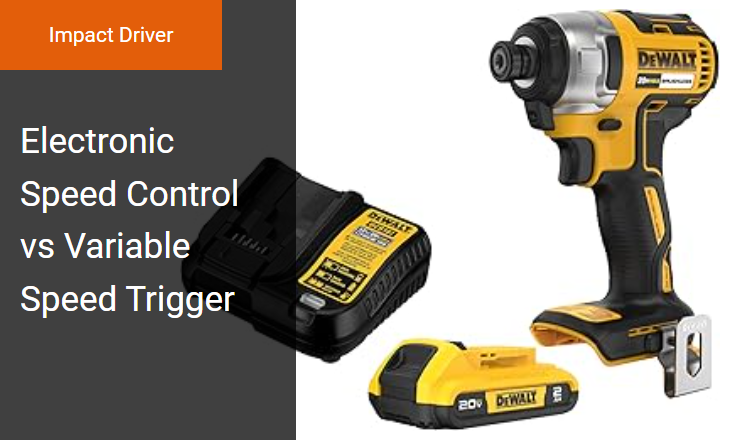
For tradespeople and precision woodworkers, controlling the raw kinetic force of a high-torque impact driver remains a persistent challenge, frequently resulting in stripped fastener heads or fractured workpieces. Traditionally, operators relied on the mechanical slip-clutches of standard drill-drivers to limit torque.
However, modern advancements show that mastering RPM optimization grants professionals unprecedented fastening precision without sacrificing driving power. It must be noted, though, that even advanced impact tools require a baseline level of user technique to avoid over-driving. For instance, when installing delicate brass hardware or fastening soft cabinet trims, relying solely on raw instinct often leads to material failure.
This article will compare the technical mechanics of Electronic Speed Control (ESC) systems against manual Variable Speed Triggers, outlining how to leverage both features to achieve optimal RPM control and prevent workpiece damage.
| Factor | Summary |
|---|---|
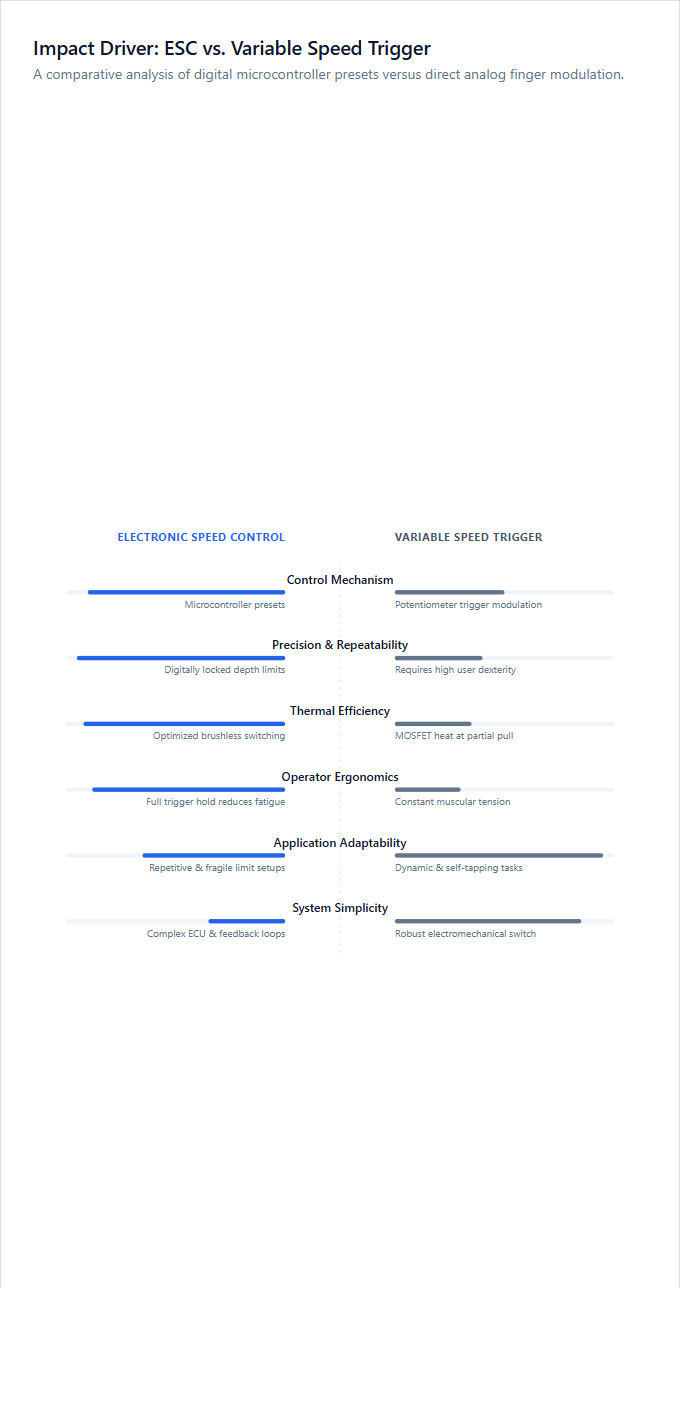
| Control Mechanism | Electronic Speed Control utilizes microcontrollers to limit motor RPM and IPM at discrete preset levels, whereas a Variable Speed Trigger relies on a potentiometer to modulate the pulse-width modulation signal based on physical finger displacement. |
| Precision and Repeatability | Electronic Speed Control ensures consistent fastener depth by digitally locking torque limits, while a Variable Speed Trigger demands high user dexterity to maintain steady velocity through tactile feedback. |
| Thermal Efficiency | Electronic Speed Control optimizes the brushless motor's switching frequency for thermal efficiency, whereas prolonged partial depression of a Variable Speed Trigger increases heat generation in the tool's metal-oxide-semiconductor field-effect transistors. |
| Operator Ergonomics | Electronic Speed Control allows the operator to fully depress the trigger without over-driving fasteners, reducing hand fatigue compared to the constant muscular tension required to modulate a Variable Speed Trigger. |
| Application Optimization | Electronic Speed Control is best suited for high-torque repetitive fastening or fragile materials requiring strict limit thresholds, while a Variable Speed Trigger excels at dynamic tasks like drilling pilot holes or driving self-tapping screws. |
| Hardware Complexity | Electronic Speed Control integrates complex digital interfaces and sensorless feedback loops within the electronic control unit, whereas a Variable Speed Trigger relies on a mechanical contact switch integrated with a variable resistor. |
Limiting ESC Duty Cycle to Prevent Fastener Shear
Modern impact drivers utilize either Electronic Speed Control (ESC) or a traditional Variable Speed Trigger (VST) to manage rotational velocity. While a variable speed trigger relies entirely on manual finger pressure to modulate power, electronic speed control introduces digital precision to the drivetrain. This digital system restricts the Pulse-Width Modulation (PWM) duty cycle to establish precise, predetermined RPM caps. By limiting the average voltage sent to the motor, ESC prevents the tool from surpassing critical torque thresholds, significantly reducing the risk of fastener head shear during high-resistance applications.
In contrast, variable speed triggers offer fluid, real-time adjustments based on tactile feedback, allowing for immediate adaptation during dynamic fastening tasks. Variable speed triggers are best suited for finish carpenters who require intuitive control over varying materials, while electronic speed control is ideal for assembly technicians who need highly repeatable, torque-limited performance.
Hall-Effect Sensors in Variable Speed Triggers
Modern professional-grade impact drivers utilize advanced velocity regulation systems to optimize fastening torque and prevent material damage. Preset electronic speed control relies on discrete power limits managed through a physical control panel, maintaining highly consistent RPM thresholds for repetitive applications.
In contrast, variable speed triggers offer continuous, on-the-fly adjustment during active operation. These systems utilize integrated Hall-effect sensors to translate the mechanical pull depth of the trigger into dynamic voltage signals for real-time motor modulation. The internal microcontroller processes these signals instantaneously to adjust the power output based entirely on user finger pressure.
Preset electronic speed control is ideal for industrial production workers requiring highly repetitive torque limits, whereas the responsive variable speed trigger suits finish carpenters and tradespeople who demand precise, adaptive modulation for diverse and fragile materials.
Closed-Loop ESC Control Maintains RPM Under Varying Loads
While variable speed triggers rely on manual user modulation to adjust power output, electronic speed control (ESC) systems automate precision. Advanced ESC microcontrollers utilize closed-loop feedback algorithms to continuously monitor motor performance. By dynamically adjusting electrical current, these intelligent systems maintain a consistent target RPM despite sudden fluctuations in mechanical impedance as fasteners drive into different materials.
Standard variable speed triggers provide direct analog control, requiring the operator to manually compensate for changes in resistance. This simpler mechanism lacks the automated load-sensing capabilities of digital microcontrollers but offers immediate, tactile responsiveness. Experienced contractors demanding flawless torque consistency for repetitive assembly benefit most from electronic speed control, whereas general DIYers prioritizing intuitive, pressure-dependent pacing favor the traditional variable speed trigger.
Speed Selection Limits Anvil Impact Energy Thresholds
Electronic speed control (ESC) and variable speed triggers manage torque and rotational velocity in modern impact drivers through different mechanisms. A key mechanical differentiator lies in how these systems regulate the kinetic energy of the anvil. By establishing discrete speed selection levels, ESC electronically caps the maximum rotational velocity. This limit directly constrains the kinetic energy threshold of the anvil before the internal impact mechanism engages, preventing fastener damage and material shear.
In contrast, a variable speed trigger relies entirely on manual finger pressure, allowing the operator to modulate speed fluidly but with less predictability regarding the exact energy threshold before impact. ESC provides precise, repeatable parameters for delicate tasks, whereas variable triggers offer rapid, on-the-fly adaptability. Electronic speed control is ideal for precision assembly technicians requiring repeatable torque limits, while variable speed triggers suit general contractors who demand versatile, intuitive control across diverse materials.
Instant Back-EMF Braking Prevents Over-Driving
Modern impact drivers utilize variable speed triggers and electronic speed control to optimize fastening precision. While a variable speed trigger allows manual modulation of motor RPM through physical finger pressure, electronic speed control manages power delivery via pre-set digital limits. A critical advantage of electronic systems is the integration of Back-EMF (electromotive force) sensing. This technology monitors the motor's reverse voltage to enable instant electronic dynamic braking the moment the trigger is released, preventing the over-driving of fasteners.
This rapid braking mechanism protects delicate work surfaces and ensures consistent depth control. Variable speed triggers are ideal for general contractors who require intuitive, on-the-fly control across diverse tasks, whereas electronic speed control with dynamic braking is suited for precision assembly technicians who demand highly repetitive, exact torque limits.
Solid-State Switching Eliminates Potentiometer Wear
In modern impact drivers, the distinction between electronic speed control and a standard variable speed trigger lies primarily in their internal architecture. Traditional variable speed triggers rely on mechanical potentiometers, which are highly susceptible to physical wear, dust intrusion, and signal degradation over time. Electronic speed selectors utilize solid-state switching to eliminate these moving parts, ensuring consistent power delivery and a significantly longer tool lifespan.
This electronic system maintains precise maximum RPM ceilings, preventing common issues like overtightening or fastener stripping. While the analog trigger offers immediate, on-the-fly modulation, the digital selector ensures repeatable performance. Industrial assembly technicians requiring precise, repetitive torque limits benefit most from electronic speed control, whereas general carpenters prioritizing tactile, adaptable control prefer the variable speed trigger.
Torque-Threshold Motor Power Shutoff Using FOC
Modern impact drivers employ either variable speed triggers for manual modulation or electronic speed control for automated precision. Electronic speed control systems leverage advanced Field-Oriented Control (FOC) algorithms to monitor motor phase current in real time. By precisely tracking these electrical currents, the system calculates load and automatically shuts off power when specific torque thresholds are met, preventing fastener stripping or material damage.
In contrast, variable speed triggers rely entirely on manual user input, altering motor output based on trigger depression depth. While FOC-driven electronic speed control benefits industrial assembly technicians requiring repeatable, high-precision fastening torque, the variable speed trigger remains the preferred choice for general contractors needing adaptable, on-the-fly control across diverse materials.
Leave a comment