
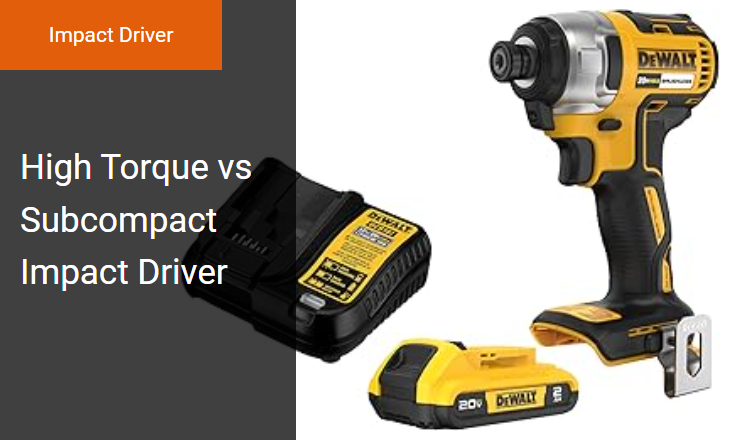
Tradespeople and serious DIYers often struggle to find the ideal balance between brute driving force and ergonomic utility. Selecting an impact driver that stalls out on heavy timbers or, conversely, causes immediate wrist fatigue in tight overhead spaces can severely derail a project's efficiency.
While standard cordless drills and basic 12V fastening tools serve as traditional baselines for general assembly, demanding structural tasks require highly specialized torque delivery. Selecting the optimal impact driver platform grants you a decisive advantage: maximum fastening efficiency with a massive reduction in user fatigue. However, we must stipulate that peak manufacturer torque ratings (measured in inch-pounds) do not always translate directly to sustained, real-world fastening power under heavy load.
For instance, driving massive 6-inch structural lag screws requires a high-torque beast, whereas repetitive cabinet installation demands a nimble subcompact. In this guide, we will analyze high-torque versus subcompact impact drivers, comparing their power-to-weight ratios, battery efficiency, and specific application limits to help you select the ultimate tool for your workflow.
| Factor | Summary |
|---|---|
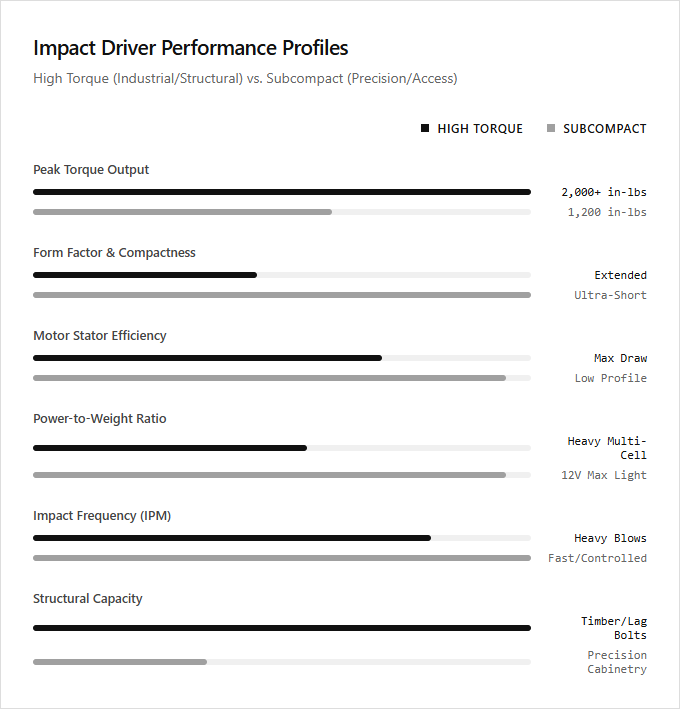
| Peak Torque Output | High-torque impact drivers leverage robust anvil mechanisms to generate upwards of 2,000 in-lbs of rotational force, whereas subcompact models utilize miniaturized impact mechanisms optimized for around 1,000 to 1,500 in-lbs of torque. |
| Form Factor and Ergonomics | Subcompact drivers feature an ultra-short head length and lightweight chassis for superior accessibility in confined joists, while high-torque units require a larger, heavier housing to accommodate reinforced internal components. |
| Motor Configuration | While both utilize brushless motor technology, high-torque tools deploy high-draw electromagnetic coils for maximum wattage, whereas subcompacts employ high-efficiency, low-profile stators to conserve battery life. |
| Power Source and Voltage | High-torque models demand high-capacity, multi-cell lithium-ion battery packs to prevent voltage sag under heavy load, while subcompacts frequently operate on lightweight 12-volt max platforms to reduce user fatigue. |
| Impacts Per Minute (IPM) | High-torque drivers combine high rotational speed with heavy-duty impact energy to break loose rusted fasteners, whereas subcompacts balance high IPM with lower rotational mass to prevent over-tightening. |
| Primary Applications | High-torque units are designed for heavy-duty structural construction such as driving lag bolts and timber screws, while subcompacts are tailored for precision trade work like electrical box installation and cabinetry. |
High-Torque Impact Drivers: High IPM for Heavy Fastening
When selecting between high-torque and subcompact impact drivers, the primary distinction lies in power output and application scale. High-torque impact drivers deliver significantly higher Impacts Per Minute (IPM) alongside massive rotational force, making them indispensable for heavy-duty fastening tasks. This rapid, forceful hammering action allows the tool to drive large lag screws and break rusted bolts loose without stalling.
Subcompact impact drivers prioritize maneuverability and reduced weight over sheer muscle. These tools feature a shorter head length and lighter body, allowing for precise control in tight overhead spaces or intricate cabinetry work. Professional contractors tackling demanding structural construction benefit most from the robust high-torque models, while cabinet makers and HVAC technicians find the nimble subcompact design ideal for their daily precision tasks.
Brushless Motors Maximize Subcompact Efficiency
Selecting the right impact driver depends on balancing raw power with accessibility. High-torque impact drivers deliver immense rotational force, making them indispensable for driving heavy-duty fasteners into dense materials. Subcompact impact drivers prioritize maneuverability; these smaller tools utilize advanced brushless motor technology to maximize efficiency and maintain high performance within confined spaces, ensuring they do not sacrifice power for their reduced footprint.
While high-torque units excel in heavy construction and structural framing, subcompact models offer superior control for overhead tasks and intricate installations. High-torque drivers are ideal for heavy-duty contractors demanding maximum fastening power, whereas subcompact models are perfectly suited for electricians, HVAC technicians, and finish carpenters working in tight quarters.
Drastically Higher Torque in Full-Sized Tools
When selecting an impact driver, understanding the engineering distinctions between full-sized high-torque models and subcompact alternatives is essential. Maximum fastening torque and breakaway torque are drastically higher in full-sized high-torque tools, enabling them to easily secure structural fasteners and break loose seized industrial bolts. This massive power output relies on larger motors and robust hammering mechanisms designed to dominate demanding jobsites.
In contrast, subcompact impact drivers prioritize ergonomics, lighter weights, and maneuverability, allowing access to confined spaces without sacrificing reasonable driving capabilities. Heavy-duty mechanics and structural framers require the raw power of high-torque drivers, while cabinet installers and electricians are best served by the lightweight precision of subcompact models.
12V Subcompact Drivers vs. 18V High-Torque Tools
Selecting the right impact driver requires understanding the fundamental differences in power delivery and tool footprint. The primary distinction lies in their electrical architecture. Subcompact impact drivers typically utilize a compact twelve-volt battery platform, which minimizes weight and tool size for maneuvering in tight spaces. In contrast, high-torque impact drivers rely on more robust eighteen-volt platforms designed to sustain heavy workloads and deliver maximum rotational force.
While twelve-volt subcompact models excel in overhead installations and precision fastening, eighteen-volt high-torque tools provide the raw power necessary for driving large lag bolts into dense materials. Heavy-duty construction professionals and automotive technicians require the relentless power of high-torque eighteen-volt platforms, whereas electricians, cabinet installers, and DIY enthusiasts benefit more from the lightweight portability of subcompact twelve-volt systems.
High-Torque Drivers Built to Withstand Extreme Force
When selecting an impact driver, the choice between high-torque and subcompact models depends on the specific demands of the application. High-torque impact drivers are engineered for heavy-duty tasks, featuring reinforced anvils and robust hex collets designed to withstand extreme rotational force. This heavy-duty construction ensures tool integrity and prevents shearing when driving large fasteners into dense structural materials.
Subcompact impact drivers prioritize maneuverability and lightweight design, offering sufficient power for standard fastening while easily fitting into tight spaces. Structural contractors and framing professionals require the relentless power of high-torque models, whereas cabinet installers and electricians benefit most from the precision and agility of subcompact tools.
Subcompacts Maintain Competitive RPMs Despite Lower Torque
When selecting an impact driver, professionals evaluate the balance between power and tool size. High-torque impact drivers deliver the massive rotational force required for heavy structural fasteners and lag screws. Subcompact impact drivers offer a distinct advantage in velocity; despite their lower torque output, these smaller models maintain highly competitive no-load speeds, often matching the RPM of larger units to ensure rapid fastening.
This high rotational speed allows smaller tools to drive common screws with remarkable efficiency. High-torque models are best suited for heavy-duty structural builders needing maximum power, while subcompact drivers are ideal for electricians and cabinet installers who require precision in confined spaces.
Speed Control Prevents Fastener Damage in High-Torque Models
High-torque impact drivers deliver immense rotational force for heavy-duty construction, whereas subcompact models prioritize maneuverability and lightweight design. On high-torque units, multi-stage electronic speed control is essential to manage the extreme power output. Without this precise modulation, the raw force of a high-torque tool can easily lead to fastener overtightening, stripped threads, or catastrophic material shear.
Electronic speed settings allow operators to dial down the impact rate, tailoring the tool's performance to the resistance of the workpiece. High-torque models are best suited for structural contractors and automotive mechanics tackling large-diameter fasteners, while subcompact drivers are ideal for electricians and cabinet installers who require agility and precision in confined spaces.
Leave a comment