
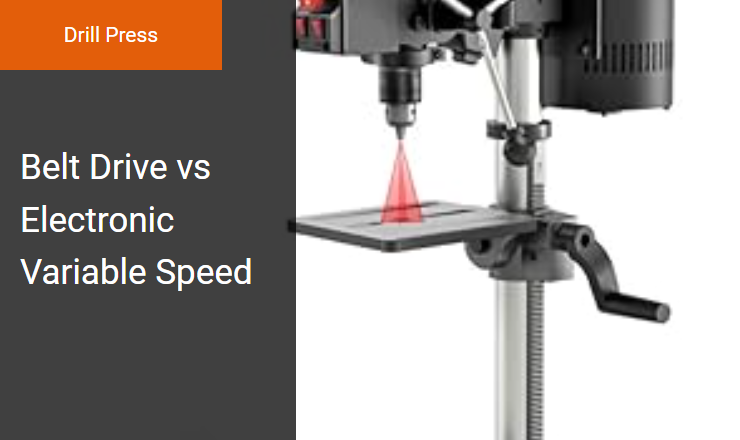
Selecting the correct spindle speed on a drill press remains a constant frustration for craftsmen, often resulting in ruined workpieces and prematurely burnt-out drill bits. When allocating your workshop's machinery budget-whether relying on traditional capital funding sources, small business equipment grants, or personal reserves-choosing the right speed control mechanism is a critical long-term decision.
Securing the optimal spindle system grants operators unparalleled boring precision and extends tool longevity. However, as an important educational stipulation, buyers must recognize that speed control is not merely a matter of convenience; it fundamentally dictates torque delivery. For example, boring a heavy-duty hole through hardened structural steel on a JET or Nova drill press demands a mechanical torque profile vastly different from spinning a Forstner bit in delicate hardwood.
Below, we provide an executive comparison of traditional belt-drive pulley systems versus modern electronic variable speed (EVS) controls, evaluating their mechanics, torque curves, and long-term operational ROI to guide your next workshop acquisition.
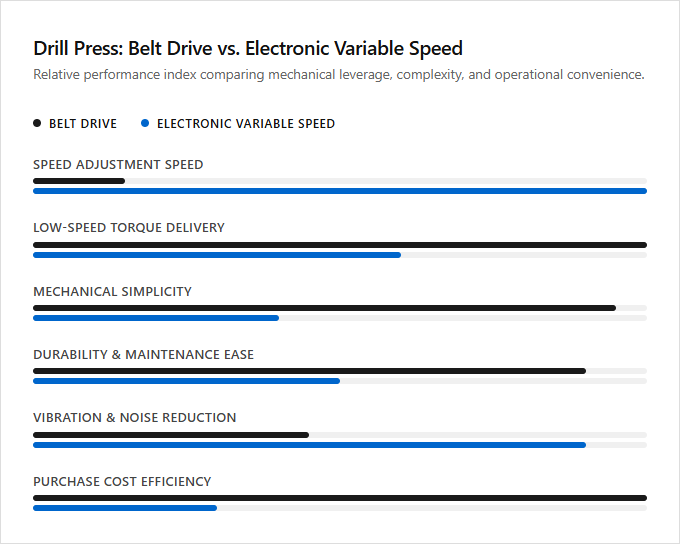
| Factor | Summary |
|---|---|
| Speed Adjustment | Belt drives require manual repositioning of the drive belt on stepped pulleys to alter spindle speeds, whereas electronic variable speed systems utilize a potentiometer for instantaneous RPM calibration. |
| Torque Delivery | Belt drives maintain maximum mechanical leverage and torque at low speeds through physical gear reduction, while electronic variable speed systems can suffer torque drop-off at lower RPMs without a sophisticated pulse-width modulation controller. |
| Mechanical Complexity | Belt-driven drill presses rely on a simple and highly durable physical pulley arrangement, whereas electronic variable speed models integrate complex solid-state electronics such as variable frequency drives. |
| Maintenance and Durability | Belt drive systems require only basic periodic belt tensioning and replacement, while electronic variable speed units are more susceptible to component failure from heat and fine sawdust infiltration. |
| Vibration and Noise | Stepped pulley systems can introduce harmonic vibrations and physical belt slap during operation, whereas electronic variable speed drives offer smoother spindle rotation with minimal mechanical noise. |
| Cost Efficiency | Belt-drive drill presses offer a significantly lower initial purchase price and cheap replacement parts, whereas electronic variable speed models demand a premium price for the convenience of digital speed control. |
Step Pulleys: Maximizing Low-Speed Spindle Torque
When selecting a drill press, the drive system determines both speed control and power delivery. Traditional belt-driven models utilize physical step pulley ratios to mechanically multiply torque at low spindle speeds. This mechanical advantage ensures maximum driving force for large-diameter bits in dense materials, as the physical gear reduction keeps the motor operating in its optimal power band without stalling.
In contrast, electronic variable speed (EVS) systems adjust spindle velocity dynamically through motor circuitry, which simplifies adjustments but can reduce torque at lower RPMs. Traditional belt-drive models suit heavy-duty metalworkers and traditional woodworkers who require maximum torque at low speeds, whereas EVS drill presses are ideal for multi-material hobbyists and production shops prioritizing rapid speed transitions.
VFDs: Continuous, On-the-Fly RPM Adjustment
When selecting a drill press, the drive system dictates operational efficiency. Traditional belt-driven models require manual pulley adjustments to change speeds, which interrupts the workflow. Modern electronic variable speed (EVS) drill presses utilize Variable Frequency Drives (VFD) to regulate motor frequency directly.
This VFD integration allows operators to make continuous, on-the-fly RPM adjustments without stopping the motor. Machinists can seamlessly transition between different materials and drill bit diameters, maintaining optimal torque and cutting speeds. This precise control reduces tool wear and improves hole quality.
Belt-drive models suit budget-conscious hobbyists performing repetitive, single-speed tasks, while EVS models are ideal for professional fabricators requiring frequent material transitions.
Polyester V-Belts: Tension and Slippage Limitations
Traditional belt-driven drill presses rely on a system of stepped pulleys and polyester reinforced V-belts to adjust spindle speeds. While highly durable and cost-effective, these systems require manual tensioning and physical belt adjustments to change speeds. Under heavy drilling loads, polyester reinforced V-belts are susceptible to rotational slip, which can temporarily stall the spindle and decrease overall torque efficiency.
Electronic variable speed (EVS) drill presses bypass these mechanical limitations through digital speed controllers. This technology allows operators to make precise, instantaneous speed adjustments via a dial, maintaining consistent torque under load without the risk of belt slippage. Traditional belt-driven models are best suited for budget-conscious hobbyists who perform repetitive drilling tasks, whereas EVS machines are ideal for precision-focused professionals who require rapid speed transitions for diverse materials.
Constant Torque in Inverter-Duty Motors via PWM
When selecting a drill press, the choice between traditional belt-drive systems and electronic variable speed (EVS) models significantly impacts workshop efficiency. Belt-drive units rely on manual pulley adjustments to alter spindle speeds, offering a mechanical simplicity that is highly reliable but time-consuming during transitions.
In contrast, premium EVS drill presses utilize advanced inverter-duty motors. These motors employ pulse-width modulation (PWM) to maintain constant torque across a wide speed range. By precisely controlling the frequency and voltage of the electrical signal, PWM ensures the spindle retains its cutting power even at low operational speeds, preventing stalling during high-resistance drilling.
Standard belt-drive models are best suited for budget-conscious hobbyists performing repetitive tasks at consistent speeds, while EVS machines are ideal for professional fabricators and machinists who require rapid, precise speed adjustments for working with diverse materials.
Precise Spindle Speed Monitoring via Closed-Loop Feedback
When selecting a drill press, the choice between traditional belt drives and electronic variable speed (EVS) systems significantly impacts workflow efficiency. Belt-driven models require manual belt positioning to alter speeds, whereas EVS systems allow turn-of-a-dial adjustments. Modern EVS drill presses often incorporate digital tachometers and closed-loop feedback systems that provide precise, real-time spindle speed monitoring, automatically adjusting motor output to maintain a consistent RPM under varying workloads.
While belt drives offer mechanical durability and robust torque at lower speeds, they lack this responsive digital control. Reliable belt-driven machines are highly suitable for budget-conscious hobbyists and general woodworkers, whereas sophisticated EVS models are preferred by professional machinists and fabricators demanding exact speed precision for diverse materials.
Mechanical Belt Drives Eliminate Electrical Failure and Distortion
When selecting a drill press, the choice between a belt drive and electronic variable speed (EVS) involves balancing mechanical simplicity against digital convenience. Direct mechanical belt drives offer distinct engineering advantages, particularly in demanding workshop environments. Because they rely on physical pulleys and belts rather than complex control circuitry, belt-driven systems eliminate electronic failure points and avoid generating harmonic distortion in the electrical supply, ensuring clean power and long-term reliability.
In contrast, electronic variable speed systems provide rapid speed adjustments at the turn of a dial, though their digital controllers are more susceptible to dust and heat. Belt-drive models are ideal for traditional craftsmen who prioritize heavy-duty reliability and straightforward maintenance, whereas electronic variable speed models suit high-production fabricators who require frequent, precise speed transitions across diverse materials.
Preventing Motor Burnout in Variable Speed Systems
When selecting a drill press, the choice between traditional belt drives and electronic variable speed (EVS) systems impacts workshop efficiency. Belt-driven models rely on manual pulley adjustments to alter speeds, offering mechanical simplicity and reliable torque. In comparison, EVS systems provide seamless, on-the-fly speed adjustments without manual belt manipulation.
Crucially, EVS technology enhances tool longevity through advanced safeguards. These systems utilize dynamic braking to halt the spindle immediately upon shutoff, minimizing downtime. Electronic overload protection also monitors motor current to prevent motor burnout during heavy-duty applications.
Belt drives are ideal for budget-conscious hobbyists performing repetitive, single-speed tasks, whereas EVS models are best suited for professional machinists requiring frequent speed changes and maximum reliability.
Leave a comment