
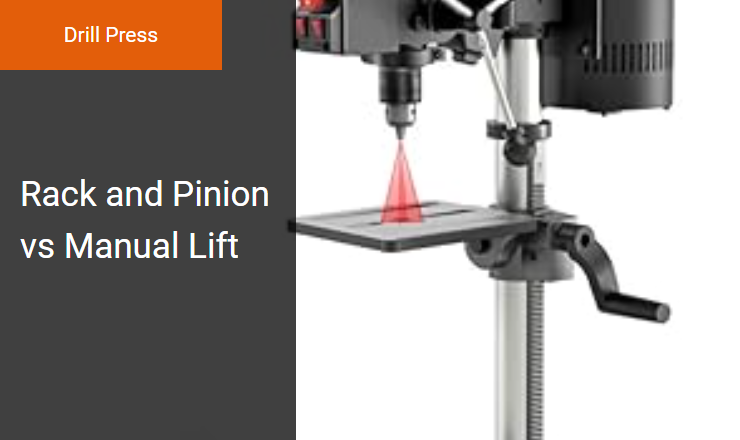
Achieving flawless perpendicularity on a drill press is useless if adjusting the work height feels like a wrestling match. For many fabricators and woodworkers, the constant struggle of manually raising a heavy cast-iron table-only to watch it slip out of alignment-is a major bottleneck that compromises precision and drains workshop productivity.
While standard workshop equipment budgets or tooling funds typically focus on motor horsepower and spindle speed, the interface you interact with most is often overlooked. Investing wisely in this interface is key; selecting the proper table elevation mechanism grants operators effortless repeatability and eliminates physical strain during complex setups.
Stipulation: No mechanism can compensate for poor maintenance; both systems require a clean, debris-free column to prevent binding and ensure smooth travel.
Whether you are boring deep Forstner bit holes in dense maple or drilling heavy steel plates, your choice of table control dictates your workflow. This guide compares rack-and-pinion gear systems against manual friction lifts, evaluating their mechanics, durability, and ergonomics to determine the best fit for your shop.
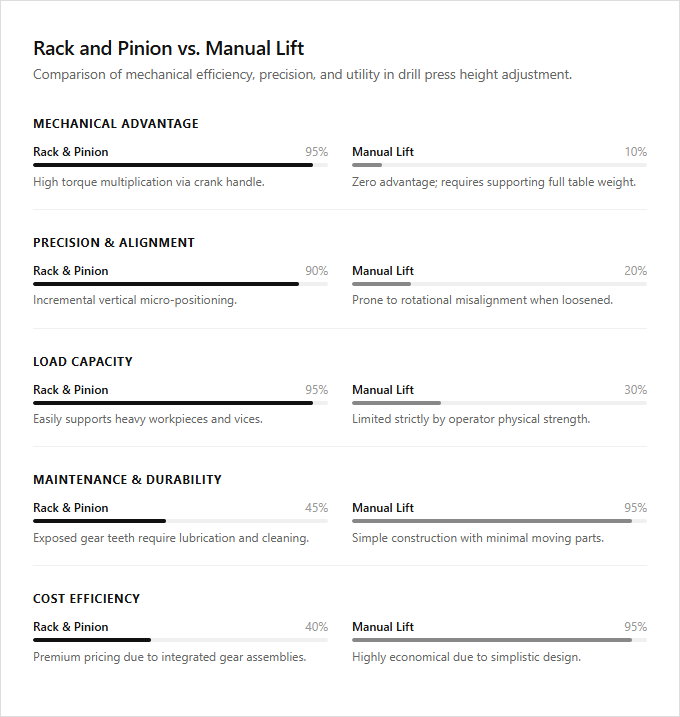
| Factor | Summary |
|---|---|
| Height Adjustment Mechanism | Rack and pinion systems utilize a geared track and pinion gear to elevate the table, whereas manual lifts rely entirely on user strength and a column clamping collar. |
| Mechanical Advantage | The crank handle on a rack and pinion system provides significant torque multiplication, while manual lifts offer zero mechanical advantage, requiring the operator to support the full weight of the worktable. |
| Precision and Alignment | Rack and pinion designs allow for incremental vertical micro-positioning, whereas manual lifts often suffer from rotational misalignment when the column clamp is loosened. |
| Maintenance and Durability | The exposed teeth of a rack and pinion gear require regular lubrication and are susceptible to sawdust fouling, while manual lift systems feature simpler construction with fewer moving parts to maintain. |
| Load Capacity | Rack and pinion mechanisms easily support heavy-duty workpieces and compound vices, whereas manual lifts are limited by the physical lifting capacity of the operator during adjustment. |
| Cost and Complexity | Manual lift drill presses are more economical due to their simplistic design, while rack and pinion models command a premium price for their integrated gear assemblies. |
Mechanical advantage of the gear ratio reducing manual physical effort
When evaluating a drill press, the table adjustment mechanism significantly impacts daily workshop efficiency. A rack and pinion system utilizes a geared track paired with a rotating crank, leveraging mechanical advantage to multiply the operator's input force. This gear ratio drastically reduces the manual physical effort required to position heavy cast-iron tables, allowing for smooth, incremental height adjustments without physical strain.
In contrast, manual lift mechanisms require the operator to directly support, loosen, and physically slide the table along the support column. Lacking any mechanical assist or gear-reduction, this configuration demands direct lifting force, which can lead to fatigue during repetitive setups or when working with substantial workpieces.
Rack and pinion systems are ideal for high-volume professionals and hobbyists requiring frequent, precise height adjustments, while manual lifts are suitable for occasional users performing light-duty, static drilling tasks.
Prevention of column binding and axis deflection during table elevation
In drill press design, table elevation mechanisms directly impact machining accuracy. Manual lift systems require the operator to physically support and rotate the table around the column, which often leads to column binding and axial deflection when the clamping pressure is released. This misalignment compromises the perpendicularity between the spindle and the table surface during repositioning.
Rack and pinion systems employ a geared track and crank that distribute lifting forces evenly. This mechanical advantage guides the table smoothly along a fixed vertical axis, minimizing lateral play and preventing the assembly from tilting or binding during height adjustments.
Manual lift models suit budget-conscious hobbyists performing occasional, light-duty drilling where tolerance requirements are flexible, whereas rack and pinion systems are essential for professional fabricators requiring frequent, high-precision vertical adjustments.
Precision of vertical displacement and backlash in gear teeth meshing
When selecting a drill press, the table elevation mechanism significantly impacts setup accuracy. Rack and pinion systems utilize a geared track to raise or lower the table. While this mechanical advantage offers ease of use, the meshing gear teeth introduce inherent backlash, which can cause micro-shifts in vertical displacement before the table is locked. In contrast, manual lift mechanisms lack these gears, eliminating backlash entirely and allowing for highly precise, undisturbed vertical alignment during setup.
Manual adjustment requires more physical effort but ensures superior rigidity once clamped into position. Rack and pinion models are best suited for general woodworkers and high-volume shops prioritizing rapid, frequent height transitions, whereas manual lift systems are ideal for instrument makers and precision machinists requiring absolute tolerance control.
Friction lock mechanism stability on the support column
A rack and pinion table adjustment system utilizes a geared track on the support column, paired with a manual crank. When secured with the column's friction lock, this design offers superior vertical stability. The physical engagement of the gears, combined with the clamp, prevents accidental slipping, ensuring the table remains securely positioned even under heavy downward drilling forces.
In contrast, manual lift tables require the operator to physically slide the table assembly along the support column before tightening the friction lock. This setup depends solely on the clamping force of the lock to resist gravity and downward pressure, which can occasionally lead to shifting under heavy loads if not fully tightened. The manual lift is suitable for budget-conscious hobbyists working with lightweight workpieces, whereas the rack and pinion system is ideal for professional operators who require frequent height adjustments and maximum stability during heavy-duty drilling.
Load-bearing capacity of the table assembly under heavy workpiece weight
When evaluating drill press table assemblies, the choice between rack and pinion and manual lift systems directly impacts load-bearing performance under heavy workpieces. Rack and pinion mechanisms utilize a geared column and hand crank, offering superior mechanical support. This design safely distributes substantial weight across the interlocking gears, preventing sudden table drops during height adjustments and ensuring rigidity under heavy downward drilling pressure.
Conversely, manual lift tables require the operator to physically support and position the assembly before securing the column clamp. While mechanically simple, manual systems present safety hazards and extreme physical strain when managing heavy metal or timber stock. Rack and pinion systems are highly recommended for industrial operators managing frequent, heavy-duty fabrication, whereas manual lifts are best suited for light-duty hobbyists seeking a cost-effective, low-maintenance utility.
Open Rack Susceptibility to Swarf and Wear
When selecting a drill press, the table adjustment mechanism presents distinct operational trade-offs. Rack and pinion systems offer excellent mechanical leverage for effortless height adjustments, but they feature an exposed gear track. This open rack is highly susceptible to swarf, metal shavings, and abrasive dust contamination. Over time, these fine particulates lodge in the gear teeth, acting as an abrasive paste that accelerates component wear, compromises adjustment precision, and leads to mechanical binding.
Conversely, manual lift systems eliminate the geared track entirely, relying on a smooth column and manual positioning. Lacking teeth to trap debris, manual systems are inherently resilient against abrasive wear and require significantly less maintenance in high-debris environments. Manual systems suit high-volume metalworking operators who prioritize rugged durability over frequent height changes, while rack and pinion systems are ideal for woodworkers and light-duty operators who value frequent, effortless adjustments in cleaner environments.
Rotational to Linear Conversion via Crank and Pinion
In a drill press, the mechanism used to adjust table height significantly impacts operational efficiency. A rack and pinion system utilizes a crank handle to convert rotational torque into linear vertical motion. As the operator rotates the crank, the pinion gear engages the geared rack on the column, smoothly raising or lowering the table with minimal physical effort. In contrast, a manual lift system relies entirely on the operator to manually slide the table along the column, requiring direct physical lifting against gravity without mechanical advantage.
The geared engagement of the rack and pinion provides precise, controlled adjustments, making it highly reliable for frequent vertical shifts. Manual lifts, while mechanically simpler and less prone to debris interference, demand substantial physical strength when adjusting heavy workpieces. The rack and pinion system is ideal for professional fabricators requiring frequent, precise height adjustments, whereas the manual lift suits occasional hobbyists working with lightweight materials on a budget.
Leave a comment