
For structural contractors, few setbacks are more frustrating than having an entire framing phase flagged during inspection due to fastener non-compliance. Navigating the choice between clipped head and round head framing nailers often feels like a costly gamble against local building codes. This technical decision directly impacts project cash flow, as institutional lenders and municipal funding sources typically withhold crucial draws until structural framing passes official inspection.
Fortunately, aligning your collation type with modern building standards grants you seamless project progression and reliable structural integrity. As a key stipulation, however, builders must remember that local jurisdictions maintain final approval over national guidelines. For example, the International Residential Code (IRC) strictly enforces full round head specifications in high-wind and seismic zones.
Below, we examine the structural differences between these collation types, analyze code compliance across various jurisdictions, and detail how to choose the right nailer to keep your projects on schedule and within budget.
| Factor | Summary |
|---|---|
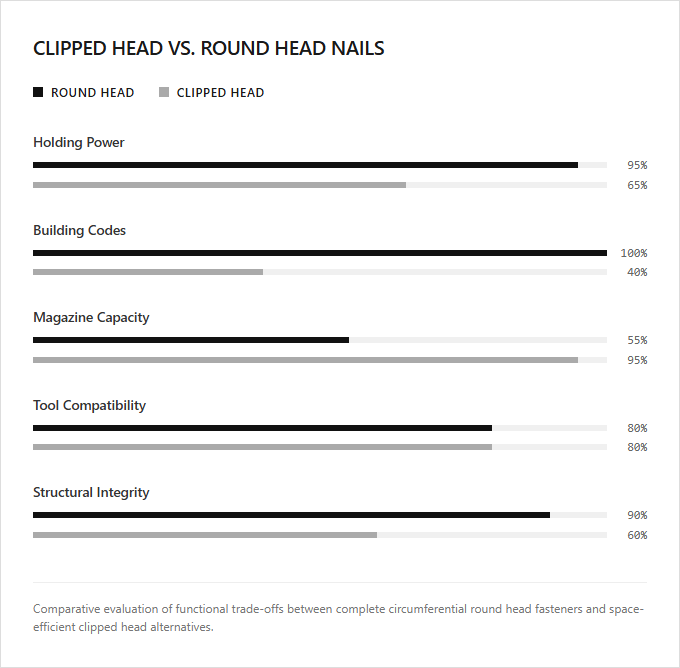
| Holding Power | Round head nails offer superior pull-through resistance and shear strength due to their complete circumferential surface area compared to clipped head alternatives. |
| Building Codes | Many jurisdictions enforcing the International Residential Code (IRC) restrict clipped head fasteners in seismic or high-wind zones, mandating full round head nails instead. |
| Magazine Capacity | Clipped head nails allow for tighter collation density along the paper tape, significantly increasing the framing nailer's magazine capacity and reducing reload frequency. |
| Tool Compatibility | Pneumatic framing nailers must be designed with a specific drive blade profile and magazine angle to accommodate either nested clipped head or spaced round head strip fasteners. |
| Structural Integrity | Full round head fasteners distribute clamping force more symmetrically across the wood fibers, minimizing the risk of splitting the substrate during high-velocity driving. |
IRC Fastener Head Requirements to Prevent Pull-Through
The International Residential Code (IRC) outlines strict prescriptive requirements for fastener head area to prevent head pull-through under design wind and seismic loads. Full round head nails provide a complete 360-degree perimeter of surface area, maximizing the holding power required by IRC tables for structural shear walls and roof diaphragms. Clipped head nails offer reduced surface area, which can limit their acceptance under strict local building codes where high pull-through resistance is mandatory.
Understanding these engineering regulations is essential for selecting the correct pneumatic tool. Round head nailers are best suited for licensed contractors working under strict structural inspections, while clipped head nailers are utilized by high-volume production framers prioritizing magazine capacity in regions with more flexible building codes.
21-Degree Magazines Restricted to Full Round Head Fasteners
When selecting a framing nailer, the choice between clipped head and full round head fasteners significantly impacts both structural integrity and tool compatibility. A key technical differentiator lies in the collation angle. Due to physical spacing requirements, 21-degree plastic-strip magazines are strictly restricted to full round head nails, as the steep angle and plastic collation provide the necessary clearance for the wider, complete heads without overlapping.
In contrast, 30- to 34-degree magazines typically utilize paper-tape collated clipped head nails, allowing for tighter nail spacing and a higher magazine capacity. Structural contractors seeking compliance with strict local building codes that mandate maximum shear strength prefer 21-degree round head nailers, whereas high-volume production framers prioritizing rapid, continuous operation and lighter tool weight favor 30-degree clipped head systems.
Code-Compliant 30°-34° Offset Round Head Nails
In structural framing, the debate between clipped head and round head nails centers on holding power and building code compliance. While clipped head nails allow for tighter collation and higher magazine capacity, many municipal building codes mandate full round head fasteners to prevent pull-through under high shear loads.
To resolve this conflict, offset round head designs are engineered specifically for 30-to-34-degree paper-tape nailers. These fasteners feature a slightly off-center head that allows them to nest closely together, maintaining the high-capacity loading efficiency of a clipped-head system while satisfying the strict legal definitions of a full round head. This innovation ensures maximum productivity without sacrificing structural approval.
Clipped head systems serve budget-conscious production framers in non-regulated regions, whereas offset round head nailers are essential for professional contractors navigating strict municipal building codes.
Minimum Lateral Resistance for Sheathing Diaphragms and Shear Walls
In structural sheathing diaphragms and shear walls, meeting lateral load resistance minimums is critical for building integrity. Building codes strictly regulate nail head dimensions because round head nails offer a full perimeter of resistance, preventing the nail head from pulling through the plywood or OSB under extreme shear stress. Clipped head nails feature a reduced surface area on one side, which can lower their pull-through resistance and lead to local building code restrictions in high-wind or high-seismic regions.
Structural engineers calculate shear wall design values based on the specific nail shank diameter and head style used. High-volume production framers often prefer clipped head nailers for their superior magazine capacity and speed, whereas municipal contractors working in strict, code-enforced seismic zones rely on round head nailers to ensure absolute compliance.
ASTM F1667 Nail Shank and Strength Standards
When selecting between clipped head and round head framing nailers, compliance with the ASTM F1667 standard is a critical safety consideration. This standard regulates essential physical properties, including nail shank diameter tolerances and minimum bending yield strength, to ensure structural joints can withstand designated loads. While both nail types can meet the bending yield strength requirements, round head nails consistently satisfy the full-head geometry preferences historically assumed by prescriptive building codes.
Clipped head nails feature a cropped design that allows for tighter collation, though some jurisdictions restrict their use due to the reduced surface area of the head. Round head nailers are ideal for general contractors navigating strict municipal inspections, whereas clipped head nailers best suit high-volume production framers prioritizing maximum magazine capacity in regions with flexible code requirements.
ICC-ES Structural Equivalence for Clipped Head Fasteners
Historically, building codes favored round head nails for structural framing, limiting clipped head fasteners due to concerns over head pull-through. However, modern engineering has bridged this gap. International Code Council Evaluation Service (ICC-ES) evaluation reports now establish structural equivalence for many proprietary clipped head fasteners. These reports verify that certified clipped head nails provide the same lateral shear strength and withdrawal resistance as traditional round head nails under code-specified design loads.
This technical equivalence allows engineers and builders to utilize clipped head nails in high-stress structural applications where round head nails were once strictly mandated. Round head nails remain the preferred choice for traditional builders seeking universal code compliance without additional documentation, while clipped head systems suit high-volume framing contractors prioritizing maximum magazine capacity and reduced reload downtime.
Clipped-Head Nail Bans in Wind and Seismic Zones
When selecting between clipped head and round head framing nailers, structural integrity and local building codes dictate the selection. Clipped head nails allow for higher magazine capacity and less frequent reloading, but their reduced head surface area offers lower resistance to pull-through forces. This structural limitation becomes critical in areas prone to extreme environmental forces.
In high-wind zones and regions classified under strict Seismic Design Categories, building codes explicitly prohibit clipped head fasteners due to the elevated risk of withdrawal. Round head nails provide the necessary holding power to withstand dynamic lateral and uplift forces, ensuring shear walls and roof decking remain secure under stress.
Clipped head nailers are highly efficient for high-volume production framers working on standard interior partitions, whereas round head nailers are indispensable for professional contractors operating in coastal or earthquake-prone regions where strict building code compliance is mandatory.
Leave a comment