
For many woodworkers, few setbacks are as frustrating as discovering unsightly oil spots on a nearly finished workpiece, or conversely, experiencing sudden tool failure mid-project due to dry cylinders. While standard equipment investments often focus heavily on compressor capacity or operating PSI, the nailer's internal lubrication system is actually the pivotal factor in long-term workshop success.
Navigating this choice is essential, as selecting the right pneumatic nailer grants immaculate, stain-free precision while safeguarding your overall operational efficiency. However, this decision comes with specific operational stipulations: oil-free models require strict adherence to duty-cycle limits, while traditional oiled units demand disciplined, daily maintenance to prevent internal wear.
For instance, delicate projects like installing pre-finished crown molding rely on oil-free designs to avoid ruined paint, whereas heavy-duty framing applications often utilize oiled tools for sustained durability. This article will compare the mechanics, maintenance demands, and performance profiles of both systems, guiding you to the optimal pneumatic nailer for your specific woodworking needs.
| Factor | Summary |
|---|---|
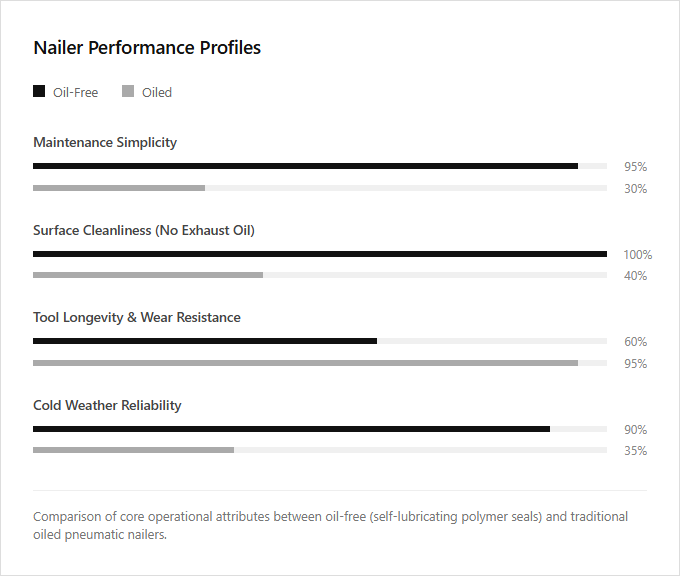
| Maintenance Requirements | Oiled nailers require manual pneumatic lubrication before each use, whereas oil-free models utilize integrated self-lubricating seals to eliminate daily user intervention. |
| Surface Contamination | Oil-free nailers prevent exhaust oil discharge from staining delicate workpieces, making them ideal for sensitive finishing carpentry applications. |
| Tool Longevity | Oiled nailers typically offer a longer service life because the constant fluid film reduces friction and heat-induced wear on internal elastomer O-rings. |
| Cold Weather Operation | Oil-free models perform more reliably in sub-zero temperatures because they lack liquid lubricants that suffer from increased viscosity and cause valve sluggishness. |
| Piston Construction | Oil-free tools utilize specialized Teflon-coated cylinder sleeves to maintain the necessary hermetic seal without the aid of liquid lubricants. |
Prevention of wood finish degradation caused by oil-mist exhaust
When selecting a pneumatic nailer, the choice between oil-free and oiled models significantly impacts the quality of your woodwork. Oiled nailers require regular lubrication, which often results in microscopic oil-mist being expelled through the tool's exhaust. When this airborne oil settles on raw wood, it creates invisible barriers that prevent stains, paints, and varnishes from adhering properly, leading to fish-eyes, peeling, and long-term finish degradation.
Oil-free nailers eliminate this contamination risk entirely by utilizing sealed bearings and self-lubricating materials, ensuring a clean exhaust stream that protects sensitive wood surfaces. Oiled nailers are best suited for high-volume framing contractors who prioritize mechanical longevity in harsh conditions, while oil-free models are the ideal choice for finish carpenters and furniture makers who require pristine, blemish-free surfaces.
Maintenance demands of manual daily lubrication using specialized pneumatic oil
Oiled pneumatic nailers require consistent manual lubrication to protect internal components and ensure optimal performance. Prior to each use, operators must apply a few drops of specialized pneumatic oil directly into the air inlet. This daily maintenance routine prevents O-ring degradation and maintains the tool's seal integrity, though failure to perform this step can lead to premature tool breakdown and costly repairs.
In contrast, oil-free nailers utilize advanced factory-sealed lubrication, eliminating the need for daily manual oiling and preventing accidental oil stains on finished wood surfaces. Oiled models are ideal for high-volume industrial professionals who prioritize maximum tool longevity through disciplined daily maintenance, while oil-free designs best serve finish carpenters and DIY enthusiasts seeking hassle-free operation and clean, stain-free workspaces.
Service life benefits of self-lubricating PTFE-coated cylinder sleeves
Modern pneumatic nailers utilize either oiled or oil-free designs to maintain internal mechanisms. Oil-free models feature advanced self-lubricating components, specifically PTFE-coated cylinder sleeves. This engineered coating minimizes friction without requiring manual lubrication, significantly extending service life by preventing premature wear caused by neglected maintenance. Additionally, the dry cylinder environment prevents abrasive wood dust from adhering to internal components, reducing abrasive wear over time.
In contrast, oiled nailers rely on regular manual lubrication to protect internal seals during high-repetition tasks. While oil-free PTFE systems offer clean, maintenance-free operation, oiled tools provide superior durability under continuous heavy-duty cycles. Oil-free nailers are ideal for finish carpenters and DIY enthusiasts who require clean workpieces and low maintenance, whereas oiled models are best suited for high-volume framing contractors who perform routine daily tool maintenance.
Tool performance stability despite temperature-induced lubricant viscosity fluctuations
Traditional oiled nailers are highly susceptible to ambient temperature variations. Cold temperatures increase oil viscosity, causing sluggish piston cycles and misfires, while extreme heat thins the lubricant, compromising internal seal protection and consistent drive power.
Oil-free nailers resolve these issues by utilizing advanced composite cylinders and self-lubricating seals. This design maintains stable frictional properties across diverse thermal ranges, ensuring reliable cycle times and uniform depth-of-drive without viscosity-related performance drops.
Oiled models are best suited for stationary, high-volume industrial shops with routine maintenance protocols, whereas oil-free units are ideal for mobile contractors and DIY users seeking reliable, maintenance-free operation in fluctuating outdoor climates.
Long-term durability differences in internal synthetic rubber O-ring seals
Oiled pneumatic nailers rely on regular lubrication to maintain the integrity of their internal synthetic rubber O-rings. The introduced oil creates a protective barrier that reduces friction, heat, and wear, preventing the rubber from drying out or cracking under high-pressure cycling. With consistent maintenance, these sealed components exhibit exceptional long-term durability, maintaining airtight compression over millions of cycles.
Conversely, oil-free nailers utilize specialized self-lubricating synthetic O-rings. While this design eliminates the risk of work-surface staining, the constant dry friction and heat accumulation eventually degrade the synthetic compounds faster than in oiled systems, leading to accelerated wear and eventual pressure loss. Oiled models are ideal for high-volume production professionals who prioritize maximum tool longevity through routine maintenance, whereas oil-free designs best suit finish carpenters and DIYers seeking mess-free, low-maintenance operation.
Risk of workpiece surface contamination during rapid cyclic actuation
During rapid cyclic actuation, oiled pneumatic nailers pose a distinct risk of oil mist escaping through the exhaust valve. This airborne lubricant can settle onto the workpiece, causing permanent stains on raw wood or interfering with delicate finishes. Maintaining these tools requires consistent manual lubrication to prevent internal wear during high-frequency operation.
Oil-free nailers eliminate this contamination hazard by utilizing advanced self-lubricating components and sealed bearings. This design ensures that high-speed firing remains entirely clean, protecting sensitive surfaces from oil blowback. Finish carpenters and furniture makers seeking pristine, stain-free surfaces benefit most from oil-free designs, while high-volume framers prioritizing maximum mechanical durability under harsh site conditions typically prefer oiled systems.
System complexity involving inline micro-fog lubricators versus dry-air configurations
Oiled pneumatic nailers rely on a continuous supply of lubricant to protect internal moving parts. In professional workshops, this requires integrating inline micro-fog lubricators into the air line configuration. While this mechanical complexity ensures maximum tool longevity under continuous heavy duty, it demands strict maintenance and introduces the risk of oil mist contaminating the work environment.
Oil-free nailers utilize advanced self-lubricating polymer seals designed specifically for dry-air configurations. This eliminates the need for inline lubrication systems, greatly simplifying the pneumatic setup and preventing any oil discharge onto delicate work surfaces.
Oiled systems are ideal for high-volume industrial manufacturers prioritizing tool durability, whereas oil-free configurations are best suited for finish carpenters and residential contractors seeking maintenance-free operation and stain-free results.
Leave a comment