
Framing carpenters and contractors frequently struggle with the physical fatigue and safety hazards of dragging pneumatic hoses across active jobsites, particularly during high-climb rafter work. Traditionally, relying on standard compressor-based setups was the only way to guarantee the consistent, rapid firing required for heavy-duty framing.
However, adopting cordless technology grants crews unmatched mobility and significantly faster setup times. While this shift promises greater efficiency, a critical stipulation must be made: the performance of cordless systems varies wildly based on environmental conditions and battery platforms. Pro-grade tools like the Paslode cordless gas system and the Milwaukee M18 FUEL battery-powered nailer demonstrate that cordless power is highly viable, yet structurally distinct.
Below, we break down the critical differences between gas fuel cells and lithium-ion battery technology, evaluating their weight, cold-weather reliability, and maintenance demands to help you choose the ultimate jobsite tool.
| Factor | Summary |
|---|---|
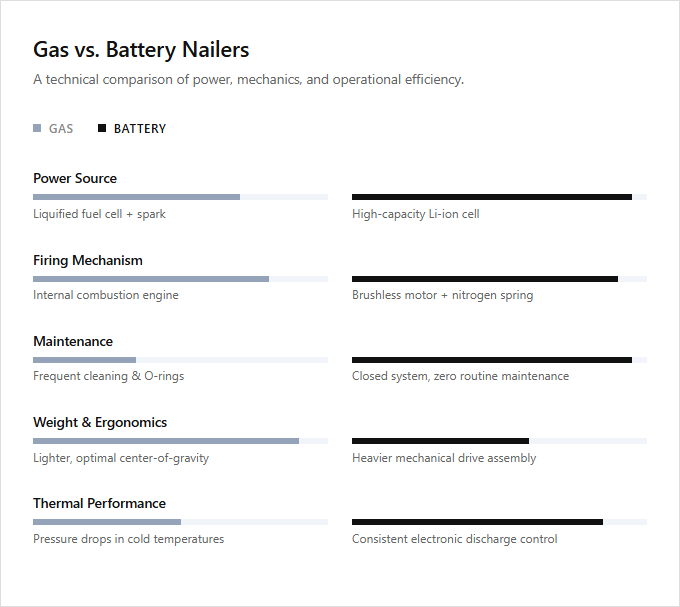
| Power Source | Gas nailers utilize a liquified petroleum fuel cell ignited by a small battery spark, whereas battery-only models rely entirely on high-capacity lithium-ion cells. |
| Firing Mechanism | Gas-actuated tools employ internal combustion to drive the piston, while battery-powered units typically use a brushless motor to compress a sealed nitrogen gas spring cylinder. |
| Maintenance Requirements | Combustion-based gas nailers require frequent cleaning of carbon soot buildup and O-ring lubrication, whereas brushless battery nailers are closed systems requiring virtually no routine servicing. |
| Weight and Ergonomics | Gas nailers are lighter and offer superior center-of-gravity balance, whereas battery-only nailers are heavier due to the weight of the battery pack and mechanical drive assembly. |
| Thermal Performance | Gas fuel cells suffer from drop-offs in propellant pressure in cold temperatures, whereas advanced lithium-ion battery electronics manage discharge rates more consistently in freezing climates. |
Combustion chamber ignition versus brushless motor flywheel drive systems
Gas-powered nailers utilize a combustion chamber ignition system, where a small dose of pressurized liquefied gas mixes with air and is ignited by a battery-powered spark plug. This explosive combustion drives the piston forward with high instantaneous power, closely mimicking traditional pneumatic performance without the restriction of air hoses.
Battery-powered cordless nailers rely on high-efficiency brushless motors to spin a heavy internal flywheel. When the trigger is pulled, the kinetic energy stored in the spinning flywheel is mechanically coupled to the driver blade, delivering consistent force with rapid ramp-up times and no combustion exhaust.
Gas systems offer lightweight portability suitable for high-volume framing contractors working in remote or cold environments, whereas battery-operated models are ideal for residential remodelers and finish carpenters seeking low-maintenance operation and instant actuation without ongoing fuel cell costs.
Fuel cell pressure drop in sub-freezing jobsite temperatures
When selecting between gas-powered and battery-only cordless nailers, temperature performance is a critical factor for winter construction. Gas nailers rely on internal combustion fueled by liquid gas cells. In sub-freezing temperatures, the pressure inside these fuel cells drops significantly, preventing the liquefied gas from vaporizing properly and leading to frequent tool misfires or complete operational failure.
Battery-powered nailers utilize lithium-ion technology to drive the piston mechanically, bypassing the thermodynamic vulnerabilities of pressurized gas. While batteries experience some capacity loss in the cold, they consistently deliver the necessary mechanical force without pressure-related performance drops. Gas nailers are ideal for production framers working in mild climates who prioritize a lightweight tool, whereas battery-powered models are best suited for year-round contractors requiring reliable, temperature-independent performance on harsh winter jobsites.
Ramp-up time of battery flywheels versus instantaneous gas combustion actuation
When evaluating cordless nailers, the core distinction lies in the firing mechanism's response time. Battery-powered flywheel nailers require a brief but noticeable ramp-up period, as the electric motor must spin the internal flywheel to operating speed before driving each fastener. In contrast, gas-actuated models utilize a miniature internal combustion cycle, delivering instantaneous actuation with zero delay upon pulling the trigger.
This difference in cycle speed directly impacts workflow and user preference during high-volume applications. Production-focused framing crews who demand rapid-fire speed and continuous bump-firing are ideal candidates for gas systems, whereas independent contractors and DIY enthusiasts seeking low-maintenance operation without the ongoing expense of fuel cells will find battery-only nailers more suitable.
Gas Nailer Maintenance: Cleaning Plugs and Filters
Gas-powered nailers offer high mobility but require a rigorous maintenance schedule. Because they rely on internal combustion, users must regularly clean the spark plugs and combustion filters to prevent carbon buildup and misfires. This overhead involves disassembling the tool, using specialized cleaning aerosols, and replacing worn-out filters to ensure consistent firing power.
In contrast, battery-powered nailers eliminate these combustion-related tasks entirely. Driven solely by electric motors, they operate without the need for fuel cells, spark plug adjustments, or filter replacements, reducing long-term downtime. High-volume framing contractors who prioritize raw, continuous power often favor gas models despite the upkeep, whereas residential remodelers and DIY enthusiasts seeking hassle-free, grab-and-go convenience are better suited for battery systems.
Tool weight distribution and ergonomics of high-capacity lithium-ion battery packs
When selecting between gas and cordless battery-powered nailers, tool weight distribution is a critical factor for operator comfort. Battery-powered models eliminate the need for fuel cells but require high-capacity lithium-ion battery packs to match the driving power of gas. These heavy battery packs, typically positioned at the base of the handle, shift the center of gravity downward. While this bottom-heavy design can reduce wrist strain during downward fastening, it increases fatigue during overhead applications compared to the more balanced, lighter profile of gas-powered alternatives.
Gas nailers remain ideal for high-volume framing carpenters who prioritize a lightweight, agile tool for extended overhead work, whereas battery-powered nailers best serve remodelers and punch-list contractors who value low maintenance and rapid setup across varied, quick-turnaround jobs.
Recurring operating costs of purchasing pressurized hydrocarbon fuel cartridges
When evaluating gas-powered versus battery-powered nailers, recurring operating costs represent a critical differentiator. Gas nailers rely on pressurized hydrocarbon fuel cartridges to chamber and ignite the propellant, which introduces an ongoing expense alongside standard fastener purchases. These specialized fuel cells have a limited shelf life and require regular replacement, adding a predictable, cumulative cost to every deployed fastner.
In contrast, cordless battery-powered nailers eliminate fuel consumables entirely, relying solely on rechargeable lithium-ion battery packs. While battery systems require a higher initial investment, their long-term operating expenses remain minimal since recharging costs are negligible. High-volume framing carpenters who prioritize a lightweight tool for all-day overhead use are best suited for gas systems, whereas residential remodelers and DIY enthusiasts seeking low-maintenance, cost-effective operation are better served by battery-powered alternatives.
Sealed nitrogen gas spring technology delivering consistent pneumatic-like drive energy
When selecting a cordless nailer, professionals often choose between traditional gas-actuated systems and battery-powered models. Modern battery-only nailers have significantly closed the performance gap by utilizing sealed nitrogen gas spring technology. This advanced internal chamber permanently seals compressed nitrogen to deliver consistent, pneumatic-like drive energy, ensuring rapid-fire actuation without the ramp-up time typical of older cordless designs.
While gas-powered nailers offer a lightweight profile, they require ongoing purchases of pressurized fuel cells and regular combustion-chamber cleaning. In contrast, battery-only systems utilizing nitrogen air-spring technology eliminate these maintenance overheads and perform reliably in cold temperatures. Gas models suit high-volume production framers prioritizing minimum tool weight, whereas battery-powered nitrogen nailers are ideal for interior trim carpenters and remodelers seeking low operating costs and instant tool response.
Leave a comment