
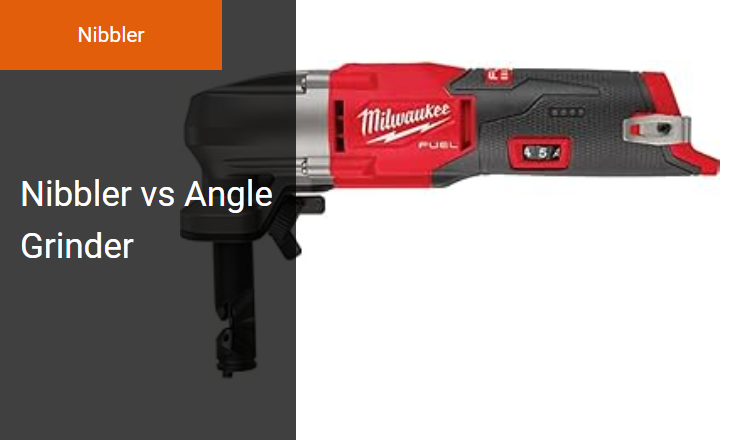
Fabricators and metalworkers frequently struggle with the frustration of jagged edges, warped workpieces, and hazardous sparks when cutting thin sheet metal. While standard workshops typically rely on traditional angle grinders or manual shears to bridge the gap, these conventional methods often compromise the integrity of the material.
Transitioning to a punch-and-die nibbler grants operators unmatched precision, delivering completely distortion-free and spark-free cuts. It is important to stipulate, however, that maximizing this tool's potential requires careful management of crescent-shaped metal waste and strict adherence to material thickness limits.
Nevertheless, for high-accuracy tasks like HVAC ductwork modification and corrugated roofing installation, its utility is highly proven. In this article, we will directly compare the nibbler and the angle grinder across key performance metrics-including edge quality, safety, speed, and operational costs-to determine the ultimate tool for your metal fabrication needs.
| Factor | Summary |
|---|---|
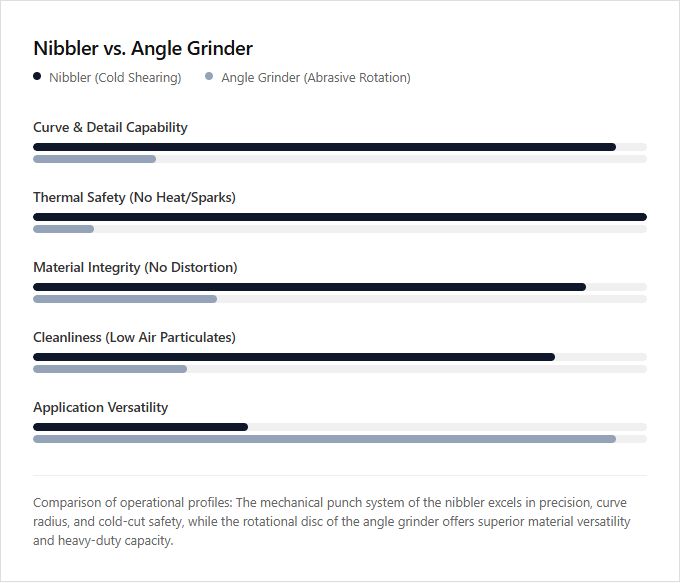
| Cutting Mechanism | While a nibbler utilizes a rapid reciprocating punch and die system to bite through metal, an angle grinder relies on high-speed rotational abrasive wheels to slice or grind materials. |
| Material Distortion | Nibblers perform cold cutting to prevent thermal distortion, whereas angle grinders generate significant friction that can create a heat-affected zone and warp thin sheet metal. |
| Curve and Detail Handling | A nibbler offers an exceptionally tight turning radius for cutting complex curves and corrugated profiles, whereas an angle grinder is limited to straight linear paths due to its rigid disc geometry. |
| Waste and Kerf | The nibbler produces a precise kerf defined by small crescent-shaped metal chips, while the angle grinder results in wider kerf loss and fine airborne particulate matter. |
| Spark and Heat Generation | Nibblers operate via mechanical shearing without producing sparks, whereas angle grinders present an ignition hazard due to the intense friction and incandescent sparks they generate. |
| Material Versatility | While nibblers are highly specialized for thin-gauge sheet metal fabrication, angle grinders are multi-functional tools used for heavy-duty metal grinding, masonry cutting, and weld blending. |
Prevention of a heat-affected zone (HAZ) via cold cutting
When cutting sheet metal, managing thermal output is critical to preserving the material's structural integrity. Angle grinders rely on high-speed friction, which generates intense heat and creates a heat-affected zone (HAZ). This thermal stress can discolor the metal, destroy protective coatings, and cause warping along the cut line.
A nibbler utilizes a rapid punching action to deliver a true cold cut. This mechanical shearing process removes tiny chips of metal without generating friction-induced heat, completely eliminating the risk of a HAZ. The metallurgical properties of the workpiece remain entirely unaltered, preventing rust and deformation.
Precision fabricators requiring clean, distortion-free edges on delicate or pre-painted metals will find the nibbler indispensable, whereas general contractors performing rapid demolition or heavy steel cutting will be better served by the aggressive capabilities of an angle grinder.
Distortion-free cutting of thin-gauge sheet metal
When working with thin-gauge sheet metal, achieving a distortion-free cut is paramount. A nibbler operates by rapidly punching out small metal chips, which prevents heat build-up and mechanical warping along the cut line. This cold-cutting process ensures that the structural flatness of the sheet is completely preserved, making the tool ideal for clean, intricate, and curved cuts without bending the workpiece.
In contrast, an angle grinder relies on high-speed friction, generating significant heat that often warps thin metal and leaves rough burrs requiring extensive post-cut clean-up. While grinders excel at rapid, straight demolition cuts, they lack the delicate precision needed for pristine sheet metal fabrication. A nibbler is best suited for precision HVAC installers and auto body technicians requiring flawless, warp-free finishes, whereas an angle grinder is ideal for general metal fabricators and demolition workers prioritizing speed and versatility.
Minimal burr formation requiring no secondary finishing
When cutting sheet metal, the choice between a nibbler and an angle grinder depends heavily on the desired edge quality. A nibbler operates by punching out small pieces of metal at high speeds, creating a distortion-free cut through cold-processing. This mechanical action results in minimal burr formation, completely eliminating the need for secondary finishing processes like grinding or deburring.
In contrast, an angle grinder relies on high-speed friction, which generates intense heat. This thermal process melts the metal edges, leaving heavy slag, discoloration, and sharp burrs that require extensive post-cut cleanup. While the fast-cutting angle grinder suits demolition workers and fabricators prioritizing speed over precision, the burr-free nibbler is ideal for HVAC technicians and precision metalworkers who require clean, ready-to-assemble edges.
Superior maneuverability for tight minimum cutting radius
When metal fabrication requires intricate curves and precise shapes, the choice of cutting tool is critical. While an angle grinder is a powerful option for straight lines, its rigid, circular disc inherently limits its maneuverability. In contrast, a sheet metal nibbler excels at navigating tight spaces, boasting an exceptionally small minimum cutting radius that allows for sharp turns and complex templates without distorting the surrounding material.
The nibbler operates via a rapid punching action, removing tiny chips of metal to enable seamless directional changes that are impossible with a spinning grinder wheel. Detail-oriented fabricators and HVAC technicians requiring intricate, distortion-free curve work will benefit most from a nibbler, whereas general contractors performing rapid, straight demolition cuts will find the angle grinder more suitable.
Generation of clean crescent-shaped chips instead of abrasive dust
When cutting sheet metal, the choice between a nibbler and an angle grinder significantly impacts both the working environment and the finish quality. A nibbler operates by rapidly punching out small, clean, crescent-shaped metal chips. This cold-cutting mechanical process prevents the generation of airborne abrasive dust, toxic fumes, and hazardous sparks, preserving the material's coating and maintaining a pristine workspace.
Angle grinders rely on high-speed abrasive friction, which creates intense heat, sparks, and fine particulate dust that requires respiratory protection. While grinders offer rapid separation of thick metals, nibblers excel in distortion-free curves and precise internal cutouts. High-precision sheet metal fabricators requiring clean, dust-free indoor operation are best suited for the nibbler, while general demolition contractors needing fast, aggressive cuts across various materials will benefit most from the angle grinder.
Variable Cutting Speed Control via SPM
When comparing a nibbler to an angle grinder for metal fabrication, cutting speed control is a critical differentiator. A nibbler offers precise variable speed control measured in strokes per minute (SPM), typically ranging from 1,000 to 2,500 SPM. This adjustable linear frequency allows operators to carefully match the cutting rate to the material thickness and complexity of the profile, preventing thermal deformation and ensuring clean, burr-free edges.
In contrast, angle grinders operate at high, fixed rotational speeds (RPM) rather than reciprocating strokes. While highly efficient for rapid material removal, the grinder lacks the delicate SPM modulation of a nibbler, which often introduces significant heat and sparks to the workpiece. Nibblers are ideal for precision fabricators requiring intricate, distortion-free curved templates in thin sheet metal, whereas angle grinders are best suited for heavy demolition workers needing fast, aggressive straight cuts on thick steel plates.
Precise punch and die clearance to prevent material pinching
When selecting between a nibbler and an angle grinder for sheet metal fabrication, the cutting mechanism dictates the quality of the finished edge. A nibbler operates using a rapid punch and die system, where a precise clearance between the tooling components is engineered to shear the metal cleanly. This exact alignment prevents material pinching and minimizes deformation, ensuring the workpiece remains flat and structurally sound. Conversely, an angle grinder relies on high-speed friction from an abrasive disc, which frequently introduces excessive heat and increases the risk of binding or tearing the metal.
Because the nibbler's punch and die clearance delivers burr-free, distortion-free results, it is the superior choice for delicate or highly visible installations. Metal fabricators requiring intricate, precise curves in prepainted or thin-gauge sheets will find the nibbler indispensable, whereas demolition specialists and general contractors needing rapid, rough cuts through thick structural steel are better served by the versatile angle grinder.
Leave a comment