
Achieving clean, distortion-free cuts in sheet metal is a persistent challenge for fabricators, as traditional cutting methods frequently warp or harden the workpiece edges. While operators often rely on standard aviation snips, abrasive wheel grinders, or outsourcing to expensive laser cutting services, these baseline approaches often compromise either efficiency or the structural integrity of the metal.
This is where the specialized nibbler provides a distinct advantage, granting metalworkers the ability to execute tight radius curves and straight cuts without heat deformation. However, an important technical stipulation applies: pneumatic models require a continuous, high-volume shop air supply, whereas electric variants require direct proximity to power outlets or carry the weight of onboard batteries. Widely utilized in precision HVAC ductwork and custom automotive body restoration, nibblers deliver unmatched edge quality.
In this article, we will compare air and electric nibblers across cutting capacity, maneuverability, and long-term operating costs, helping you select the optimal tool for your fabrication workflow.
| Factor | Summary |
|---|---|
| Power Source | Air nibblers operate utilizing compressed air via pneumatic fittings, whereas electric nibblers are powered by AC induction motors or cordless DC batteries. |
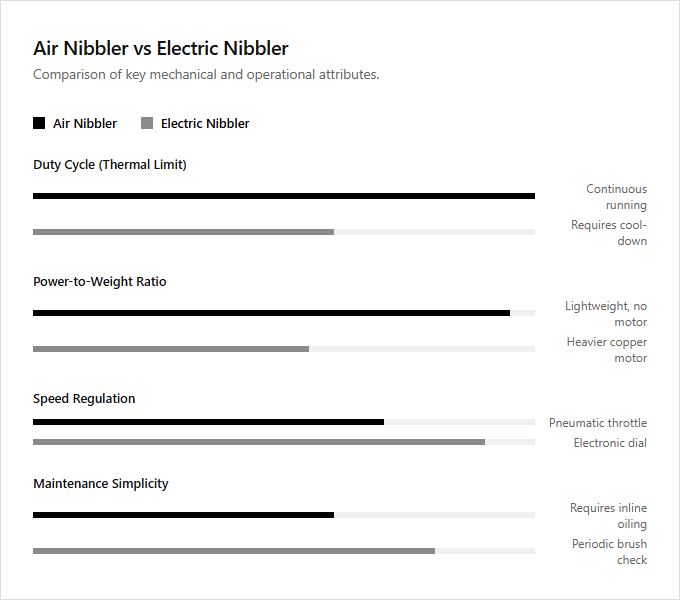
| Duty Cycle | Air nibblers can run continuously without thermal overload because the expanding exhaust air naturally cools the tool, unlike electric motors that require cool-down periods to prevent armature damage. |
| Weight and Ergonomics | Lacking a heavy copper-wound motor, air nibblers provide a significantly higher power-to-weight ratio than electric variants, minimizing user fatigue during prolonged sheet metal fabrication. |
| Speed Regulation | Speed is adjusted via a variable-flow pneumatic throttle on air models, whereas electric nibblers utilize electronic speed control dials to regulate the strokes per minute (SPM). |
| Maintenance | Pneumatic nibblers require constant inline lubrication to prevent cylinder wear, while electric nibblers demand periodic inspection of the carbon brushes and commutator components. |
Pneumatic Flow Rates vs. Motor Amperage Draw
Pneumatic air nibblers rely on a continuous supply of compressed air to drive the cutting piston. To maintain peak performance during heavy-gauge sheet metal cutting, these tools typically require a consistent flow rate of 4 to 6 CFM at a standard operating pressure of 90 PSI. This pneumatic system ensures a high power-to-weight ratio and cool operation under continuous, high-volume duty cycles.
Electric nibblers utilize onboard motors with an amperage draw generally ranging from 3.5 to 5.0 amps. This electrical draw provides consistent, direct torque without requiring an external compressor, although the motor housing increases the overall weight of the handheld unit.
Pneumatic models are ideal for high-volume industrial fabricators with dedicated workshop air systems, while electric alternatives best serve mobile contractors and roofing installers who prioritize plug-and-play portability across diverse job sites.
Strokes Per Minute (SPM) variance under load conditions
When comparing air and electric nibblers, the variance in Strokes Per Minute (SPM) under load is a critical performance differentiator. Pneumatic air nibblers deliver high speed but are susceptible to SPM drops under heavy load if the air compressor cannot maintain consistent pressure. Electric nibblers, powered by robust electric motors, often utilize electronic speed control to maintain a stable SPM even when cutting through maximum-capacity sheet metal. This consistency ensures cleaner cuts and predictable feed rates during demanding operations.
Air models offer a lightweight, stall-resistant design, whereas electric models provide reliable, self-contained power. Air nibblers are ideal for automotive technicians with existing workshop compressor systems, while electric nibblers best serve mobile contractors requiring consistent cutting performance across diverse job sites.
Intrinsically safe spark-free operation in volatile environments
When cutting sheet metal in hazardous areas, selecting the correct tool is critical for safety. Electric nibblers rely on electric motors that inherently generate minor sparks during operation. In contrast, pneumatic air nibblers utilize compressed air to drive the cutting mechanism, ensuring a completely cold, spark-free process. This makes air-powered tools intrinsically safe for volatile environments containing flammable gases, dust, or chemical vapors where ignition sources must be eliminated.
While electric models offer greater portability for standard fabrication, air alternatives provide necessary safety compliance for high-risk sites. Electric nibblers are ideal for independent roofers and workshop fabricators working in non-hazardous spaces, whereas air nibblers are the essential choice for industrial technicians operating in refineries, chemical plants, and marine environments.
Continuous duty cycle limitations and thermal overload prevention
Air nibblers leverage compressed air to deliver an exceptionally high duty cycle. Because pneumatic systems lack an electric motor, they generate virtually no internal heat during operation, which eliminates the risk of thermal overload. As long as a consistent air supply is maintained, these tools can run continuously without requiring cool-down periods, making them highly reliable for demanding, high-volume production environments.
In contrast, electric nibblers are limited by motor heat buildup and require careful monitoring to prevent thermal overload. Prolonged use under heavy loads can trigger internal thermal protection switches, necessitating periodic rest intervals to prevent armature damage. Industrial fabricators requiring non-stop, station-based cutting benefit most from the endless duty cycle of pneumatic models, whereas onsite contractors prioritizing portability for intermittent installations find electric nibblers highly suitable.
Punch and die clearance optimization for minimal kerf distortion
Achieving clean, distortion-free cuts with nibblers requires precise punch and die clearance optimization. Air-powered nibblers, utilizing pneumatic pressure, offer rapid reciprocating strokes that excel in maintaining consistent clearance under load, effectively minimizing kerf distortion in thinner sheet metals. Conversely, electric nibblers provide steady, high-torque power, allowing operators to maintain optimal punch-to-die alignment through thicker, tougher materials without stalling.
Proper clearance adjustment directly prevents burrs and material deformation along the cut line. Pneumatic air nibblers are ideal for automotive technicians requiring lightweight, spark-free operation in shop environments, while electric models are best suited for field-based construction workers needing maximum portability and torque for heavy-duty onsite fabrication.
Power-to-weight ratio impacting ergonomic maneuverability
When selecting between pneumatic and electric nibblers, the power-to-weight ratio is a critical factor governing ergonomic maneuverability. Air nibblers offer a superior power-to-weight ratio because they lack a heavy internal motor, relying instead on external compressed air. This lightweight design reduces operator fatigue during overhead or vertical cutting, allowing for precise, fluid control along intricate templates.
Electric nibblers, while heavier due to their onboard motors, provide unmatched portability without the restriction of air hoses. This added weight can help stabilize the tool on long, flat cuts, though it limits rapid directional changes in tight spaces. Pneumatic models are ideal for industrial fabricators in dedicated workshops with established air systems, whereas electric variants suit mobile contractors requiring on-site flexibility across various locations.
Minimum cutting radius capabilities and maximum material gauge capacity
When selecting between pneumatic and electric nibblers, understanding their mechanical differences is essential for precise metalworking. Air nibblers generally feature a more compact, lightweight cutting head, allowing for an exceptionally tight minimum cutting radius-often down to 1/4 inch-which excels at intricate scrollwork. Electric nibblers, while slightly bulkier due to the onboard motor housing, typically offer a minimum cutting radius of 1/2 to 1-1/2 inches, prioritizing stability during continuous runs.
Material thickness capabilities also differ significantly between the two configurations. Heavy-duty electric models frequently lead in maximum material gauge capacity, comfortably slicing through up to 10-gauge mild steel. Air-powered alternatives usually peak around 14 to 16-gauge steel, requiring a consistent workshop air supply to maintain optimal torque. Pneumatic units are highly suited for automotive restorers requiring maneuverability in tight shop spaces, whereas electric nibblers are ideal for structural contractors needing portable, high-capacity cutting power on-site.
Leave a comment