
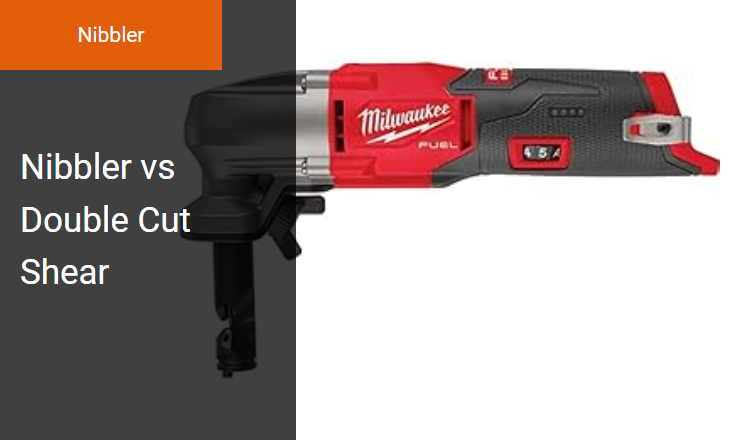
Sheet metal fabrication is notoriously unforgiving, particularly when negotiating tight curves. Fabricators frequently struggle to achieve clean, distortion-free radius cuts without warping the metal or leaving jagged edges. While workshops traditionally rely on standard tin snips, angle grinders, or single-cut shears, these conventional methods often pinch the material and limit overall precision.
Transitioning to a reciprocating punch nibbler solves this bottleneck, offering unparalleled maneuverability and perfectly flat edges by removing a continuous path of tiny, undistorted metal segments. However, operators must manage expectations: nibblers produce sharp, crescent-shaped waste debris and have strict material thickness thresholds that must be respected.
In high-precision applications like HVAC ducting installation and automotive body panel restoration, choosing the correct tool prevents costly material waste. This article compares the reciprocating punch nibbler directly against the double-cut shear, analyzing their cutting mechanisms, radius capabilities, and operation limits to help you select the ideal tool for your curved metal projects.
| Factor | Summary |
|---|---|
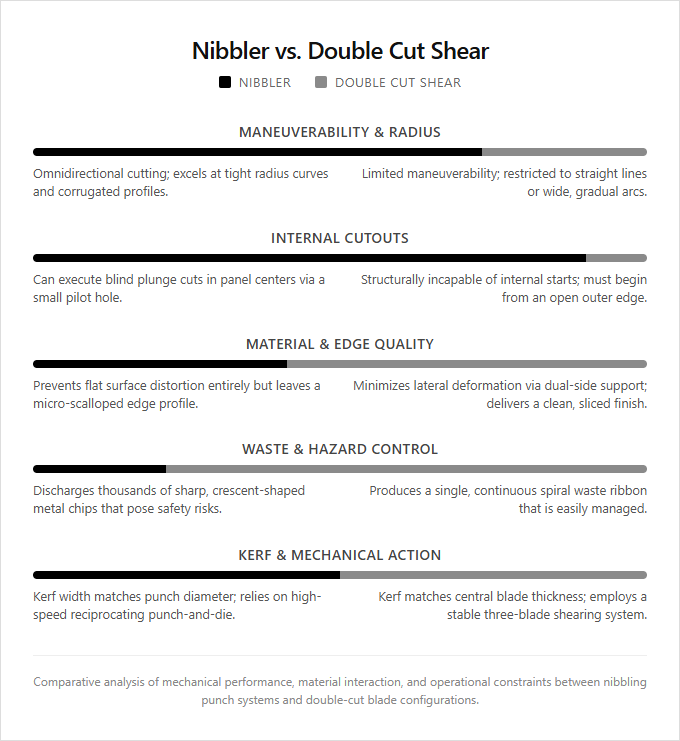
| Cutting Mechanism | A nibbler utilizes a rapid reciprocating punch and die system to bite away material, whereas a double-cut shear employs a three-blade configuration to slice out a continuous ribbon. |
| Material Distortion | Double-cut shears minimize lateral deformation by supporting the sheet metal on both sides of the cut, while nibblers prevent surface distortion entirely but leave a slightly scalloped edge. |
| Maneuverability | Nibblers excel at tight radius cuts and navigating corrugated profiles due to their omnidirectional cutting action, whereas double-cut shears are limited to straight paths or wide arcs. |
| Waste Production | Double-cut shears produce a clean, continuous spiral waste coil, whereas nibblers discharge thousands of sharp, crescent-shaped metal swarf chips that can pose safety hazards. |
| Internal Cutouts | Nibblers can initiate a plunge cut in the middle of a panel once a pilot hole is drilled, whereas double-cut shears are structurally restricted to starting from an exposed edge. |
| Kerf Width | The kerf of a nibbler is determined by the physical diameter of its punch, whereas a double-cut shear creates a kerf equal to the thickness of its central actuator blade. |
Tight-Radius 360-Degree Reciprocating Punch Nibbler
When selecting sheet metal cutting tools, the choice between a nibbler and a double-cut shear depends heavily on the complexity of the required cut. A reciprocating punch nibbler excels in maneuverability, offering an infinitely adjustable 360-degree cutting path. This unique action allows operators to execute tight minimum turning radius maneuvers, making it highly effective for cutting corrugated materials, pipes, or intricate internal cutouts without distorting the surrounding metal.
Double-cut shears remove a continuous thin strip of waste material to produce clean, distortion-free straight lines or gentle curves. While shears are highly efficient for rapid linear fabrication, they lack the tight-radius agility of the punch design. Sheet metal fabricators requiring intricate, multi-directional scrollwork benefit most from the nimble versatility of a nibbler, whereas roofing installers and HVAC technicians performing long, straight cuts will find the stability of a double-cut shear more productive.
Double-Cut Shears: Low Distortion, Limited Curves
When choosing between metal cutting tools, understanding the mechanical differences between a nibbler and a double-cut shear is essential. A double-cut shear utilizes a three-blade design that removes a thin continuous curl of waste metal, which minimizes material distortion along the cut edge. This specialized design keeps the workpiece flat and clean, although the physical width of the cutting head restricts the tool from making tight radius curved cuts.
The nibbler operates with a rapid punch-and-die mechanism, allowing it to navigate sharp angles and intricate curved profiles without binding. Sheet metal installers prioritizing clean, distortion-free straight cuts will find the double-cut shear indispensable, whereas custom fabricators tackling complex shapes and corrugated materials are best suited for the highly maneuverable nibbler.
Nibbler Kerf and Chip Formation
When selecting sheet metal cutting tools, the choice between a nibbler and a double-cut shear depends heavily on the cutting mechanism. The nibbler operates via a rapid punch and die assembly that continuously stamps out material. This unique action creates a distinct kerf width composed of tiny, crescent-shaped metal chips, leaving a clean, distortion-free edge. Double-cut shears utilize a two-blade system to remove a continuous curl of waste metal, which minimizes loose debris but restricts tight-radius maneuvering.
Each tool serves distinct professional needs based on these operating characteristics. Nibblers are best suited for roofers and custom fabricators requiring high maneuverability for tight curves and corrugated panels, while double-cut shears are ideal for HVAC installers who prioritize straight, distortion-free cuts with minimal jobsite cleanup.
Nibbler Plunge Cuts Only Require a Pilot Hole
When selecting between a nibbler and a double-cut shear for sheet metal fabrication, the method of executing internal cuts is a primary differentiator. A reciprocating nibbler excels at internal plunge cuts, requiring only a small drilled pilot hole to insert the punch and begin cutting. This capability allows operators to initiate detailed, enclosed cutouts in the middle of a panel without distorting the surrounding material.
Double-cut shears, by contrast, remove a continuous metal strip and are highly efficient for straight lines or wide curves starting from an outer edge, but they lack the agility needed for tight, internal profiles. While the nibbler is ideal for technicians performing intricate, interior cutouts on ductwork or automotive panels, the double-cut shear is best suited for installers requiring fast, deformation-free straight cuts on large sheets.
Adjusting Blade Clearance Prevents Shear Binding
When selecting sheet metal cutting tools, the mechanical design of nibblers and double-cut shears dictates their specific applications. Double-cut shears remove a thin continuous waste strip, producing clean, distortion-free edges on flat surfaces. To maintain this efficiency, the dual side-blade clearance adjustment on double-cut shears is critical for preventing material binding during operation. Proper calibration of this clearance ensures smooth feeding through varying metal gauges and minimizes mechanical resistance.
Conversely, nibblers employ a rapid punch-and-die mechanism, making them ideal for tight radius curves and corrugated materials. While nibblers create tiny, sharp metal chips, they offer exceptional maneuverability compared to the straight-line precision of shears. Professional fabricators requiring clean, linear cuts on flat sheets benefit most from double-cut shears, whereas HVAC technicians and roofing installers dealing with corrugated profiles and intricate templates are better suited for a nibbler.
Sheet Metal Gauge Dictates Tool Speed and Feed
The maximum sheet metal gauge capacity of a nibbler or double cut shear directly dictates its stroke speed and feed rate efficiency. Nibblers utilize a rapid punch-and-die mechanism that maintains high stroke speeds in thicker materials without binding, though they produce tiny waste chips. In contrast, double cut shears remove a continuous metal curl, offering optimal feed rates on thinner gauges but slowing significantly as material thickness nears the tool's capacity limit.
Operating efficiency depends on matching the tool to the material thickness and shape requirements. Industrial fabricators requiring intricate, curved cuts in heavy-gauge steel will find the robust nibbler indispensable, while HVAC installers performing rapid, distortion-free straight runs on thin-gauge ductwork are ideal candidates for double cut shears.
Deburring Scalloped Punch Edges
Sheet metal fabrication often requires selecting between a nibbler and a double-cut shear. A nibbler utilizes a rapid, reciprocating punch and die system to bite away small metal pieces. This mechanical action inherently leaves a scalloped edge profile along the cut path, which typically requires subsequent deburring to achieve a smooth, safe finish.
Double-cut shears remove a continuous, thin ribbon of metal, producing clean, straight edges with virtually no distortion. Technicians tackling intricate, curved cutouts in corrugated materials benefit most from the nimble steering of a nibbler, whereas roofing contractors and duct installers needing fast, burr-free straight cuts on flat sheets are better suited for double-cut shears.
Leave a comment