

Achieving a flawless flush trim in tight cabinet corners is a persistent challenge that often leads to tedious hand-chiseling and ruined workpieces. Woodworkers typically rely on standard, factory-issued router bases for these edge-profiling tasks. While these standard configurations serve as reliable workhorses for open surfaces, they lack the physical clearance required for obstructed, tight-clearance areas.
Transitioning to an offset base solves this bottleneck, as it grants the operator an offset belt-driven spindle that shifts the cutting bit to the outer perimeter of the tool's footprint. It is important to stipulate, however, that these specialty bases require precise feed-rate control and are limited to light-duty trimming bits. Professional cabinetmakers regularly leverage this setup for seamless laminate countertop installations and flush-fitting face frames.
Below, we compare the mechanics, stability profiles, and ideal applications of offset versus standard bases to optimize your routing maneuverability.
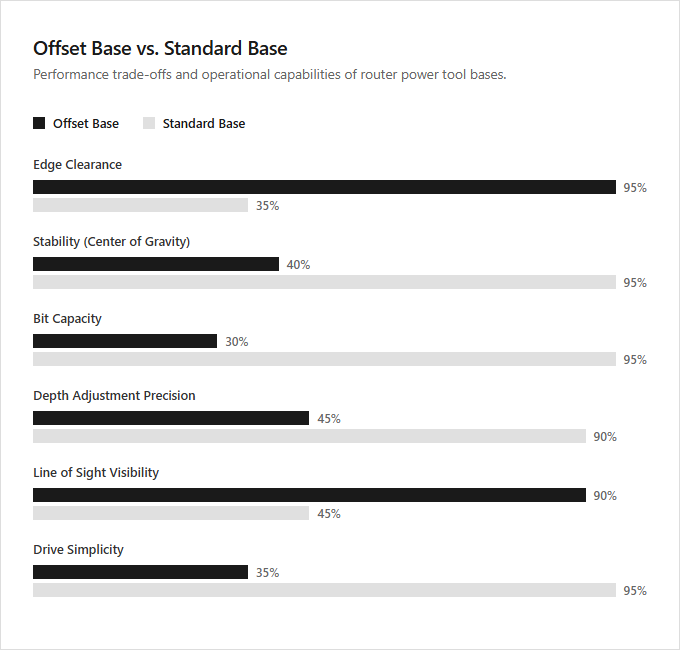
| Factor | Summary |
|---|---|
| Drive Mechanism | Offset bases utilize a specialized transfer belt to shift the spindle axis away from the motor, whereas standard bases connect the collet directly to the motor's drive shaft. |
| Edge Clearance | The offset base excels at flush-trimming laminates in tight corners, while the standard base is obstructed by the motor housing near vertical obstructions. |
| Center of Gravity | Standard bases provide optimal stability because the center of gravity remains directly over the workpiece, whereas offset bases have an asymmetrical balance that requires careful handling. |
| Bit Capacity | Standard bases accommodate large-diameter cutters with half-inch shanks, whereas offset bases are restricted to smaller bits due to tight clearances in the offset pulley assembly. |
| Depth Adjustment | Standard bases often feature precise rack-and-pinion gearing for micro-adjustments, while offset bases rely on simplified mechanical stops due to their offset belt configuration. |
| Visibility | Offset bases offer a clearer line of sight to the contact point of the guide bushing, while standard bases can block the operator's view of the cut line. |
Minimizing Cutter Clearance with Asymmetric Sub-Bases
When selecting a router base, the choice between standard and offset configurations depends entirely on your workspace constraints. A standard base features a symmetrical design centered around the collet, providing excellent stability for general edge routing and template work. Offset bases are engineered specifically for tight spaces. The asymmetric sub-base footprint in offset models minimizes the clearance gap between the cutter and vertical obstructions, allowing users to rout flush against walls, backsplashes, or inside corners.
While standard bases offer reliable control for open-surface routing, the offset base provides the necessary access for specialized installations. Standard bases are ideal for benchtop woodworkers requiring maximum stability on flat surfaces, whereas offset bases are best suited for cabinet installers and remodeling contractors who frequently navigate restricted, pre-assembled structures.
Belt-Driven Power Transfer in Offset Bases
A standard router base aligns the collet directly with the motor shaft, delivering direct drive power along a centralized vertical axis. In contrast, offset bases utilize a belt-driven spindle mechanism to transfer rotational power away from the motor axis. This mechanical relocation places the cutting bit closer to the outer edge of the frame, allowing the tool to operate flush against vertical surfaces and within tight physical confines where a standard cylindrical housing cannot fit.
While the standard configuration provides maximum stability and concentric balance for general edge profiling, the offset design excels at specialized clearance. Professional cabinetmakers and countertop installers require the offset base for precise flush-trimming in restricted corners, whereas general woodworkers and hobbyists will find the standard base best suited for versatile, everyday workshop applications.
Standard vs. Offset Bases: Preventing Tipping
When selecting a router base, understanding how weight distribution affects stability is essential for achieving precise cuts. Standard bases maintain a centralized center of gravity directly over the workpiece, providing uniform support for general routing tasks. This configuration ensures consistent control during interior profiling and surface routing, where the entire base remains in complete contact with the material.
Edge routing introduces the risk of the tool tipping. Offset bases address this challenge by shifting the tool's weight inward to mitigate cantilever tipping when navigating narrow edges. Relocating the center of gravity away from the overhanging edge provides a larger, more stable footprint that prevents gouging and uneven cuts. Standard bases are ideal for general woodworkers performing varied workshop tasks, while offset bases are best suited for cabinetmakers and installers executing precise edge-profiling operations.
Direct Torque Transmission Prevents Pulley Power Loss
When selecting a router base, understanding the mechanics of power transmission is critical for achieving optimal cutting performance. Standard bases feature direct motor-to-collet engagement, ensuring direct torque transmission without mechanical interference. This coaxial design prevents the slight power loss often associated with offset pulley systems, delivering maximum efficiency and consistent RPM directly to the router bit under heavy loads.
Offset bases utilize a belt-driven pulley system to shift the spindle location, allowing the tool to reach tight corners and vertical surfaces. While this configuration offers unmatched close-quarters accessibility, the belt-and-pulley linkage introduces slight frictional resistance, marginally reducing overall torque transfer compared to a direct-drive setup.
Standard bases are ideal for high-production cabinetmakers requiring raw power and continuous heavy material removal, whereas offset bases are best suited for finish carpenters needing precise trim control in confined, hard-to-reach spaces.
Controlling Bit Deflection with Offset Bases
A standard router base provides a symmetrical, centered footprint that ensures balanced pressure and predictable tracking during routing. In contrast, an offset base shifts the spindle and weight distribution away from the operator's primary grip to access tight corners and flush edges. This asymmetrical configuration alters directional feed stability, requiring precise control and deliberate hand pressure to counter lateral bit deflection and prevent the tool from drifting off the cut line.
Managing these physical forces requires a firm grip, as the offset leverage amplifies any inconsistency in the feed rate. Standard bases offer an inherently stable platform for general-purpose profiling, whereas offset bases require active, skilled guidance to maintain a clean cut. Standard bases are ideal for general woodworkers seeking predictable handling during everyday edge-shaping, while offset bases are suited for professional cabinetmakers executing specialized, close-quarters flush trimming.
Bearing Alignment for Tight-Clearance Flush Trimming
In precision woodworking, choosing between a standard base and an offset base significantly impacts control during intricate edge routing. Tight-clearance flush trimming relies on the precise alignment of the pilot bearing with the template edge. While a standard base positions the motor directly over the workpiece, it can limit physical access and stability near narrow borders or vertical obstructions.
An offset base addresses this challenge by shifting the router's spindle and weight distribution away from the edge, providing a wider footprint on the workpiece. This configuration stabilizes the tool on narrow stock, ensuring the pilot bearing maintains constant, perpendicular contact with the template. Standard bases are best suited for general-purpose woodworkers prioritizing versatile, balanced operations, while offset bases are essential for specialized cabinetmakers executing frequent face-frame trimming in confined spaces.
Standard vs. Offset Router Base Adjustments
Standard and offset bases serve distinct roles in routing operations, primarily distinguished by their spindle access and depth adjustment mechanisms. Standard bases feature an open design that allows direct collet engagement, facilitating rapid depth adjustments and straightforward bit changes. This direct access simplifies routine setups on flat workpieces.
In contrast, offset bases shift the spindle away from the motor center to enable flush trimming against vertical surfaces. This specialized configuration requires recessed spindle wrench clearance, making bit changes and micro-adjustments more deliberate. Precision cabinetry professionals requiring flush-to-wall cuts benefit most from the offset base, while general woodworkers prioritizing fast setups are better served by the standard base.
Leave a comment