
Selecting the ideal angle grinder often leaves professionals and fabricators paralyzed by seemingly minor specification differences, risking wasted project time and budget on underperforming equipment. When planning your workshop acquisitions, relying solely on standard equipment funding sources-such as basic shop-tool allowances or rigid departmental budgets-frequently overlooks how critical wheel diameter is to overall productivity.
Optimizing this single specification is vital, as the correct size grants operators unparalleled control over material removal rates and accessory longevity. With the strict educational stipulation that operating speeds (RPM) must always align with your specific guard and disc ratings, making the right choice between a 4.5-inch and a 5-inch model is the deciding factor in demanding applications like heavy weld blending or precise pipe fabrication.
To help you navigate this decision, the following analysis outlines the key differences in cutting depth, motor torque, and maneuverability, ensuring your next tool purchase perfectly matches your operational requirements.
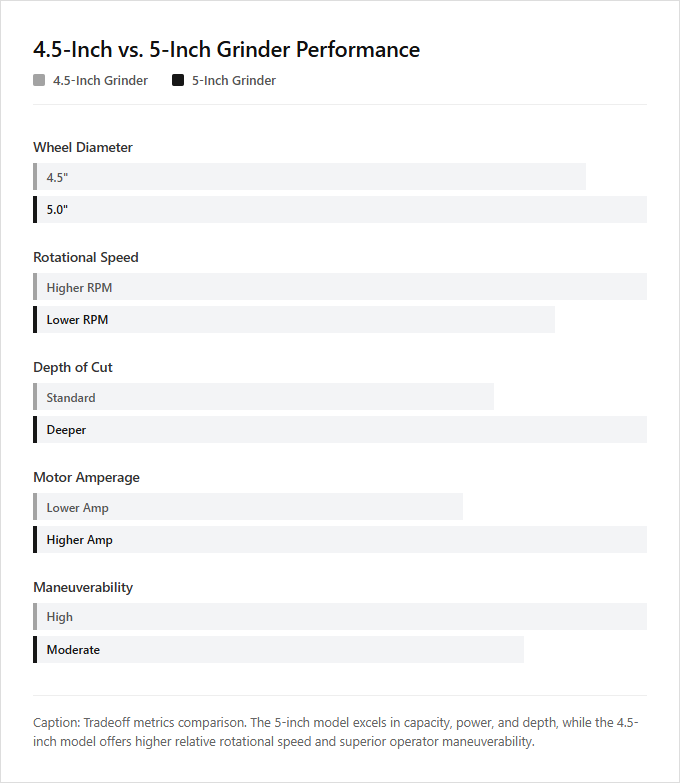
| Factor | Summary |
|---|---|
| Wheel Diameter | The 5-inch grinder accommodates a larger abrasive disc than the 4.5-inch model, providing a greater surface area contact per rotation. |
| Rotational Speed | Smaller 4.5-inch grinders typically operate at a higher RPM (Revolutions Per Minute) to compensate for their smaller wheel size. |
| Depth of Cut | A 5-inch grinder offers a deeper maximum cutting depth, which is essential for penetrating thicker metal stock or masonry. |
| Motor Amperage | Five-inch grinders generally feature higher amperage motors to deliver the necessary torque for heavy-duty applications without stalling. |
| Maneuverability | The 4.5-inch grinder is lighter and offers superior maneuverability, reducing operator fatigue during prolonged overhead usage. |
5-Inch Disc Upgrade Adds 1/4-Inch Cut Depth
When selecting an angle grinder, the choice between a 4.5-inch and a 5-inch model often comes down to the required depth of cut. Upgrading to a 5-inch disc increases the depth of cut capacity by approximately a quarter-inch. This increment improves efficiency when slicing through thicker metals, reducing the need to make multiple passes or flip the workpiece during operation.
Beyond cutting depth, 5-inch grinders frequently feature higher-wattage motors to handle the larger surface area, whereas 4.5-inch models offer superior maneuverability in tight spaces. Budget-conscious DIYers and detail-oriented metal fabricators typically benefit from the compact control of a 4.5-inch grinder, while industrial contractors and heavy-duty masonry professionals require the extended reach and power of the 5-inch option.
Higher RPM Optimizes 4.5-Inch Grinder Speed
When selecting between a 4.5-inch and a 5-inch angle grinder, understanding the relationship between disc size and rotational speed is essential. Because smaller discs have a shorter circumference, 4.5-inch grinders are engineered with a higher maximum rated RPM. This elevated speed optimizes the peripheral velocity at the outer edge of the wheel, ensuring the abrasive material cuts and grinds with maximum efficiency despite the smaller diameter.
In contrast, 5-inch grinders operate at lower maximum RPMs to prevent the larger disc edges from exceeding safe linear speeds, while offering a deeper depth of cut and greater surface coverage. The compact 4.5-inch model is ideal for DIY enthusiasts and tradespeople performing detail work in tight spaces, while the high-capacity 5-inch unit suits industrial fabricators requiring sustained material removal on large surfaces.
5-Inch Motors: Higher Amperage for Sustained Torque
When selecting between a 4.5-inch and a 5-inch angle grinder, the primary differentiator lies in their mechanical capacity and electrical power requirements. While both tools offer versatility, 5-inch units typically demand a higher motor amperage draw. This increased electrical current is essential to sustain the necessary torque under heavy loads, ensuring the larger grinding disc maintains its rotational speed without stalling during demanding applications.
A 4.5-inch grinder operates with a lower amperage motor, making the tool lighter and more maneuverable for intricate tasks. In contrast, 5-inch models leverage their superior power to handle thicker materials and larger surface areas efficiently. Home DIY enthusiasts and hobbyist metalworkers benefit from the nimble control of a 4.5-inch grinder, whereas professional industrial fabricators and concrete contractors require the robust torque and endurance of a 5-inch unit.
5-Inch Wheels: Higher SFPM Speeds Material Removal
When selecting between a 4.5-inch and a 5-inch angle grinder, the primary differentiator lies in operating efficiency. While both tools often utilize similar motor capacities, the larger diameter of the 5-inch wheel increases the Surface Feet per Minute (SFM) at the contact point. This higher velocity accelerates the material removal rate, allowing operators to complete heavy-duty grinding and cutting tasks more quickly.
The 4.5-inch grinder offers superior maneuverability in tight spaces and reduces user fatigue during detailed work. The 4.5-inch model is best suited for DIY hobbyists and light metalworkers requiring precision, while the 5-inch model is designed for professional fabricators and contractors undertaking heavy material resurfacing.
Standard 5/8"-11 UNC Spindle Thread Compatibility
When selecting between a 4.5-inch and a 5-inch angle grinder, users often evaluate capacity and maneuverability. Despite the difference in maximum wheel size, both options generally share the same accessory mounting standard. Spindle thread compatibility typically standardizes at a 5/8-inch-11 UNC thread for both diameters, allowing operators to share wire brushes, flap discs, and backing pads across both tool classes.
While this shared spindle thread simplifies accessory management, the choice between these tools depends on the specific demands of the task. The 4.5-inch model offers superior control in confined areas, whereas the 5-inch model provides increased cutting depth and surface coverage. Detailed metal fabricators requiring precision and agility benefit most from the 4.5-inch model, while heavy-duty industrial operators undertaking extensive material removal are better served by the 5-inch variant.
5-Inch Models: Gyroscopic Precession, Control, and Fatigue
When selecting between a 4.5-inch and a 5-inch angle grinder, the mechanical forces during operation warrant careful consideration. The larger 5-inch model features a heavier wheel rotating at high speeds, which significantly amplifies gyroscopic precession. This physical phenomenon causes the tool to resist changes in direction, requiring more physical effort from the operator to steer. Over extended periods, managing this increased rotational resistance accelerates muscle fatigue and reduces overall precision.
In contrast, the 4.5-inch grinder offers a lighter rotating mass, resulting in diminished gyroscopic forces and superior maneuverability. The smaller profile allows for agile handling and sustained comfort during detailed tasks. The 4.5-inch model is best suited for DIY enthusiasts and metal fabricators requiring high precision in confined areas, while the heavier 5-inch model is ideal for industrial professionals executing heavy-duty, continuous material removal on large surfaces.
More Abrasive Volume Extends 5-Inch Disc Life
Selecting between a 4.5-inch and a 5-inch angle grinder involves evaluating task efficiency and consumable longevity. While both sizes are common in metalworking, the 5-inch model offers a distinct advantage in usable abrasive volume. The larger surface area of a 5-inch disc provides more consumable material before the wheel wears down to the hub. This extended duty cycle reduces the frequency of wheel changes, maximizing uptime during heavy grinding or cutting operations.
Additionally, the increased circumference allows for deeper cuts and faster material removal rates. The 4.5-inch grinder is best suited for DIY enthusiasts and maintenance technicians requiring high maneuverability in tight spaces, whereas the 5-inch grinder is ideal for industrial operators and fabricators undertaking heavy-duty, high-volume production work.
Leave a comment