
Selecting the incorrect handheld rotary tool for metal fabrication often leads to ruined workpieces, wasted shop hours, and compromised safety. When optimizing workshop efficiency, managers typically look to traditional equipment funding sources-such as capital expenditure budgets or equipment finance loans-to secure heavy machinery, yet they frequently overlook the critical impact of smaller hand tools.
However, identifying the precise utility of each tool grants operators the ability to drastically reduce rework and maximize throughput. As a necessary stipulation, neither the angle grinder nor the die grinder is a one-size-fits-all solution; each serves distinct operational tolerances. For instance, custom chassis builders rely on precision die grinders for intricate weld blending, while structural steel fabricators depend on high-torque angle grinders for heavy material removal.
This article compares these two essential tools, analyzing their power-to-weight ratios, RPM ranges, and specific applications to help you make an informed procurement decision for your shop floor.
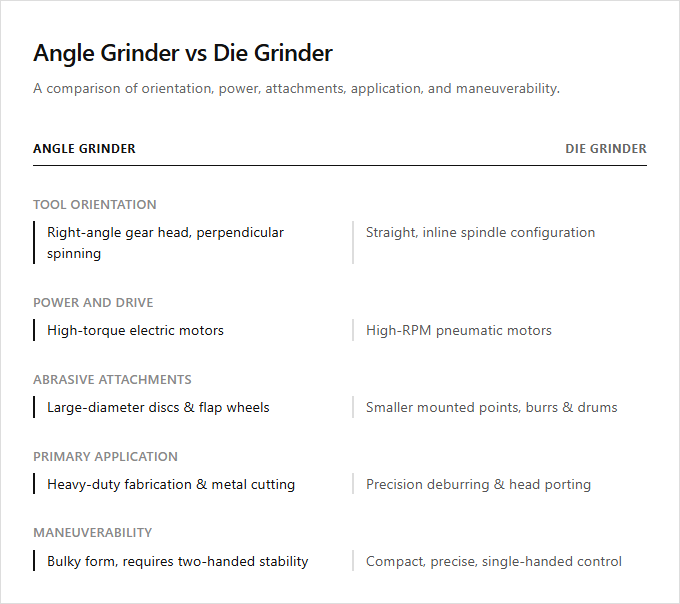
| Factor | Summary |
|---|---|
| Tool Orientation | Angle grinders feature a right-angle gear head for perpendicular disc spinning, whereas die grinders utilize a straight, inline spindle configuration. |
| Power and Drive | Angle grinders are typically driven by high-torque electric motors, while die grinders frequently employ high-RPM pneumatic motors powered by compressed air. |
| Abrasive Attachments | Angle grinders utilize large-diameter grinding discs and flap wheels, whereas die grinders accept smaller mounted points, carbide burrs, and sanding drums. |
| Primary Application | Angle grinders excel at heavy-duty fabrication tasks like weld blending and metal cutting, while die grinders are designed for precision deburring and cylinder head porting. |
| Maneuverability | The bulkier form factor of an angle grinder requires two-handed operation for stability, whereas the compact shape of a die grinder allows for high-precision, single-handed maneuverability in tight spaces. |
Die Grinder Collets vs. Angle Grinder Arbors
Angle grinders and die grinders are essential workshop tools, distinguished primarily by their accessory mounting systems and intended applications. The angle grinder utilizes a threaded arbor and flange nut to secure flat, heavy-duty discs. This robust mechanical locking mechanism is engineered to withstand the high lateral forces generated during heavy material removal, such as cutting thick steel, grinding welds, and beveling heavy plates.
In contrast, die grinders employ a high-precision collet system designed to grip shank-mounted accessories like rotary burrs, mounted points, and small wire wheels. This collet system ensures concentricity and balance at extremely high rotational speeds, which is critical for intricate work in confined spaces. Metal fabricators requiring heavy-duty cutting and weld preparation will find the angle grinder indispensable, whereas machinists, toolmakers, and detail-oriented crafters performing precision deburring, porting, or engraving are better suited for a die grinder.
Angle vs. Die Grinders: Gear vs. Direct Drive
Angle grinders and die grinders differ fundamentally in their mechanical design and power transmission. An angle grinder utilizes a right-angle bevel gear transmission, which redirects the motor's power at a ninety-degree angle to the spindle. This configuration allows for a compact head design that accommodates larger grinding discs, providing high torque for heavy-duty material removal.
A die grinder features a direct-drive inline configuration, where the output shaft aligns directly with the motor. This straight-line design delivers high rotational speeds to smaller attachments, ensuring exceptional precision in confined spaces. Heavy-duty fabricators and welders require the high-torque, surface-clearing power of the angle grinder, whereas detail-oriented machinists and auto body technicians rely on the high-speed precision of the die grinder for intricate polishing and porting.
Die Grinder Speed vs. Angle Grinder Torque
When selecting professional grinding equipment, the primary distinction lies in rotational dynamics and power delivery. Die grinders operate at exceptionally high rotational speeds, often reaching up to thirty thousand RPM, which enables precise material removal using small, specialized attachments. In contrast, angle grinders utilize a lower-speed, high-torque spindle rotation designed to drive larger abrasive discs through heavy workloads.
This mechanical variance dictates the ideal application for each tool. The high-velocity die grinder excels at intricate polishing, deburring, and engraving in confined spaces, while the high-torque angle grinder is engineered for aggressive cutting, weld blending, and heavy surfacing. Precision-focused fabricators and detail-oriented metalworkers will benefit most from the finesse of a die grinder, whereas structural welders and construction professionals require the robust power of an angle grinder.
Angle Grinders vs. Die Grinders: Power vs. Precision
When selecting the appropriate grinding tool for industrial applications, understanding the distinct operational profiles of angle grinders and die grinders is essential. Angle grinders are engineered for heavy-duty tasks requiring high material removal rates, making them indispensable for aggressive weld grinding, surface preparation, and cutting large metal workpieces. Their robust design and right-angle configuration provide the necessary leverage and power for demanding fabrication projects.
Die grinders are optimized for high-speed precision deburring, intricate detailing, and die cavity profiling in restricted spaces. Operating at high RPMs with inline configurations, these compact tools excel at delicate metal finishing and mold making where control is paramount. Heavy-duty fabricators and welders require the rugged power of the angle grinder for bulk material shaping, while machinists, mold makers, and detailers rely on the surgical precision of the die grinder.
Die Grinder vs. Angle Grinder: Attachment Differences
Choosing between an angle grinder and a die grinder depends largely on the scale and precision of the task. Die grinders are compact, high-RPM tools designed to accommodate carbide burrs and mounted points, making them ideal for intricate grinding, deburring, and carving in confined spaces. Angle grinders are larger, high-torque machines that utilize larger diameter bonded abrasive wheels and flap discs to perform rapid material removal, surface preparation, and heavy-duty cutting.
The mechanical design of each tool dictates its operational capability. The inline configuration of the die grinder allows for high maneuverability, while the right-angle design of the angle grinder provides the leverage necessary for forceful grinding on flat surfaces. Detailers and precision machinists requiring meticulous control on intricate metalwork will find the die grinder indispensable, whereas structural welders and demolition workers needing to process large volumes of material are best suited for an angle grinder.
Angle vs. Die Grinders: Face vs. Peripheral Action
Selecting the appropriate grinding tool requires understanding their distinct mechanical actions. Angle grinders rely on lateral torque and face grinding contact, making them highly effective for heavy material removal and surface preparation. The perpendicular orientation of the grinding spindle allows operators to apply substantial downward pressure across broad, flat surfaces.
In contrast, die grinders utilize peripheral cutting action, operating at much higher rotational speeds with inline attachments. This design excels in precision deburring, engraving, and accessing confined spaces where maneuverability is critical. Fabrication professionals requiring rapid metal removal and weld blending will benefit most from the robust power of the angle grinder, whereas automotive technicians and machinists require the high-speed precision of the die grinder for intricate finishing work.
Pneumatic Die Grinders vs. Electric Angle Grinders
When selecting between an angle grinder and a die grinder, the primary distinction lies in their power delivery systems. Die grinders are commonly powered by pneumatic air consumption systems in industrial fabrication shops, relying on a continuous supply of compressed air to maintain high rotational speeds for precision work. Angle grinders predominantly utilize electric brushed or brushless motors, offering high torque and excellent portability directly from standard electrical outlets or battery packs.
These design differences dictate their specific roles in material processing. The pneumatic die grinder excels in intricate deburring and polishing tasks within fixed workshop environments, while the electric angle grinder provides the robust power needed for heavy-duty cutting and weld blending on various job sites. Heavy fabrication specialists requiring high-speed precision benefit most from the pneumatic die grinder, whereas general contractors and metal fabricators needing portable, high-torque cutting power are better suited for the electric angle grinder.
Leave a comment