
Few workshop disruptions are as frustrating as an air compressor undergoing sudden thermal shutdown, halting your pneumatic tools right in the middle of a critical operation. When planning equipment upgrades, professionals often look to standard capital funding sources or basic horsepower ratings to solve these capacity issues. However, selecting the correct pump metallurgy grants your operation a much more valuable asset: guaranteed thermal efficiency and maximized duty cycles.
To set realistic expectations, we must establish a key stipulation: a compressor's true duty cycle is dictated by its pump's heat dissipation capabilities, not just its motor size. For instance, busy automotive service bays running high-draw pneumatic impact wrenches all day will quickly expose the limits of subpar materials. To help you make an informed investment, this article compares cast iron versus aluminum pumps, analyzing their durability, weight, and thermal performance so you can choose the ideal compressor for your shop's demands.
| Factor | Summary |
|---|---|
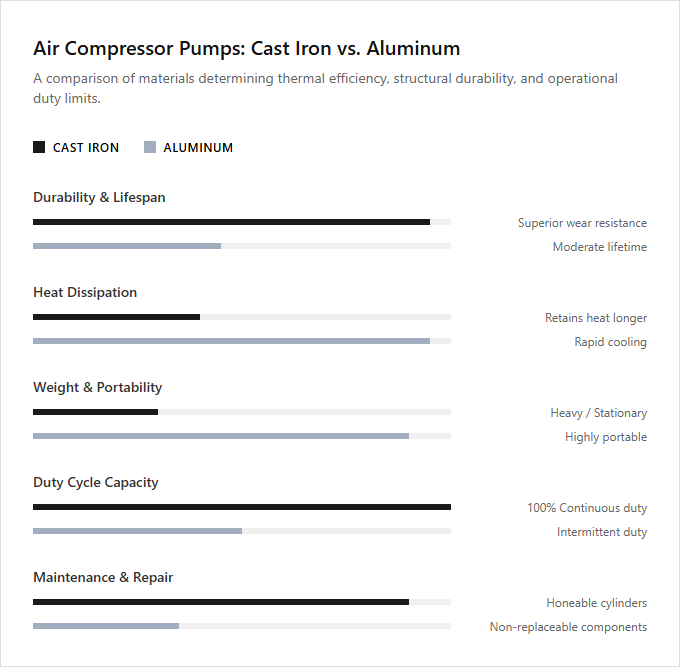
| Durability and Lifespan | Cast iron pumps offer superior wear resistance and high tensile strength compared to aluminum, significantly extending the operating lifespan of the air compressor under harsh conditions. |
| Heat Dissipation | Aluminum pumps possess significantly higher thermal conductivity than cast iron, allowing them to dissipate heat rapidly and run cooler during short-duration tasks. |
| Weight and Portability | The lower material density of aluminum reduces the overall weight of the pump, drastically improving the portability and power-to-weight ratio of the air compressor. |
| Duty Cycle Capacity | Cast iron pumps are engineered for continuous operation and a 100% duty cycle, whereas aluminum pumps are typically rated for intermittent duty cycles due to quicker thermal expansion. |
| Maintenance and Repair | While cast iron cylinders can be honed during overhaul, aluminum pumps often feature non-replaceable cylinders, making them more prone to total pump replacement after cylinder scoring. |
Thermal conductivity and heat dissipation rates under continuous load
When evaluating air compressor pumps, thermal conductivity and heat dissipation rates are critical factors under continuous load. Aluminum pumps possess high thermal conductivity, allowing them to dissipate heat rapidly into the surrounding air during operation. While this quick heat transfer keeps the system cool during intermittent use, aluminum's lower thermal mass means it can struggle to maintain stability under prolonged, uninterrupted workloads.
In contrast, cast iron pumps exhibit lower thermal conductivity but offer exceptional thermal mass. They absorb and retain heat gradually, preventing rapid temperature spikes and maintaining structural integrity during heavy-duty cycles. Aluminum models are best suited for DIY enthusiasts and mobile contractors requiring lightweight portability, while durable cast iron pumps are ideal for industrial shops and professionals demanding continuous, high-volume operation.
Coefficient of thermal expansion and dimensional stability of cylinder bores
Cast iron air compressor pumps offer superior dimensional stability due to a low coefficient of thermal expansion. Under high-heat, continuous-duty cycles, the cast iron cylinder bores resist distortion, maintaining tight tolerances and optimal compression efficiency. This excellent thermal resistance minimizes component wear and significantly extends the operational lifespan of the equipment under demanding conditions.
Aluminum pumps feature a higher coefficient of thermal expansion, meaning the cylinder bores expand more under thermal load, which can affect tolerance consistency during prolonged operation. This rapid heat transfer allows for faster cooling cycles, and the lightweight nature of the metal greatly enhances overall portability. Cast iron models suit industrial professionals requiring continuous, heavy-duty stationary power, while aluminum models are ideal for mobile contractors and DIY users prioritizing portability and intermittent use.
Vibration dampening capacity and mechanical fatigue limits of the crankcase
Cast iron crankcases offer superior mass and density, providing exceptional vibration dampening capacity that minimizes harmonic transfer and extends the life of internal components. This material possesses a high mechanical fatigue limit, allowing it to withstand continuous, high-pressure duty cycles without structural degradation.
In contrast, aluminum pumps are lighter and dissipate heat rapidly, but they exhibit lower vibration absorption and a defined fatigue limit, meaning sustained stress over time can lead to structural wear.
The structural integrity of cast iron makes it ideal for stationary, industrial applications where longevity under constant use is critical. Industrial operators requiring continuous-duty power benefit most from heavy-duty cast iron pumps, while mobile contractors and DIY enthusiasts are better served by lightweight aluminum models.
Ultimate tensile strength and wear resistance against piston ring friction
When selecting an air compressor, the pump material significantly influences overall durability and performance. Cast iron pumps deliver superior ultimate tensile strength, allowing them to withstand high operating pressures and structural stress without deforming. Furthermore, cast iron provides exceptional wear resistance against continuous piston ring friction, as its porous structure naturally retains lubricating oil to minimize abrasive wear. In contrast, aluminum pumps possess lower tensile strength and are more susceptible to friction-related wear over time, though they excel in rapid heat dissipation and weight reduction.
Lightweight aluminum models are ideal for DIY enthusiasts and mobile contractors who prioritize portability and intermittent tool use, while heavy-duty cast iron compressors are best suited for industrial workshops and automotive professionals requiring continuous, high-demand operation.
Continuous duty cycle rating versus intermittent duty limitations
Cast iron air compressor pumps are engineered for demanding applications requiring a continuous duty cycle. The thermal stability and structural density of cast iron allow these pumps to dissipate heat efficiently, enabling them to run constantly under heavy loads without overheating or experiencing premature wear.
In contrast, aluminum pumps operate with intermittent duty limitations, typically requiring a fifty-percent duty cycle to prevent thermal stress. While aluminum transfers heat quickly, it lacks the mass to sustain prolonged operation under continuous pressure. Heavy-duty industrial operators requiring uninterrupted airflow benefit from cast iron systems, while DIY enthusiasts and mobile contractors prioritizing portability and occasional use are better served by lightweight aluminum models.
Operating temperature thresholds and thermal mass capacity
Cast iron air compressor pumps possess high thermal mass capacity, allowing them to absorb and dissipate heat gradually during prolonged operations. This significant thermal inertia keeps operating temperatures stable under heavy workloads, preventing rapid thermal expansion and reducing wear on internal components during continuous, high-demand cycles.
Aluminum pumps feature lower thermal mass but offer rapid heat transfer due to the metal's high thermal conductivity. While they reach their maximum operating temperature thresholds more quickly than cast iron, they cool down rapidly during intermittent duty cycles, maintaining system efficiency without requiring heavy structural support.
Industrial operators requiring continuous, heavy-duty performance benefit from cast iron pumps, while mobile contractors and DIY enthusiasts needing lightweight, intermittent-use tools are ideal candidates for aluminum models.
Weight-to-horsepower ratio and structural rigidity under high pressure
Aluminum air compressor pumps offer an exceptional weight-to-horsepower ratio, making them highly portable and efficient for rapid thermal dissipation. Their lightweight construction minimizes the physical footprint of the tool, though they offer less resistance to extreme mechanical stress over extended operating periods.
Cast iron pumps provide superior structural rigidity under high operating pressures. This dense material effectively dampens vibration, resists cylinder deformation, and maintains tight internal tolerances during demanding, continuous-duty cycles.
Aluminum models are ideal for mobile contractors and DIY enthusiasts who prioritize portability for light-duty tasks, while robust cast iron units are best suited for stationary automotive shops and industrial operators requiring relentless, high-pressure performance.
Leave a comment