
Woodworkers and shop managers often face a frustrating reality: despite running high-capacity air filtration systems, fine nuisance dust continues to settle on surfaces and linger in the breathing zone. When addressing this chronic issue, operators typically look to allocate capital from standard shop improvement budgets or equipment replacement funds to acquire larger units.
However, optimizing the relationship between CFM and static pressure capacity grants workshop owners true particulate control and long-term respiratory safety. The critical stipulation is that high nominal airflow means little if the fan blower cannot overcome the resistance of dense media, such as 1-micron pleated inner filters or rigid HEPA cartridges.
This article will examine the mechanical interplay between airflow volume and static resistance, detail how pressure capacity maintains system velocity, and outline the key engineering specifications required to select an efficient workshop air cleaner.
| Factor | Summary |
|---|---|
| CFM Rating | This rating measures the volumetric flow rate of air moving through the system, indicating the overall volume of air the intake fan can cycle per minute under zero-resistance conditions. |
| Static Pressure Capacity | This capacity represents the maximum resistance, measured in inches of water column, that the blower can overcome to force air through restrictive ductwork and filtration media. |
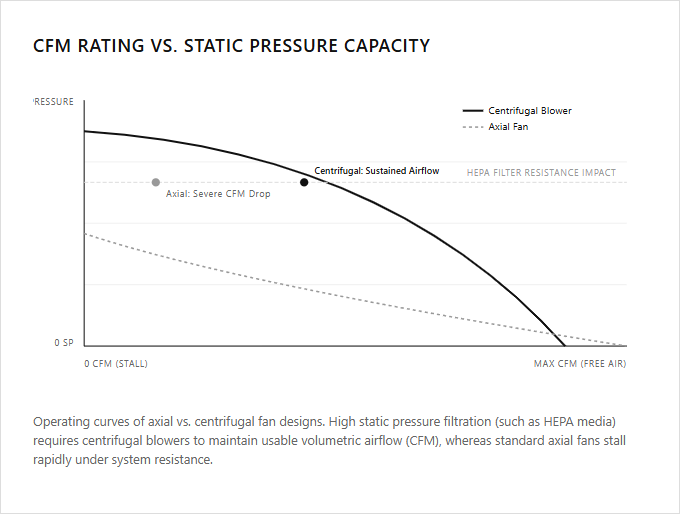
| Filter Resistance impact | High-efficiency particulate air (HEPA) filters create significant static pressure, meaning a fan with high CFM but low static pressure capacity will experience a severe drop in actual airflow velocity. |
| Fan Curve Performance | The fan curve defines the operational relationship between CFM and static pressure, illustrating how the air cleaner's volumetric efficiency decreases as system resistance rises. |
| Impeller Design Selection | Centrifugal blowers are utilized for high static pressure requirements to maintain constant airflow, whereas axial fans offer superior raw CFM but stall easily when encountering resistance from loaded dust collectors. |
Fan Curves: Airflow vs. System Resistance
When selecting a workshop air cleaner, understanding the relationship between the Cubic Feet per Minute (CFM) rating and static pressure capacity is critical. Fan performance curves illustrate an inherent inverse relationship: as system resistance from ductwork or clogged filters increases, the volumetric airflow rate decreases. High CFM ratings represent maximum airflow under zero-resistance conditions, whereas high static pressure capacity indicates the fan's ability to maintain airflow through restrictive filtration media.
Matching the tool to the environment ensures optimal air filtration and workshop safety. High-CFM units are ideal for hobbyist woodworkers needing rapid air turnover in open-layout spaces, while high-static-pressure systems are essential for commercial fabricators utilizing dense HEPA filtration or complex duct networks.
High-Efficiency Filters Cause Significant Pressure Drop
When selecting a workshop air cleaner, balancing Cubic Feet per Minute (CFM) with static pressure capacity is critical. High-efficiency media such as MERV 15 or HEPA filters offer superior particle capture but introduce a substantial initial pressure drop. If the fan motor lacks sufficient static pressure capacity to overcome this resistance, the actual airflow will decline drastically, rendering the filtration system ineffective.
Choosing the correct configuration depends heavily on the specific workshop environment. High-CFM units with lower static resistance are suited for general woodworkers requiring rapid ambient air turnover, while high-static-pressure systems are necessary for specialized technicians and laboratory operators working with hazardous, ultra-fine particulates that require strict HEPA filtration.
Filter Loading Causes Exponential Pressure Rise
When selecting an industrial air cleaner, understanding the relationship between Cubic Feet per Minute (CFM) and static pressure capacity is critical. While a high initial CFM rating indicates rapid air exchange in a clean environment, particulate loading on the filter element exponentially increases total external static pressure over time. As dust and debris accumulate within the filter media, resistance rises sharply, which can severely choke airflow if the motor and blower lack sufficient static pressure capability.
To maintain optimal filtration efficiency, air cleaners must balance these two metrics based on the specific workshop environment. High-CFM systems suit general hobbyists seeking rapid ambient air turnover in low-dust environments, while high-static pressure systems are designed for professional woodworkers and fabricators who generate high volumes of fine dust and require dedicated source extraction.
Squirrel Cage vs. Backward-Inclined Blowers Under High Pressure
When selecting an air cleaner, evaluating the CFM rating alongside static pressure capacity is critical. While a fan might boast high free-air CFM, its performance shifts under the resistance of HEPA or dense carbon filters. This resistance, or static pressure, restricts airflow and demands a blower design that can maintain velocity under load.
Squirrel cage centrifugal blowers deliver impressive volume in low-resistance environments, yet they lose CFM rapidly as static pressure rises. In contrast, backward-inclined motorized impellers are engineered to overcome resistance, maintaining consistent airflow even as filters accumulate debris. Standard squirrel cage systems are ideal for hobbyists requiring general ambient filtration in open shops, whereas backward-inclined impellers suit professionals managing heavy dust extraction through dense containment filtration.
Calculating Operating CFM Using Fan and System Curves
When selecting a workshop air cleaner, understanding the distinction between the nominal CFM rating and static pressure capacity is critical. While a manufacturer's rated CFM represents maximum airflow under zero resistance, real-world performance is dictated by the system's resistance. Calculating the actual operating CFM requires intersecting the fan's performance curve with the unique system curve of the workshop enclosure, which accounts for filter resistance, ductwork, and intake restrictions.
Operating at this specific intersection point ensures the ventilation system maintains the target air changes per hour necessary to capture fine particulate matter. High-CFM units with lower static pressure are suited for hobbyists seeking rapid ambient air turnover in open spaces, whereas high static pressure units are required for professionals employing dense HEPA filtration or ducted source-capture networks.
Maintaining ACH: Sustaining CFM Against Filter Resistance
In workshop air filtration, selecting the right air cleaner requires balancing the raw Cubic Feet per Minute (CFM) rating with static pressure capacity. While CFM indicates the volume of air moved under ideal conditions, static pressure capacity determines the unit's ability to push air through restrictive filters. Maintaining the target Air Changes per Hour (ACH) depends entirely on sustaining this CFM as filters accumulate dust and reach maximum resistance.
A standard high-CFM unit maintains rapid turnover in unobstructed environments, whereas a high static pressure capacity system overcomes resistance from dense HEPA filters. High-CFM ambient units are best suited for hobbyists seeking general dust reduction in open workspaces, while high-static-pressure systems are essential for commercial fabricators requiring continuous, heavy-duty filtration through fine-particulate media.
Low Static Pressure Reduces Workshop Capture Velocity
When selecting a workshop air cleaner, understanding the relationship between CFM (Cubic Feet per Minute) rating and static pressure capacity is vital for maintaining a safe environment. While CFM indicates the volume of air a unit can move in free space, static pressure capacity determines the blower's ability to overcome resistance from filters and ductwork. Insufficient static pressure capacity leads to a critical drop in capture velocity at the workshop air intake, allowing hazardous fine dust to bypass the hood and remain suspended in your breathing zone.
Matching the machine's capabilities to your specific workspace layout ensures optimal dust collection. Standard high-CFM, low-static-pressure ambient units are ideal for hobbyists seeking general air turnover in small, open garages, while high-static-pressure systems are necessary for professional woodworkers utilizing dedicated, multi-branch duct networks.
Leave a comment