
Professional drywall contractors constantly battle the physical toll of high-volume overhead fastening, where choosing between raw driving power and lightweight maneuverability directly impacts daily square-footage output. Traditionally, fleet managers rely on standard tool procurement budgets to fund uniform, high-voltage equipment. However, strategic selection between battery platforms yields a massive operational dividend, maximizing ergonomics without sacrificing fastening speed.
To manage expectations, we must establish the stipulation that higher voltage does not automatically guarantee superior installation quality; optimal deployment depends on balancing torque requirements with installer fatigue. Leading-edge tools like the Milwaukee M18 FUEL and the ultra-compact DeWalt 12V MAX demonstrate how different voltage classes serve distinct jobsite demands.
This comparative analysis evaluates the runtime, weight distribution, and overall productivity of 18-volt versus 12-volt cordless drywall screw guns, providing a clear decision-making framework to optimize your next tool investment.
| Factor | Summary |
|---|---|
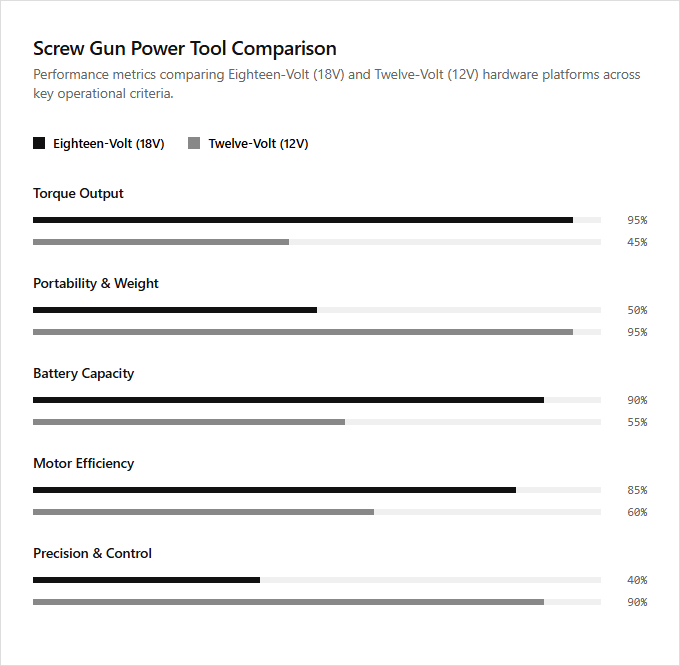
| Torque Output | Eighteen-volt screw guns deliver significantly higher torque, measured in Newton-meters (Nm), making them superior for driving fasteners into dense structural materials. |
| Form Factor and Weight | Twelve-volt models utilize compact lithium-ion cell configurations, resulting in a lighter chassis that minimizes user fatigue during overhead fastening tasks. |
| Battery Capacity | Eighteen-volt platforms typically feature higher Ampere-hour (Ah) ratings, providing extended duty cycles and runtime under heavy workloads. |
| Motor Efficiency | Modern eighteen-volt screw guns frequently employ brushless DC motors to maximize energy transfer and extend tool longevity. |
| Application Suitability | Twelve-volt screw guns are ideal for precision driving in cabinetry due to their lower rotational speed and sensitive clutch settings. |
RPM Impact on Fastening Speed: Steel vs. Wood
When selecting a screw gun, voltage dictates the no-load speed (RPM), directly affecting fastening velocity across different materials. Eighteen-volt models typically deliver high RPMs, often exceeding 4,000, providing the momentum necessary to rapidly drive self-tapping screws through dense, heavy-gauge steel studs. In contrast, twelve-volt screw guns operate at lower RPMs, offering the precise control and adequate torque required for fastening into wood studs without stripping the material.
These RPM variances dictate efficiency under load, as high-voltage units maintain speed through dense metal whereas compact twelve-volt systems excel in lighter framing tasks. Commercial contractors tackling high-volume steel installations require the power of the eighteen-volt tool, while residential installers and finish carpenters prioritizing ergonomics on wood-framed projects are best served by the twelve-volt model.
Battery Capacity and Runtime for Sheet Installation
When selecting a screw gun for high-volume sheet installation, battery capacity and energy output dictate productivity. An eighteen-volt (18V) system paired with a 5.0 Amp-Hour (Ah) battery yields 90 Watt-hours (Wh) of energy, providing the sustained runtime necessary for continuous fastening. A twelve-volt (12V) platform using a 4.0 Ah battery delivers 48 Wh, reducing tool weight but requiring more frequent charging cycles during demanding boarding tasks.
The higher Watt-hour rating of 18V tools ensures the thermal efficiency and endurance required for rapid, large-scale drywall hanging. Commercial drywall contractors requiring maximum daily output find the eighteen-volt system indispensable, while residential remodelers and finish carpenters prefer the lightweight maneuverability of the twelve-volt model for overhead or tight-space installations.
Optimizing Power-to-Weight to Reduce Overhead Installation Fatigue
Overhead drywall and ceiling installations require a careful balance between tool performance and physical endurance. While eighteen-volt screw guns deliver superior torque and faster driving speeds, their heavier battery packs significantly increase muscle fatigue during prolonged overhead work. Conversely, twelve-volt models offer an optimized power-to-weight ratio, providing sufficient muscle for standard drywall fasteners while drastically reducing the load on the operator's shoulder and wrist joints.
Selecting the appropriate voltage platform depends on the specific demands of the job site and the physical tolerance of the installer. High-capacity eighteen-volt units are best suited for commercial contractors tackling dense materials and high-volume projects, whereas lightweight twelve-volt screw guns are ideal for residential remodelers and installers who prioritize ergonomic comfort during repetitive overhead tasks.
Brushless Motor efficiency and electronic speed control under continuous load.
When selecting between eighteen-volt and twelve-volt screw guns, the integration of brushless motor technology is a critical differentiator. Brushless motors optimize energy draw by adjusting power output based on resistance, reducing friction and heat buildup. Under continuous load, both platforms utilize sophisticated electronic feedback loops to maintain consistent rotational speed. The eighteen-volt system possesses greater thermal capacity and overhead, allowing its electronic speed control to sustain high torque without degradation during prolonged applications.
In contrast, twelve-volt brushless screw guns prioritize efficiency within a compact footprint. Their electronic control systems manage power delivery to maximize battery runtime, though they face physical limitations under extreme, non-stop workloads. Professionals undertaking heavy-duty framing or drywall installations require the relentless stamina of the eighteen-volt platform, whereas cabinet installers and technicians benefit from the lightweight, agile precision of the twelve-volt alternative.
Collated Screw Attachment torque compatibility and feeding reliability.
Eighteen-volt screw guns provide the robust torque necessary for seamless integration with heavy-duty collated screw attachments. This high voltage ensures consistent drive depth through dense materials without stalling the motor. Twelve-volt systems offer lower torque, which can struggle under the mechanical resistance of auto-feed attachments, occasionally leading to incomplete drives.
Feeding reliability also differs significantly between the two platforms. The sustained power of an 18V battery maintains a high, steady RPM, facilitating smooth, continuous cycling of the collated strip. While 12V models are highly maneuverable, they may experience occasional feed hesitations during rapid, repetitive tasks. High-volume drywall contractors requiring maximum speed and reliability benefit most from the 18V platform, whereas light-duty remodelers prioritizing ergonomics will find the compact 12V system ideal.
Depth-Sensitive Nosecone Clutch Precision Across Voltages
The depth-sensitive nosecone clutch is critical for achieving flush, damage-free screw seating in drywall and framing applications. In eighteen-volt screw guns, the higher voltage provides robust torque and sustained motor speed, ensuring the clutch disengages with high repeat accuracy even when driving fasteners into dense materials. This platform excels in high-volume environments where maintaining depth consistency under heavy loads is paramount.
Twelve-volt screw guns utilize the same precise depth-sensitive mechanics but operate within a more manageable power band. The lower voltage reduces overall tool weight and enhances user control, which prevents over-driving in delicate substrates while still maintaining reliable, repetitive depth precision.
Commercial drywall contractors requiring rapid, high-production output benefit most from the powerful eighteen-volt platform, while residential finish carpenters and installers prioritizing overhead ergonomics and precise control find the compact twelve-volt system ideal.
Commercial Thermal and Duty Cycle Limits
In high-demand commercial environments, the choice between 18-volt and 12-volt screw guns depends heavily on thermal management. Eighteen-volt models feature robust motors and larger heat sinks designed for continuous duty cycles, allowing them to drive fasteners repeatedly without triggering thermal overload protection. In contrast, twelve-volt systems possess smaller motors with limited heat dissipation. During prolonged operations, these compact tools experience rapid heat buildup, forcing the internal thermal sensors to shut down the tool to prevent permanent damage.
While 18-volt units excel in heavy-duty drywalling, 12-volt units are optimized for intermittent tasks in tight spaces. High-volume commercial contractors requiring uninterrupted production benefit most from the endurance of 18-volt systems, whereas service technicians or finish carpenters prioritizing maneuverability over high duty cycles find 12-volt models ideal.
Leave a comment