
For automotive technicians and industrial fabricators, accessing cramped engine bays or chassis brackets while managing stubborn, high-torque fasteners presents a constant operational bottleneck. Traditionally, professionals have relied on manual socket wrenches or standard shop-wide pneumatic lines to bridge the gap between human limitation and mechanical necessity.
However, selecting the correct powered ratchet grants more than just raw speed; it delivers a critical advantage in daily workshop throughput and ergonomic safety. While we must stipulate that manufacturer torque ratings do not always translate to real-world breakaway force under sustained load, the distinction remains vital. For instance, in heavy-duty suspension assembly, the choice between a cordless tool's mobility and an air tool's relentless duty cycle is immediately apparent.
This article provides a comprehensive evaluation of cordless versus pneumatic ratchets, analyzing key performance metrics, power-to-weight ratios, and long-term utility to help you select the optimal tool for high-torque fastening.
| Factor | Summary |
|---|---|
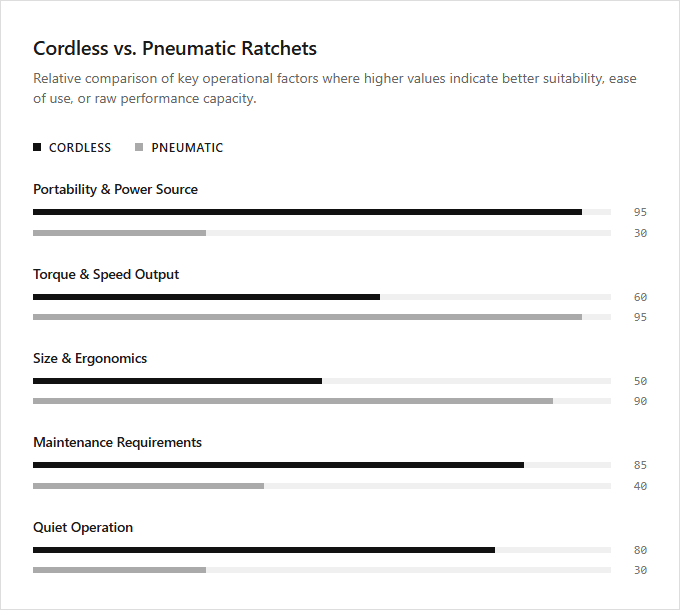
| Power Source & Portability | Cordless ratchets utilize rechargeable lithium-ion batteries for maximum jobsite portability, whereas pneumatic ratchets require a continuous connection to an air compressor. |
| Torque & Speed Output | Pneumatic ratchets generally deliver higher sustained working torque and revolutions per minute (RPM) compared to battery-powered alternatives. |
| Size & Ergonomics | Pneumatic models feature a more compact head design and lower tool weight because they lack the bulky brushless motor and battery pack of cordless units. |
| Maintenance Requirements | Pneumatic tools require daily pneumatic tool oiling to prevent internal corrosion, whereas cordless ratchets need minimal mechanical maintenance but require battery lifecycle management. |
| Noise Level | Pneumatic ratchets produce significant decibel levels from compressed air exhaust, while cordless electric models operate much quieter using enclosed planetary gear systems. |
Torque-to-weight ratio advantages in pneumatic models
When selecting a power ratchet, evaluating the torque-to-weight ratio is essential for optimizing workshop efficiency. Pneumatic ratchets hold a distinct advantage in this category; because they rely on external air compressors rather than heavy onboard batteries, they deliver high torque output within an exceptionally lightweight, streamlined chassis. This favorable ratio minimizes operator fatigue during overhead or repetitive tasks and allows the tool to fit into highly restricted engine bays where bulkier electric models cannot maneuver.
Cordless ratchets, by contrast, integrate the motor and battery into the handle, which increases overall weight but eliminates the restriction of air hoses. Pneumatic ratchets are best suited for high-volume automotive technicians in established garages with existing air infrastructure, whereas cordless models are ideal for mobile service mechanics and DIY enthusiasts who prioritize portability and convenience.
Brushless motor integration and electronic torque control in cordless models
In modern automotive and industrial maintenance, the choice between cordless and pneumatic ratchet wrenches depends on specific operational requirements. Cordless ratchets have evolved significantly through the integration of brushless motors, which eliminate carbon brushes to reduce internal friction and maximize runtime. Furthermore, advanced electronic torque control systems allow operators to program precise fastening limits, preventing over-tightening and protecting delicate threads without manual clutches.
Pneumatic ratchets rely on a constant air supply to deliver high, sustained speed in a lightweight chassis, though they lack the smart power management of battery-operated alternatives. Pneumatic ratchets are best suited for stationary workshop mechanics with dedicated air compressors, whereas cordless models are ideal for mobile technicians requiring precise, highly portable fastening power.
Battery Ah vs. Pneumatic SCFM Limits
Cordless electric ratchets offer unmatched portability, powered by rechargeable lithium-ion batteries. Their performance is governed by Amp-hour (Ah) capacity, which directly dictates runtime. Higher Ah batteries provide extended operation under heavy load but add physical weight, making balance a key consideration during prolonged overhead assembly tasks.
Pneumatic ratchets rely on a continuous supply of compressed air, measured in Standard Cubic Feet per Minute (SCFM). While they offer a superior power-to-weight ratio and unlimited runtime, they are tethered to an air compressor and require high SCFM ratings to prevent tool stall under load. Mobile mechanics and roadside assistance professionals benefit most from cordless convenience, whereas high-volume automotive technicians in dedicated service bays thrive with pneumatic systems.
Reaction torque transference to the operator's wrist under high load
Under high-load applications, the key distinction between cordless and pneumatic ratchets lies in how they manage reaction torque. Pneumatic ratchets utilize raw air pressure, delivering immediate, high-speed power. When a fastener bottoms out, the kinetic energy transfers abruptly to the operator's wrist, requiring significant physical resistance to prevent twisting injuries during heavy-duty fastening tasks.
Cordless electric ratchets employ internal electronic clutches and overload protection systems. These safety features modulate power delivery and stall the motor gradually, significantly dampening the rotational force transferred to the user's arm. Heavy-duty pneumatic ratchets are best suited for stationary industrial mechanics who prioritize raw speed, while cordless models are ideal for mobile service technicians who value portability and ergonomic torque management.
RPM Under Maximum Fastening Load
When comparing cordless and pneumatic ratchet wrenches, free speed capacity under maximum fastening load is a critical performance differentiator. Pneumatic ratchets consistently deliver superior velocity, often reaching 150 to 300 RPM. This speed remains relatively stable under load due to the continuous supply of compressed air, allowing for highly efficient fastening.
Conversely, cordless ratchets generally operate at slightly lower free speeds, typically ranging from 150 to 250 RPM. Under maximum fastening loads, battery-powered motors experience a more pronounced drop in rotational speed compared to air-powered alternatives. Pneumatic models are ideal for stationary workshop mechanics requiring rapid, high-volume assembly, while cordless units best serve mobile technicians who prioritize portability and convenience over maximum rotational speed.
Planetary gear reduction mechanisms handling high-torque stress
In both cordless and pneumatic ratchet wrenches, the planetary gear reduction mechanism is critical for managing intense torque stress. This system distributes the rotational load across multiple planet gears, minimizing wear and preventing tooth shear during heavy fastening tasks. Pneumatic models utilize continuous air pressure to drive these gears, maintaining cool operating temperatures under sustained loads. Cordless variants rely on robust, hardened-steel planetary assemblies paired with brushless motors to manage sudden torque spikes and electronic brake resistance.
The choice between these systems depends heavily on your operating environment. Pneumatic ratchets are highly suitable for stationary automotive technicians with access to dedicated air compressors, while cordless ratchets are ideal for mobile service operators requiring maximum portability and rapid deployment.
Variable speed trigger modulation for precise torque application
When choosing between cordless and pneumatic ratchet wrenches, the responsiveness of the variable speed trigger is a critical factor for precise torque application. Cordless electric ratchets utilize sensitive electronic switches to modulate power. This design allows operators to gently feather the trigger, delivering incremental speed to prevent over-tightening or stripping delicate threads during assembly.
Pneumatic ratchets rely on mechanical air-flow valves for speed modulation. The immediate surge of compressed air demands a skilled hand to maintain control, though it offers unparalleled tactile feedback for rapid fastening. Cordless models are ideal for mobile diagnostic technicians prioritizing delicate control and portability, whereas pneumatic ratchets best suit stationary shop mechanics who require relentless speed and have a dedicated workshop air supply.
Leave a comment