
Industrial blasting operators constantly struggle with the suffocating dust plumes that compromise worksite safety, degrade visibility, and trigger stringent regulatory penalties. Traditionally, businesses attempt to mitigate this by allocating capital budgets toward complex containment shrouds and heavy-duty ventilation systems-costly investments that fail to address the dust at its source.
Fortunately, transitioning to wet abrasive blasting grants operations an immediate, cost-effective path to dust-free compliance. However, this success is contingent on a critical stipulation: water volume must be precisely metered to prevent media dampening and subsequent flash rust. Industry-standard solutions, such as Clemco's Water Injection Nozzles (WIN) and multi-port Halo Rings, have emerged as the leading technologies to achieve this delicate balance.
This article provides a comparative analysis of Water Injection Nozzles versus Halo Rings, evaluating their dust suppression capabilities, media consumption efficiency, and ease of integration to help you select the optimal tool for your surface preparation workflow.
| Factor | Summary |
|---|---|
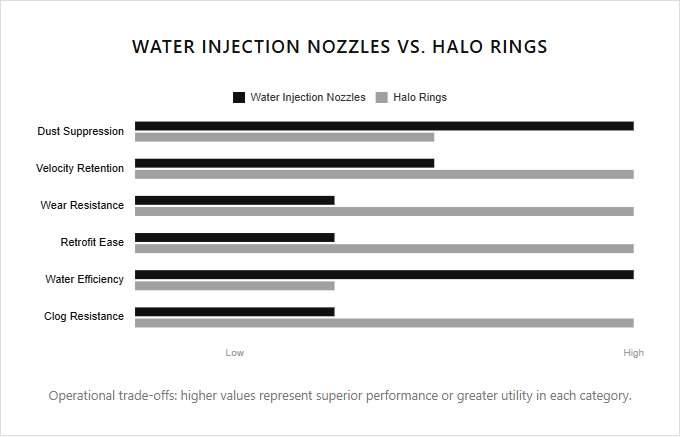
| Dust Suppression | Water Injection Nozzles provide superior dust suppression through internal hydro-coalescence, whereas Halo Rings create an external water curtain that is less effective at capturing fine particulates. |
| Abrasive Velocity | Halo Rings maintain higher particle velocity because they do not introduce fluid drag inside the nozzle, unlike Water Injection Nozzles which alter the internal kinetic energy transfer. |
| Nozzle Wear | Water Injection Nozzles suffer from accelerated frictional erosion inside the bore, while Halo Rings experience negligible internal wear since water is introduced post-orifice. |
| Retrofitting | Halo Rings offer universal compatibility with standard blasting setups via modular coupling, whereas Water Injection Nozzles require specialized, integrated nozzle holders. |
| Water Consumption | Water Injection Nozzles utilize precise hydro-dynamic metering to minimize water usage, while Halo Rings generally demand higher volumetric flow rates to maintain the external barrier. |
| Media Clogging | Halo Rings eliminate the risk of damp media blowback and subsequent nozzle clogging because they prevent moisture from backflowing into the blast hose assembly. |
Internal abrasive encapsulation versus external boundary layer impingement
Water injection nozzles utilize internal abrasive encapsulation, mixing water directly with the blast media inside the nozzle body before discharge. This method ensures that every abrasive particle is thoroughly wetted, delivering highly efficient dust suppression and a consolidated impact pattern upon the target surface.
In contrast, halo rings employ external boundary layer impingement by projecting a pressurized water curtain around the dry abrasive stream at the nozzle exit. This configuration dampens dust as it disperses outward, preserving the high velocity of a dry blast while mitigating airborne particulates.
Water injection nozzles are ideal for industrial operators requiring maximum dust suppression in confined spaces, whereas halo rings suit mobile contractors seeking adaptable, retrofitted dust control for standard dry-blasting setups.
Venturi-driven atomization versus low-pressure droplet barrier creation
Water injection nozzles utilize Venturi-driven atomization, introducing water directly into the high-velocity air and abrasive stream inside the nozzle chamber. This internal pressure differential finely atomizes the water, ensuring complete encapsulation of the blast media to maximize dust suppression immediately upon surface impact.
Halo rings establish a low-pressure droplet barrier around the nozzle exterior. This design creates a dense water curtain that intercepts escaping dust without interfering with the internal blast stream, thereby preserving maximum kinetic energy and abrasive velocity. Water injection nozzles are ideal for operators prioritizing maximum dust containment in confined spaces, while halo rings suit high-production specialists requiring uncompromised blasting speed in open areas.
Optimized water consumption rate versus high volumetric flow requirements
Water injection nozzles introduce water directly into the abrasive stream at the nozzle head, optimizing the water consumption rate by mixing the liquid and media internally. This precise delivery method achieves highly efficient dust suppression while keeping site runoff and clean-up requirements to an absolute minimum.
Halo rings project a circular water curtain around the blast stream, demanding a much higher volumetric flow rate to envelop the dust pattern. This configuration creates an external barrier that is effective for heavy-duty applications but results in significant slurry accumulation.
Water injection systems are ideal for mobile contractors requiring resource-efficient operation on sensitive urban jobsites, whereas halo rings are best suited for high-production industrial operators with access to unlimited water and robust containment drainage.
Accelerated nozzle bore erosion versus zero-wear external fluid delivery
Water injection nozzles suppress dust by introducing water directly into the abrasive stream inside the nozzle chamber. While this internal mixing provides highly efficient dust encapsulation, the resulting turbulent slurry significantly accelerates nozzle bore erosion, leading to rapid deterioration of the nozzle's internal geometry and more frequent replacement cycles.
In contrast, halo rings utilize an external manifold to project a water shroud around the abrasive stream after it exits the nozzle. This external fluid delivery method ensures zero-wear operation, preserving the integrity of the nozzle bore and maintaining consistent blasting pressure over extended periods of heavy use.
Water injection nozzles are best suited for operators requiring maximum maneuverability in confined spaces, while halo rings are ideal for high-volume industrial contractors prioritizing extended component lifespan and minimal maintenance downtime.
Abrasive kinetic energy retention versus external droplet drag deceleration
Water injection nozzles introduce moisture directly into the blast stream before exit, preserving the abrasive's kinetic energy. Because the water and media accelerate simultaneously through the nozzle bore, there is minimal droplet drag to decelerate the particles, which maintains maximum impact velocity on the target substrate.
Halo rings deploy an external water curtain around the nozzle exit, intercepting the abrasive stream post-acceleration. This external intersection introduces droplet drag that decelerates the media prior to impact, though it provides excellent dust containment. Water injection systems are ideal for industrial contractors requiring rapid, heavy-duty coating removal, whereas halo rings best suit historical restoration specialists operating in strict, dust-sensitive urban environments.
High hydrostatic backpressure pump requirements versus low-pressure mains water operation
Water injection nozzles suppress dust by mixing water directly into the high-velocity abrasive stream within the nozzle. This internal mixing creates significant hydrostatic backpressure, requiring a specialized high-pressure pump to overcome the blast pressure. In contrast, water halo rings introduce water at the nozzle exit, creating a surrounding mist jacket. This external design relies on the Venturi effect, allowing the system to operate efficiently using standard, low-pressure mains water.
The choice between these configurations dictates the support equipment required on-site. High-pressure injection delivers highly efficient dust suppression at the cost of increased mechanical complexity, whereas halo rings prioritize simplicity and rapid deployment. Water injection nozzles suit industrial contractors performing heavy-duty, confined-space blasting, while halo rings are ideal for mobile operators seeking rapid setup and minimal equipment footprints.
Proprietary thread coupling configurations versus universal collar mounting compatibility
In wet abrasive blasting, the choice between water injection nozzles and halo rings hinges on their mounting architecture. Water injection nozzles utilize proprietary thread coupling configurations designed specifically for seamless integration with matching blast gun models. This specialized engineering ensures a leak-free, high-pressure seal and optimal water-to-abrasive mixing, though it limits accessory interchangeability across different brands.
Conversely, dust-suppression halo rings employ universal collar mounting compatibility. This design allows the ring to clamp externally onto almost any standard nozzle holder, providing excellent fleet adaptability and quick installation without replacing the existing nozzle. Proprietary thread systems are ideal for specialized industrial contractors requiring dedicated, high-performance dust suppression, while universal halo rings are best suited for versatile, multi-brand operators needing cost-effective compatibility across diverse equipment fleets.
Leave a comment