
Achieving a flawless, swirl-free finish on automotive paint is a notoriously frustrating challenge, often leaving detailers caught between the risk of holograms and the inefficiency of underpowered tools. When upgrading a workshop's arsenal, professionals typically rely on standard equipment financing or shop capital budgets to secure high-end machinery.
However, selecting the correct dual-action (DA) polisher grants operators unparalleled control over paint correction speed and safety, maximizing the return on your tool investment. To achieve these results, one must stipulate that optimal performance is entirely contingent upon matching the drive mechanism to the paint's specific hardness and the operator's experience. For instance, comparing industry benchmarks like the gear-driven Rupes Mille LK 900E and the random orbital FLEX XFE 7-15 illustrates how distinct mechanical designs dictate real-world correction power.
This article will analyze the mechanical differences, safety margins, and defect-removal capabilities of both systems, helping you select the ideal polisher for your detailing business.
| Factor | Summary |
|---|---|
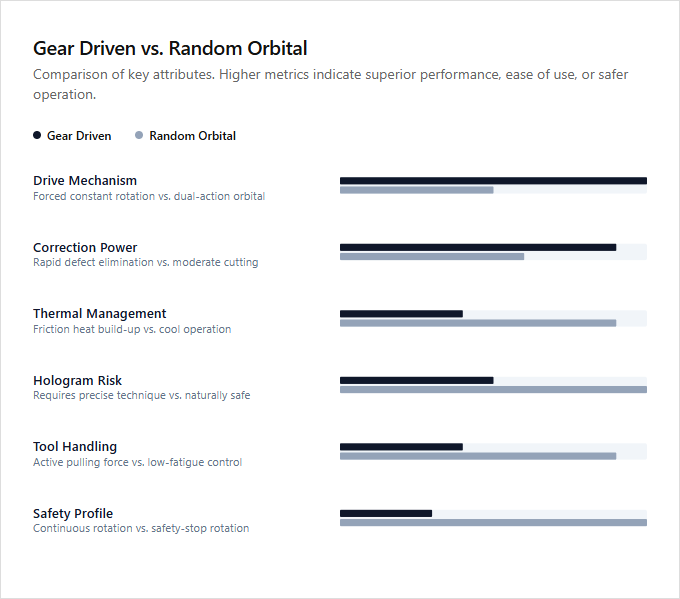
| Drive Mechanism | Gear-driven polishers utilize a forced rotation mechanism to maintain constant pad spinning, whereas random orbital polishers rely on a dual-action counterweight system that can stall under heavy pressure. |
| Correction Power | The high torque output of gear-driven machines allows for rapid elimination of deep paint defects, while random orbital machines offer a more moderate cutting capacity. |
| Thermal Management | Forced rotation in gear-driven units generates substantial friction heat at the contact point, whereas random orbital movement minimizes paint temperature build-up. |
| Hologram Risk | Random orbital polishers naturally prevent paint holograms due to their multi-directional orbital path, whereas gear-driven units require precise technique to avoid micro-marring. |
| Tool Handling | Gear-driven polishers exhibit an active pulling force that requires physical effort to guide, compared to the low-fatigue, vibration-dampened operation of random orbital tools. |
| Safety Profile | Random orbital polishers feature an inherent safety-stop mechanism when over-edged, making them highly forgiving compared to the continuous rotation of gear-driven polishers. |
Forced Rotation Eliminates Polisher Pad Stalling
Random orbital polishers rely on a free-spinning pad design that can easily stall under heavy downward pressure or when navigating complex vehicle curves. Gear-driven polishers, by comparison, utilize a forced rotation mechanism that physically locks the pad's rotation to the motor's drive. This direct mechanical connection completely eliminates pad stalling under load, ensuring continuous, highly efficient cutting action regardless of the pressure applied or the panel shape.
While random orbital units offer superior safety against paint burn-through, gear-driven machines provide the relentless torque needed for rapid defect correction. Professional detailers tackling heavy paint correction on rigid contours benefit most from the relentless drive of gear-driven models, whereas DIY enthusiasts seeking a safer, user-friendly finish typically opt for random orbital polishers.
Contour Pressure Sensitivity in Centrifugal Orbital Rotation
When selecting a dual-action polisher, the rotation mechanism determines its paint correction behavior. Standard random orbital polishers utilize a free-spinning design where orbital rotation relies on centrifugal force. This mechanism is highly sensitive to contour pressure, meaning the pad can easily stall when navigating complex vehicle curves or applying too much downward force. While this sensitivity serves as an excellent safety buffer against paint burn-through, it demands precise technique to maintain pad rotation.
Gear-driven polishers employ a forced rotation mechanism that prevents stalling regardless of surface pressure or panel curvature. This positive drive action delivers consistent cutting power and predictable movement across all body lines. Free-spinning random orbitals are best suited for hobbyists and beginners seeking a forgiving tool that prevents paint damage, whereas gear-driven units are ideal for seasoned collision repair professionals requiring rapid, heavy defect correction.
Higher Frictional Heat in Gear-Driven Systems
Selecting the right polisher requires understanding how different drive systems manage thermal energy on painted surfaces. Gear-driven polishers utilize a direct, forced rotation mechanism that maintains a constant path under load. This continuous mechanical connection generates intense friction, resulting in significantly higher heat accumulation compared to random orbital systems. Because the pad cannot stall, thermal energy builds rapidly on the work area.
In contrast, random orbital polishers employ a free-spinning pad that slows down when excessive pressure is applied, naturally dispersing heat and reducing the risk of paint burn. Random orbital polishers are ideal for enthusiasts and beginners seeking safety against paint damage, while gear-driven units are best suited for experienced professionals requiring rapid paint correction and heavy defect removal.
Large Orbits Maximize Paint Finishing Efficiency
Selecting the right paint correction tool requires understanding the mechanical differences between gear-driven and random orbital actions. While gear-driven polishers provide forced rotation to guarantee cutting power under heavy loads, modern random orbital machines utilize large orbit throws to maximize paint finishing efficiency. These larger throws cover more surface area per pass, distributing heat safely and significantly reducing the time required to achieve a flawless, hologram-free finish.
Gear-driven units excel in precision contour work where pad stalling must be prevented, whereas large-throw random orbital polishers offer unmatched safety and speed on expansive, flat panels. Professional collision repair technicians tackling severe paint defects favor the relentless, consistent torque of gear-driven tools, while detailing enthusiasts and finish specialists seeking rapid, swirl-free results on delicate paintwork prefer large-throw random orbital polishers.
Constant RPM Ensures Predictable Hard Clear Coat Correction
When selecting a paint correction machine, rotational mechanics dictate overall efficiency. Gear-driven dual-action polishers maintain a forced rotation that prevents pad stalling under pressure. This constant, regulated RPM delivers a highly predictable defect correction rate on hard clear coats by ensuring consistent friction, whereas free-spinning random orbital polishers can stall on complex body curves, leading to variable correction times.
For heavy correction on hard clear coats, the forced rotation of the gear-driven unit offers reliable efficiency, while the random orbital excels in finishing stages on sensitive paint systems. Gear-driven polishers are best suited for high-volume professionals who require consistent, rapid defect removal, whereas random orbitals are ideal for enthusiasts and detailers prioritizing safety and a hologram-free finish.
Random Orbital Paths Minimize Paint Marring
When selecting a paint correction polisher, understanding the mechanical differences between gear-driven and random orbital actions is essential for achieving professional results. Random orbital polishers employ a free-spinning, dual-action movement that combines rotation with oscillation. This distinct multi-directional path significantly minimizes the risk of micro-marring and unsightly buffer trails, as the pad constantly shifts position, preventing the concentrated heat buildup and holograms often associated with rotary machines.
In contrast, gear-driven polishers utilize a forced-rotation mechanism that delivers relentless, high-torque cutting power even under heavy downward pressure. This direct drive offers faster defect removal but demands greater technique to prevent paint damage. Gear-driven machines are highly suitable for experienced professionals tackling severe paint defects, whereas random orbital units are ideal for enthusiasts and detailers seeking a safer, user-friendly tool for flawless finishing.
Dynamic Counterbalances Control Vibration and Fatigue
When selecting between gear-driven and random orbital polishers, the engineering of the dynamic counterbalance system is a critical factor. This internal mechanism directly dictates the vibration amplitude experienced during operation. Because gear-driven polishers force a fixed, driven rotation combined with an orbit, their counterbalance systems must manage high torque, which often results in a distinct, consistent vibration pattern. Conversely, random orbital polishers rely on a free-spinning pad, allowing the counterbalance to smooth out lateral forces and significantly reduce operator fatigue during extended detailing sessions.
Managing these vibrational forces is essential for maintaining precision and preventing physical strain over long hours. Heavy-duty paint correction specialists require the unyielding, stall-free torque of gear-driven polishers, while finishing technicians and enthusiasts benefit most from the forgiving, low-fatigue operation of random orbital machines.
Leave a comment