
Achieving a flawless finish on drywall often feels like an uphill battle, especially when plagued by the constant frustration of torn paper faces or proud screw heads that ruin your joint compound application. When allocating traditional tool procurement budgets-whether drawing from standard workshop funding sources or capital equipment reserves-contractors must weigh efficiency against precision. A dedicated, depth-sensitive screw gun represents a high-yield investment, granting operators unparalleled speed and micro-adjustable depth control that eliminates manual errors.
To manage expectations, a crucial stipulation must be noted: while a standard impact driver remains a versatile utility player for general construction, it lacks the specialized nosecone required for high-volume sheetrocking. For instance, when hanging heavy-duty 5/8-inch Type X drywall, the margin for error is razor-thin.
This guide analyzes the key mechanical differences between screw guns and impact drivers, evaluates their respective performance metrics, and outlines which tool will ultimately optimize your drywall installation workflow.
| Factor | Summary |
|---|---|
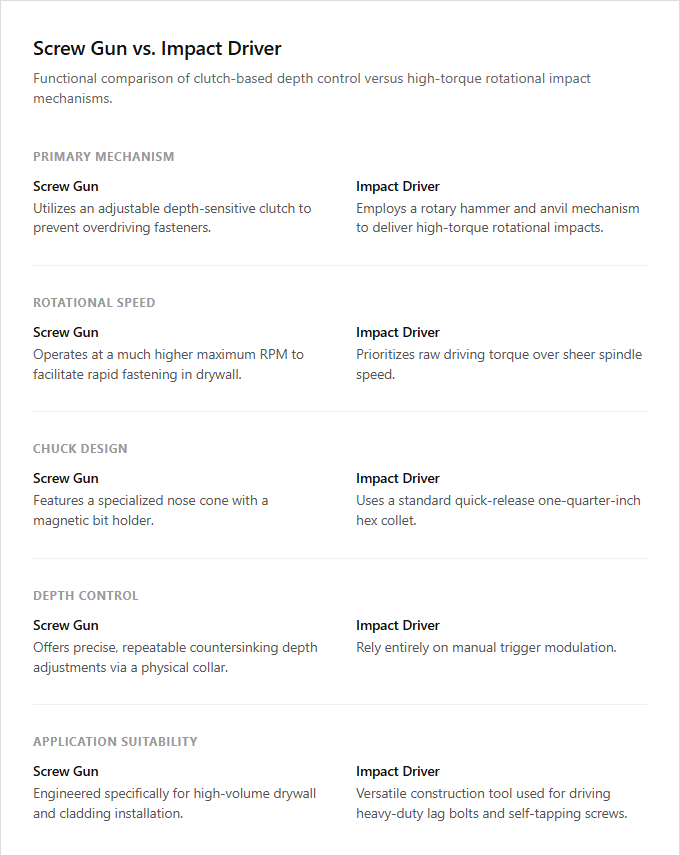
| Primary Mechanism | Screw guns utilize an adjustable depth-sensitive clutch to prevent overdriving fasteners, whereas impact drivers employ a rotary hammer and anvil mechanism to deliver high-torque rotational impacts. |
| Rotational Speed | Screw guns operate at a much higher maximum RPM to facilitate rapid fastening in drywall, while impact drivers prioritize raw driving torque over sheer spindle speed. |
| Chuck Design | Screw guns typically feature a specialized nose cone with a magnetic bit holder, whereas impact drivers use a standard quick-release one-quarter-inch hex collet. |
| Depth Control | Screw guns offer precise, repeatable countersinking depth adjustments via a physical collar, unlike impact drivers which rely entirely on manual trigger modulation. |
| Application Suitability | The screw gun is engineered specifically for high-volume drywall and cladding installation, while the impact driver is a versatile construction tool used for driving heavy-duty lag bolts and self-tapping screws. |
Depth-sensitive nosecone calibration for precise countersinking depth
While both screw guns and impact drivers drive fasteners, their mechanisms of depth control differ significantly. The screw gun features a specialized, depth-sensitive nosecone that disengages the drive clutch once the screw reaches a pre-calibrated depth. This configuration ensures perfectly flush or recessed countersinking without tearing drywall paper or damaging delicate substrates.
Impact drivers rely on rotational impacts and manual trigger modulation, which lacks the precise, repeatable depth calibration required for high-volume, uniform tasks. The screw gun's micro-adjustable collar allows operators to dial in exact depths for consistent results. Drywall installation professionals benefit from the highly specialized, repetitive precision of a screw gun, while general remodelers and deck builders require the versatile, high-torque capabilities of an impact driver.
High RPM motor specs for rapid drywall screw insertion
When installing drywall at scale, the dedicated screw gun is the preferred industry choice due to its high-RPM motor, typically operating between 4,000 and 6,000 RPM. This extreme speed enables rapid, continuous fastening, while an adjustable nosecone and silent clutch disengage the motor immediately once the screw reaches the correct depth, preventing damage to the drywall paper.
In contrast, impact drivers prioritize high rotational torque over speed, utilizing concussive force to drive larger fasteners. While highly versatile, their lower RPM range and lack of depth-setting mechanisms increase the risk of over-driving screws in delicate drywall installations.
Professional drywall contractors require the rapid, specialized precision of a high-RPM screw gun, whereas general carpenters and DIY enthusiasts are better served by the multi-purpose, high-torque capabilities of an impact driver.
Silent clutch mechanism for automatic drive disengagement
While both screw guns and impact drivers drive fasteners, their internal mechanics serve different operational purposes. A dedicated screw gun features a specialized silent clutch system engineered for high-precision, repetitive fastening. This depth-sensitive mechanism automatically disengages the drive shaft once the screw head reaches a pre-set depth, allowing the motor to keep spinning quietly without over-driving the fastener or damaging fragile materials.
An impact driver utilizes rotational force combined with rapid concussive blows to drive large fasteners into dense substrates. The screw gun's silent clutch offers a quieter, controlled operation that prevents paper tearing on drywall. Production drywall installers seeking speed and depth consistency benefit most from the specialized screw gun, while general renovators needing versatile, high-torque fastening are better suited to the impact driver.
Collated screw attachment integration for continuous auto-feed fastening
When comparing a dedicated screw gun to an impact driver, the key differentiator in high-volume applications is the integration of collated screw attachments. Dedicated screw guns seamlessly accept auto-feed mechanisms, converting the tool into a highly efficient, continuous-fastening system. This integration enables rapid, one-handed operation with precise depth-of-drive control, eliminating the need to manually load individual fasteners.
In contrast, impact drivers utilize rotational force to deliver high torque, which is ideal for heavy-duty fastening but lacks the speed and ergonomic balance required for rapid, sequential tasks. Professional drywallers and subflooring contractors benefit most from the rapid, continuous output of a collated screw gun, while general renovators and DIYers requiring versatility for diverse tasks are better suited for an impact driver.
Rotary impact mechanism risk of fracturing the drywall gypsum core
When fastening drywall, selecting the correct power tool is critical for maintaining structural integrity. An impact driver utilizes a rapid rotary impact mechanism to drive fasteners with high torque. This concussive force poses a significant risk of fracturing the fragile gypsum core of the drywall, which frequently tears the paper face and compromises the holding strength of the screw.
A dedicated screw gun avoids this issue by employing a silent clutch and an adjustable depth-sensitive nosecone. This mechanism disengages the drive motor once the screw reaches the precise depth, ensuring a perfect flush finish without any damaging impact force. Drywall screw guns are highly suited for specialized drywall contractors requiring rapid, damage-free installations, while impact drivers are best utilized by general carpenters and remodelers who need a versatile tool for heavy-duty fastening and framing.
Continuous-run lock-on switch to minimize operator trigger fatigue
When selecting high-volume fastening tools, understanding the ergonomic differences between a screw gun and an impact driver is essential for workplace efficiency. Dedicated screw guns feature a continuous-run lock-on switch, which allows the motor to operate continuously without requiring constant manual pressure on the trigger. This specific mechanism significantly minimizes operator trigger fatigue during prolonged, repetitive tasks.
In contrast, impact drivers require continuous manual trigger modulation to manage speed and torque, which can lead to hand strain over extended periods. While impact drivers deliver high rotational force for stubborn fasteners, screw guns utilize a nosecone depth-locator alongside the lock-on feature for rapid, uniform installations. Drywall installers and production specialists benefit most from the highly specialized screw gun, whereas general contractors and remodelers require the versatile, high-torque impact driver for diverse fastening applications.
Tangential torque control limitations in standard impact drivers
While both screw guns and impact drivers drive fasteners, they utilize fundamentally different mechanisms. Impact drivers rely on rotary-impact force, applying tangential torque through a series of rapid internal blows. This mechanism lacks precise depth control because the tool cannot easily detect when a fastener is flush. Standard impact drivers lack adjustable clutch systems, meaning they cannot stop automatically at a precise depth, which often leads to over-driving or stripping delicate materials.
In contrast, screw guns feature a depth-sensitive nosecone and a silent clutch. The motor engages only when pressure is applied and disengages instantly when the pre-set depth is reached, ensuring uniform depth across thousands of fasteners. High-volume drywall installers require the precision depth control of a screw gun, whereas general contractors and renovators benefit more from the high torque and versatility of an impact driver.
Leave a comment