

Achieving deep-depth plunge cuts in reinforced concrete without overcutting corners is a notorious struggle for masonry and demolition contractors. While standard equipment funding sources typically prioritize traditional flat or road saws, specialized deep-cut applications require a more strategic allocation of capital. Investing in the proper high-performance equipment is crucial, as the right technology grants operators the ability to achieve precise, square corners up to 16 inches deep without structural damage.
Stipulation: It is important to note that tool efficiency is highly dependent on aggregate hardness and steel reinforcement density. For example, field teams utilizing the Husqvarna K970 Ring Saw achieve rapid, deep cuts, whereas those deploying the ICS 695XL Chain Saw excel in tight, pocket-style excavations.
This article compares concrete ring saws and chain saws across critical metrics-including cutting depth, consumable longevity, and upfront investment-to help you select the ideal tool for your deep-depth cutting needs.
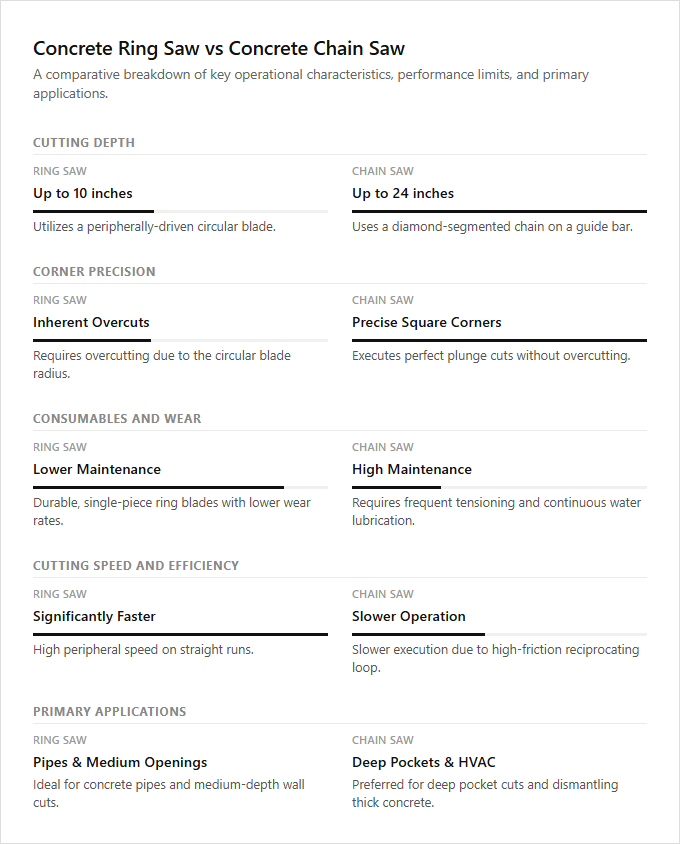
| Factor | Summary |
|---|---|
| Cutting Depth | While a concrete ring saw utilizes a peripherally-driven circular blade to achieve cutting depths of up to 10 inches, a concrete chain saw uses a diamond-segmented chain on a guide bar to execute plunge cuts up to 24 inches deep. |
| Corner Precision | Concrete chain saws excel at cutting precise square corners without overcutting, whereas concrete ring saws inherently produce overcuts due to the radius of the circular blade. |
| Consumables and Wear | Ring saws feature durable, single-piece ring blades with lower maintenance, while chain saws require frequent chain tensioning, drive sprocket replacement, and continuous water lubrication to prevent chain stretch. |
| Cutting Speed and Efficiency | The concrete ring saw offers significantly faster cutting speeds on straight runs due to peripheral drive efficiency, compared to the slower, high-friction operation of a concrete chain saw's reciprocating loop. |
| Primary Applications | Ring saws are ideal for cutting concrete pipes and creating medium-depth wall openings, whereas chain saws are preferred for deep pocket cuts, HVAC duct openings, and dismantling thick reinforced concrete. |
Ring Saw Peripheral Drive vs. Chain Saw Direct Drive
Concrete ring saws and concrete chain saws utilize distinct drive mechanisms to execute deep structural cuts. A ring saw features a peripheral drive system, driving the blade from its outer edge rather than a central spindle. This design eliminates the center arbor, enabling a 14-inch blade to achieve an impressive 10-inch cutting depth with minimal mechanical resistance.
In contrast, a concrete chain saw employs a direct sprocket drive system, where a drive sprocket rotates a diamond-segmented chain around a guide bar. While this layout allows for precise, square-cornered plunge cuts without overcutting, the direct mechanical interface increases friction and requires more frequent chain tensioning and maintenance.
The ring saw is best suited for utility contractors needing rapid, straight, deep cuts through pipes and masonry, whereas the chain saw is ideal for specialized demolition technicians performing intricate window, door, or HVAC openings.
Cutting Depth: 10-Inch Ring Saws vs. 25-Inch Chain Saws
When selecting professional concrete cutting equipment, understanding the depth capabilities of ring saws versus chain saws is essential for project efficiency. Concrete ring saws utilize a peripheral drive system that allows a 14-inch blade to achieve an impressive maximum cutting depth of ten inches. In contrast, concrete chain saws feature a specialized guide bar and diamond chain configuration, enabling them to plunge-cut up to twenty-five inches deep into heavy masonry or reinforced concrete.
While ring saws excel at fast, clean cuts in medium-depth applications, chain saws are indispensable for deep pocket cuts and precise square corners without overcutting. Handheld ring saws are ideal for general contractors performing standard window or door installations, whereas heavy-duty concrete chain saws are best suited for demolition specialists and utility workers tackling deep, structural masonry modifications.
Eliminating Corner Overcuts via Diamond Chain Plunge Cutting
When cutting precise openings in reinforced concrete, choosing between a concrete ring saw and a concrete chain saw depends largely on the tolerance for overcuts. While a ring saw offers excellent cutting depth, its circular blade inevitably creates corner overcuts on the back side of the wall to achieve a complete depth-of-cut on the front.
A concrete chain saw resolves this limitation through the plunge cutting method of a diamond-segment chain. This linear cutting action allows the operator to plunge straight into the material, creating perfect 90-degree corners with zero overcut, which preserves the structural integrity of the surrounding masonry.
High-volume utility contractors generally favor the rapid straight-cutting capability of the ring saw, while specialized demolition professionals and HVAC installers require the precision-focused chain saw for clean, damage-free square openings.
High drive-wheel and tensioning roller wear rates on ring blades
When comparing concrete ring saws and concrete chain saws, mechanical wear is a critical operational consideration. Ring saws utilize a unique perimeter-driven blade that relies on drive wheels and tensioning rollers to transfer power and maintain alignment. Because these drive components remain in constant contact with the blade under high pressure, they experience rapid wear from abrasive concrete slurry, requiring frequent inspection and replacement to prevent slippage.
In contrast, concrete chain saws distribute mechanical stress across a guide bar and drive sprocket. While chain saws require regular chain tensioning and chain replacements, they avoid the localized roller wear issues inherent to ring blades. The concrete ring saw is ideal for precision-focused pipe installers and utility contractors requiring fast, clean cuts, whereas the concrete chain saw is best suited for structural demolition specialists needing deep, square corners without overcuts.
Diamond chain stretch requiring frequent guide-bar adjustment during deep plunging
When selecting between a concrete ring saw and a concrete chain saw for deep-cutting applications, mechanical maintenance is a key operational differentiator. While ring saws utilize a perimeter-driven blade to achieve impressive depths without a central spindle, chain saws employ a guide bar and diamond chain to plunge up to twenty inches. The immense tension and friction generated during deep chain-saw plunging cause the diamond chain to stretch rapidly, requiring operators to perform frequent manual guide-bar adjustments to prevent derailment and maintain cutting efficiency.
In contrast, ring saws experience no chain stretch, offering continuous operation with minimal mid-cut adjustments. Professional masonry contractors requiring precise, pocket-cut corners benefit most from the specialized capability of the chain saw, whereas general utility crews performing rapid, continuous straight cuts find the low-maintenance ring saw more suitable.
Gyroscopic effect differences affecting operator control and kickback potential
Concrete ring saws and concrete chain saws exhibit distinct handling characteristics due to their blade mechanics. A ring saw utilizes a rapidly spinning circular blade that generates a strong gyroscopic effect. This rotational inertia stabilizes the tool in straight lines but resists sudden directional changes, demanding more physical effort from the operator during maneuvers. In contrast, a concrete chain saw utilizes a linear chain moving along a guide bar, producing negligible gyroscopic force and allowing for effortless, agile handling in confined spaces.
This rotational momentum also impacts kickback dynamics. The high peripheral speed of the ring saw presents a higher potential for violent rotational kickback if the blade pinches. Chain saws pose a lower rotational kickback risk, though they require careful management of linear thrust. Heavy-duty operators performing long, straight cuts excel with the stable ring saw, while specialists requiring precise, deep plunge cuts in corners find the highly maneuverable chain saw ideal.
Water Requirements: Diamond Chains vs. Ring Blades
When selecting concrete cutting equipment, water management is a critical factor in tool performance and longevity. Concrete chain saws require a dedicated water supply with a minimum pressure of 20 PSI to actively cool the diamond chain segments and flush abrasive slurry from the deep guide bar. Without this consistent high pressure, the chain suffers rapid wear and potential breakage during deep pocket cuts.
In contrast, concrete ring saws operate efficiently with significantly lower water flow and pressure requirements. The peripheral drive system of a ring blade sheds slurry easily, needing water primarily for basic dust suppression rather than high-pressure cooling. Specialized utility contractors requiring deep, square-cornered penetrations benefit most from the heavy-duty chain saw, while general masonry installers needing quick, mid-depth cuts prefer the highly portable and less water-dependent ring saw.
Leave a comment