
Achieving a perfectly flat, square face on rough lumber is a constant struggle for woodworkers, especially when machine vibration and power loss ruin premium stock. While standard equipment purchasing strategies often prioritize motor horsepower alone, analyzing how that power actually reaches the cutterhead is the real key to performance. Selecting the right transmission system grants operators a significant competitive advantage: maximizing torque delivery while reducing wear on critical components.
To set realistic expectations, however, this efficiency comes with a clear stipulation: there is an inherent trade-off between mechanical simplicity and vibration dampening. For example, high-volume shops running 12-inch helical cutterheads have vastly different power requirements than a hobbyist operating a standard 6-inch benchtop jointer.
This article will evaluate the critical differences between belt drive and direct drive systems, comparing their torque transfer, noise levels, maintenance demands, and overall impact on your jointing precision to help you select the ideal configuration for your shop.
| Factor | Summary |
|---|---|
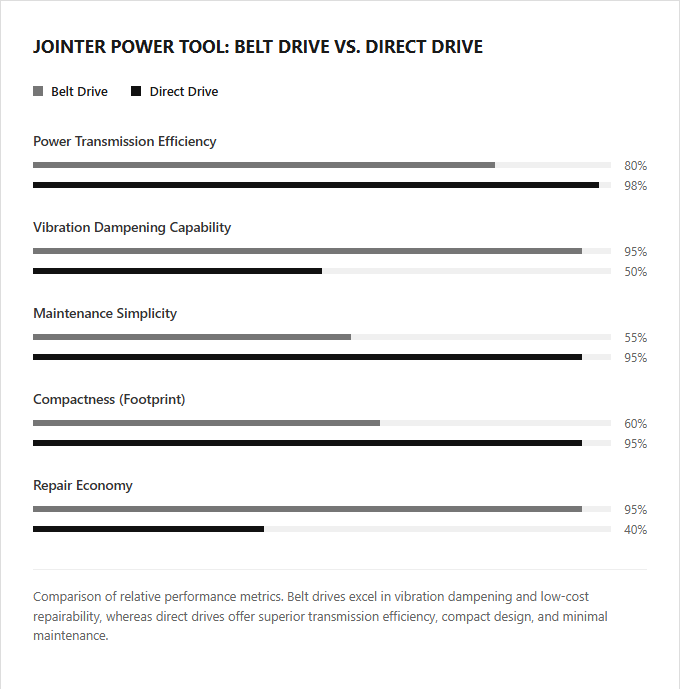
| Power Transmission Efficiency | Direct drive systems transfer torque directly to the cutterhead with minimal mechanical loss, whereas belt drive systems can experience minor power degradation due to belt slippage under heavy loads. |
| Vibration Dampening | Belt drive jointers naturally isolate motor vibrations through the flexible drive belt, whereas the rigid coupling of direct drive models transmits more harmonic vibration to the machine beds. |
| Maintenance Overhead | Direct drive induction motors require virtually no maintenance, while belt-driven configurations demand periodic pulley alignment and belt tension adjustments to prevent premature wear. |
| Machine Footprint | Direct drive jointers feature a more compact enclosure because the motor is mounted coaxially with the cutterhead, whereas belt drive units require additional cabinet space to house the pulley system. |
| Repair Cost | Belt drive systems offer highly economical repair options using standard replacement V-belts, whereas a major failure in a direct drive system often requires replacing the entire integrated motor-spindle assembly. |
Vibration damping capacity of elastomeric belts versus rigid coupling harmonics
Belt drive jointers utilize elastomeric belts to transmit power from the motor to the cutterhead. These flexible belts inherently absorb high-frequency motor vibrations and shock loads, preventing their transfer to the cutterhead. This damping capacity ensures a smoother cutting action, reducing scalloping and surface imperfections on the machined timber.
In contrast, direct drive systems employ a rigid coupling that eliminates belt slippage but transmits motor harmonics directly to the cutterhead. While highly efficient, this rigid connection can translate subtle motor pulsations into the wood, requiring highly precise engineering to mitigate. Belt-drive models suit fine woodworkers prioritizing pristine surface finishes, while direct-drive units favor high-volume commercial shops demanding maximum power transfer and minimal maintenance.
Pulley ratio customization for optimizing cutterhead rotational speed
In jointer design, the choice between belt drive and direct drive systems fundamentally affects cutterhead performance. Direct drive configurations connect the motor shaft straight to the cutterhead, delivering a fixed speed determined solely by the motor's RPM. Conversely, belt-drive systems utilize dual pulleys, allowing operators to customize the drive ratio. By altering the diameters of the motor and cutterhead pulleys, woodworkers can precisely calibrate the rotational speed to optimize the cutterhead's cuts-per-minute.
This customization enables fine-tuning of the machine's performance to reduce tear-out on highly figured grains. Direct drive units lack this mechanical adaptability but offer maintenance-free operation and compact footprints. Direct-drive jointers are ideal for weekend hobbyists seeking space-saving convenience, while customizable belt-drive models are best suited for professional artisans requiring precise speed control for diverse lumber species.
Mechanical slippage elimination and direct torque transmission efficiency
When selecting a jointer, the drivetrain design directly impacts machining performance and long-term reliability. Direct drive systems couple the motor shaft directly to the cutterhead, entirely eliminating the mechanical slippage often associated with belt stretch or deterioration. This configuration ensures maximum torque transmission efficiency, delivering consistent, uncompromised rotational power straight to the cutterhead during heavy stock removal.
In contrast, belt drive systems utilize pulleys to transfer power, which introduces minor energy loss through friction but offers superior vibration dampening and motor isolation. Heavy-duty professional woodworkers demanding continuous high-torque output and zero slippage thrive with direct drive machinery, while home workshop enthusiasts seeking quieter operation and simpler motor replacement generally prefer belt-driven models.
Overhung load isolation using independent cutterhead bearing blocks
In stationary jointers, the choice between belt drive and direct drive configurations significantly impacts machine longevity and alignment. A key engineering distinction lies in the management of overhung load. Belt-driven jointers utilize independent cutterhead bearing blocks to isolate the cutterhead from the lateral tension exerted by the drive belt. This design prevents drive-induced forces from misaligning the cutterhead, ensuring consistent planing precision during heavy stock removal.
In contrast, direct-drive systems couple the motor directly to the cutterhead shaft, eliminating belt maintenance but transferring operational vibrations more directly. High-volume professional woodworkers requiring maximum precision and field-serviceability typically benefit from the robust isolation of belt-driven jointers, whereas hobbyists prioritizing a compact footprint and minimal maintenance favor direct-drive units.
Thermal overload protection requirements during cutterhead stall conditions
In direct-drive jointers, the motor shaft connects directly to the cutterhead, leaving no mechanism for mechanical slippage. During a cutterhead stall, the motor experiences an immediate, severe spike in electrical current. This rapid heat generation requires highly sensitive thermal overload protection systems to cut power instantly and prevent permanent motor winding damage.
Belt-drive jointers utilize a drive belt that can slip during a stall, absorbing a portion of the initial mechanical shock. This slippage delays the critical thermal spike in the motor, allowing for slightly less sensitive thermal breakers while still ensuring safety during prolonged blockages. Belt-drive models are ideal for high-volume professionals requiring repairable, heavy-duty machinery, whereas direct-drive units are best suited for hobbyists prioritizing compact, maintenance-free designs.
Parallel misalignment elimination in integrated motor-spindle designs
Direct drive jointers feature integrated motor-spindle designs that couple the motor shaft directly to the cutterhead. This integration completely eliminates parallel misalignment, a common issue in belt-driven systems where pulleys can drift out of parallel alignment over time. By removing belts and pulleys, direct drive units minimize rotational vibration, reduce power transmission loss, and ensure highly consistent, flat cuts across the workpiece surface.
Conversely, belt drive jointers utilize a separate motor and pulley system, which dampens sudden shock loads but requires regular maintenance to prevent pulley misalignment. Belt-driven models are ideal for traditional woodworkers who prioritize easy, modular repairs, whereas direct-drive systems suit high-production professionals demanding maintenance-free precision and minimal runout.
Poly-V belt tension maintenance versus maintenance-free direct coupling
In woodworking jointers, the drive system dictates both performance and upkeep. Belt-driven jointers, particularly those utilizing Poly-V belts, offer smooth power transmission and excellent vibration dampening. This design requires periodic tension adjustments and eventual belt replacement to prevent slippage and maintain optimal cutterhead speed.
Direct-drive jointers employ a maintenance-free direct coupling between the motor and the cutterhead. This configuration completely eliminates belt wear, slippage, and alignment chores, ensuring highly efficient energy transfer. While mechanically simpler, direct-drive systems transmit slightly more motor vibration directly to the workspace.
Direct-drive units are best suited for hobbyists prioritizing a compact, hassle-free setup, while belt-drive systems are ideal for production-grade woodworkers who require maximum vibration dampening and long-term mechanical serviceability.
Leave a comment