
Achieving perfectly flat, twist-free face joints on rough lumber-especially stubborn hardwoods like warped white oak-is a constant struggle for woodworkers aiming for seamless panel glue-ups. Many shops initially attempt to bridge this gap using standard shop workarounds, such as custom planer sleds or manual hand planes. While these traditional methods can work, they require significant setup time and sacrifice workshop efficiency.
Investing in a dedicated stationary jointer grants craftsmen the ultimate asset: immediate, repeatable precision that ensures perfectly flat reference faces. However, a crucial educational stipulation must be made: a jointer is designed strictly to flatten and square stock, not to dimension its thickness.
To help you navigate this machinery investment, this article compares compact benchtop models against heavy-duty cabinet jointers. We will evaluate critical factors including footprint, bed length, and motor capacity, helping you select the ideal precision tool for your shop's specific demands.
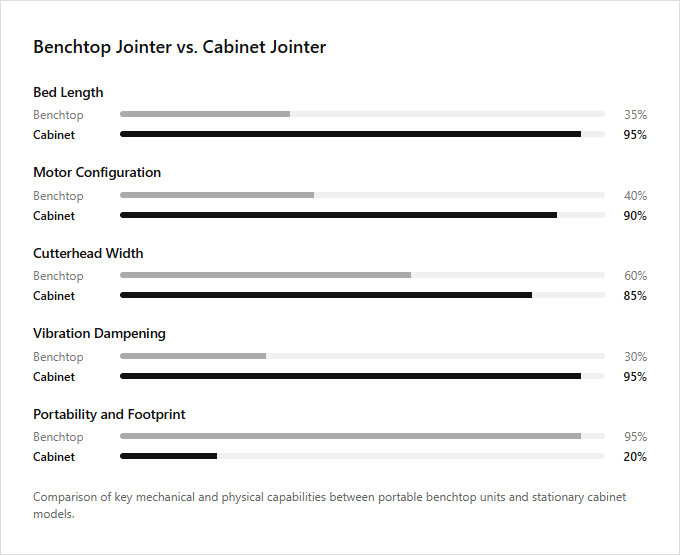
| Factor | Summary |
|---|---|
| Bed Length | Cabinet jointers feature significantly longer cast-iron infeed and outfeed tables to stabilize long lumber, while benchtop models are restricted by shorter beds. |
| Motor Configuration | Benchtop units typically utilize loud universal motors, whereas cabinet jointers employ powerful, quiet induction motors designed for continuous duty-cycles. |
| Cutterhead Width | While benchtop jointers are usually limited to a six-inch capacity, cabinet jointers often accommodate wider helical cutterheads for superior face jointing. |
| Vibration Dampening | The massive cast-iron beds of cabinet jointers effectively absorb harmonic vibration, providing smoother cuts than lightweight benchtop alternatives. |
| Portability and Footprint | Benchtop jointers offer a highly portable space-saving design, whereas cabinet jointers require a dedicated workshop footprint due to their integrated enclosed stands. |
Infeed and outfeed table coplanarity and bed length
Benchtop jointers feature compact beds, typically 30 to 40 inches long, which limits their capacity to flatten boards longer than twice the bed length. In contrast, cabinet jointers offer expansive cast-iron beds stretching 70 inches or more, providing the necessary physical support to flatten long, heavy stock accurately.
Achieving perfect coplanarity between the infeed and outfeed tables is critical for eliminating snipe and ensuring straight edges. Benchtop models often rely on lightweight aluminum tables that can lose alignment under pressure, while cabinet jointers utilize precision-machined, heavy cast-iron tables with robust adjustment mechanisms that maintain strict coplanarity under heavy use.
Compact benchtop units are ideal for hobbyists with limited workshop space working on small-scale crafts, whereas heavy-duty cabinet jointers are suited for professional woodworkers processing large furniture components.
Helical indexable carbide insert cutterhead
Integrating a helical indexable carbide insert cutterhead significantly upgrades both benchtop and cabinet jointers. This advanced cutterhead utilizes small, rotatable carbide inserts that shear wood fibers at an angle, resulting in a glass-smooth finish, reduced noise, and virtually no tear-out on figured grain. In benchtop jointers, this technology maximizes the efficiency of smaller, portable motors, allowing woodworkers to achieve premium surface preparation within a compact footprint.
Cabinet jointers leverage the helical cutterhead to its fullest potential, combining the superior cutting action with heavy cast-iron tables and high-horsepower induction motors for maximum stability and depth of cut. Benchtop models are suited for hobbyists and mobile carpenters working with shorter stock, while cabinet jointers are designed for professional furniture makers requiring maximum precision and high-volume capacity.
Vibration-dampening cast-iron chassis
When comparing benchtop and cabinet jointers, the chassis construction is critical for performance. Cabinet jointers feature a massive, fully enclosed cast-iron base that excels at dampening motor vibrations, ensuring incredibly smooth cuts on heavy lumber. Benchtop models, while prioritizing portability, often incorporate cast-iron tables to provide a stable, vibration-resistant surface despite their lighter aluminum or steel frames.
The superior mass of a cabinet jointer minimizes harmonic distortion during heavy-duty operations, whereas benchtop units require secure mounting to manage movement. Benchtop jointers are ideal for hobbyists and mobile contractors needing portability for light-duty projects, while cabinet jointers are suited for professional woodworkers requiring maximum stability and precision for continuous, large-scale production.
Parallelogram table adjustment mechanism
Benchtop jointers offer compact utility, with premium models featuring parallelogram table adjustment mechanisms. This design allows the tables to travel in a tight arc around the cutterhead, maintaining a consistent, safe gap between the table lip and the knives for cleaner cuts.
Stationary cabinet jointers utilize robust, heavy-duty parallelogram beds as a standard. This mechanism ensures the heavy cast-iron tables remain perfectly coplanar over years of intensive use, allowing for precise calibration and minimal deflection when flattening large lumber.
Benchtop units are ideal for hobbyists with limited shop space working on smaller projects, while cabinet jointers are best suited for professional woodworkers requiring maximum capacity and absolute precision for daily production.
Totally Enclosed Fan Cooled induction motor
Benchtop and cabinet jointers differ significantly in capacity, stability, and power configuration. Cabinet jointers typically house a heavy-duty, Totally Enclosed Fan Cooled (TEFC) induction motor within their enclosed base. This sealed motor design prevents fine wood dust from entering critical electrical components, ensuring reliable, continuous operation. Conversely, compact benchtop jointers generally utilize loud universal motors, though premium portable models sometimes feature smaller TEFC induction systems to balance quiet performance with longevity.
While cabinet models leverage the high torque of a TEFC induction motor to mill wide boards with minimal vibration, benchtop units sacrifice this thermal efficiency for portability. Benchtop jointers suit hobbyists and mobile contractors prioritizing space-saving portability, whereas cabinet jointers are ideal for professional woodworkers requiring heavy-duty, high-volume stock preparation.
Rigid center-mounted cast-iron fence assembly
In precision woodworking, a rigid, center-mounted cast-iron fence assembly is critical for ensuring square edges. Benchtop jointers often compromise on fence mass to maintain portability, utilizing lighter materials or scaled-down mounting systems. While these compact designs save space, they lack the anchoring weight of larger machines, making them more susceptible to deflection under the pressure of heavy workpieces.
Cabinet jointers feature massive, center-mounted cast-iron fences that remain perfectly square during demanding operations. This heavy-duty system absorbs vibrations and provides an unwavering reference surface across the bed. Benchtop models are ideal for weekend hobbyists with limited workshop space, while cabinet jointers are suited for professional furniture makers requiring absolute precision for large-scale production.
Maximum cutting width capacity
Benchtop jointers typically offer a maximum cutting width of 6 to 8 inches. These compact machines are engineered for smaller workshops where space is premium, providing sufficient capacity for flattening faces and squaring edges on standard-sized lumber.
Cabinet jointers deliver substantially larger capacities, often ranging from 8 to 12 inches or wider. Their expansive beds and powerful motors allow woodworkers to flatten wide, rough-sawn boards without the need for pre-ripping, ensuring superior stability and precision on large-scale projects.
Benchtop models are ideal for hobbyists and DIY enthusiasts working on smaller crafts in limited garage spaces, whereas cabinet jointers are suited for professional furniture makers and high-production shops handling large, heavy timber.
Leave a comment