
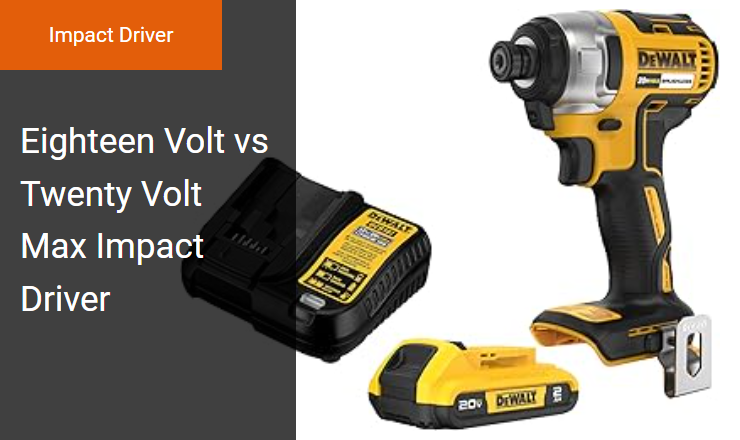
Selecting the right high-torque impact driver is often a source of frustration for trade professionals navigating confusing marketing claims and voltage ratings. While standard tooling procurement budgets typically prioritize brand ecosystem and upfront acquisition costs, choosing the correct platform ultimately grants operators a decisive advantage in sustained torque output, thermal efficiency, and overall job site productivity.
To evaluate these tools objectively, we must first establish a key technical stipulation: 18V and 20V Max systems utilize the same nominal battery cell chemistry. As proven by field-tested standards like the Milwaukee M18 FUEL and the DeWalt 20V Max XR, real-world performance depends far more on advanced brushless motor integration and electronic speed control than voltage labeling alone.
In this article, we will examine the engineering differences between these platforms, analyzing torque curves under load, battery duty cycles, and power-to-weight ratios to help you select the optimal tool for your heavy-duty fastening needs.
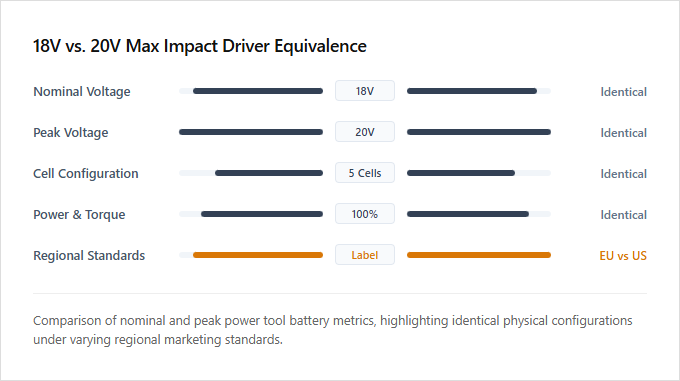
| Factor | Summary |
|---|---|
| Nominal Voltage | Both battery platforms operate at an identical nominal voltage of 18 volts under active workload conditions. |
| Peak Voltage | The "20V Max" designation represents the transient open-circuit voltage measured immediately after a full charge before any work begins. |
| Cell Configuration | Both packs utilize five lithium-ion cells connected in series, meaning their chemical potential and internal resistance are equivalent. |
| Power and Torque | There is no difference in the wattage output or mechanical torque generated by the brushless motor of either tool. |
| Regional Standards | The labeling variance is driven by regional consumer protection standards, where the EU mandates nominal voltage ratings and the US permits maximum voltage marketing. |
18V Nominal vs. 20V Transient Peak Voltage
When comparing eighteen-volt and twenty-volt max impact drivers, the primary distinction lies in electrical terminology rather than actual power output. An eighteen-volt rating represents the nominal operating voltage under a working load, which is the standard sustained output during tool operation. Conversely, a twenty-volt max rating indicates the transient peak voltage of the battery immediately after a full charge, before the motor is engaged.
Under continuous work conditions, both battery platforms operate at the identical nominal pressure of eighteen volts. This means that torque, speed, and overall driving performance remain virtually equivalent between the two classifications, as they utilize the same internal cell configuration.
Budget-conscious DIY enthusiasts seeking straightforward value often prefer the transparently rated eighteen-volt models, while professionals seeking the latest premium brand ecosystems gravitate toward twenty-volt max platforms.
Lithium-ion cell chemistry utilizing a five-cell series configuration
In the power tool industry, the distinction between eighteen-volt and twenty-volt max impact drivers is primarily nomenclature rather than electrical capability. Both systems utilize a lithium-ion battery pack featuring a five-cell series configuration. Each individual cell carries a nominal rating of 3.6 volts, yielding 18 volts during standard operation, while reaching a peak potential of 4.0 volts immediately after charging, which manufacturers label as 20V Max.
Because both configurations deliver identical torque and speed performance under load, the distinction lies in marketing and regional distribution. Heavy-duty professionals seeking global tool compatibility often choose the 18V platforms, while residential DIYers and home hobbyists typically opt for the consumer-oriented 20V Max models.
Brushless motor integration with electronic speed control feedback loops
While eighteen-volt and twenty-volt max impact drivers operate on the exact same nominal battery voltage, their true performance differentiation lies in advanced brushless motor integration. These modern power tools utilize sophisticated electronic speed control feedback loops. By continuously monitoring real-time load and spindle speed, the tool's microprocessor dynamically adjusts energy delivery, optimizing battery efficiency and preventing motor burnout under heavy loads.
Selecting the ideal platform depends primarily on regional tool ecosystems and specific jobsite demands. Traditional eighteen-volt systems are highly suited for maintenance technicians prioritizing global system compatibility, whereas twenty-volt max tools appeal to heavy-duty residential contractors requiring maximum initial torque on demanding framing projects.
Rotational Energy Delivery via Hammer-Anvil Impact
The distinction between eighteen-volt and twenty-volt max impact drivers lies primarily in marketing nomenclature rather than operational power. Both systems operate on an identical nominal voltage, utilizing the same battery cell configuration to spin an internal motor. This motor drives a spring-loaded hammer that repeatedly strikes an anvil, converting rotational kinetic energy into the sudden, high-torque impacts necessary for driving dense fasteners.
The actual kinetic energy delivered per blow depends on the mass of the hammer and the rotational velocity achieved before impact. While twenty-volt max ratings highlight peak initial voltage without a workload, eighteen-volt ratings reflect stable operating voltage under load. Heavy-duty construction professionals requiring sustained torque under continuous load benefit from the standardized reliability of eighteen-volt platforms, whereas DIY enthusiasts prioritizing maximum initial power output for intermittent tasks often prefer twenty-volt max models.
Breakaway torque and fastening torque quantified in Newton-meters or inch-pounds
Eighteen-volt and twenty-volt max impact drivers share the same nominal operating potential under load, meaning their performance capabilities are virtually identical. High-end models in both categories deliver robust fastening torque, typically ranging from 1,500 to 2,200 inch-pounds (approximately 170 to 250 Newton-meters). Breakaway torque, which is critical for loosening stubborn or rusted fasteners, routinely reaches up to 3,000 inch-pounds (340 Newton-meters) in premium brushless configurations of either designation.
The distinction between these platforms rests on marketing nomenclature rather than mechanical power, as both rely on five-cell lithium-ion battery structures. Heavy-duty 18V platforms are ideal for industrial trade professionals who require deep tool ecosystems and fleet compatibility, whereas 20V Max systems are well-suited for residential contractors and advanced DIY enthusiasts looking for ergonomics and individual tool kit value.
No-Load RPM vs. Impact Rate Under Heavy Resistance
When comparing eighteen-volt and twenty-volt max impact drivers, the correlation between no-load revolutions per minute (RPM) and impacts per minute (IPM) under heavy resistance is critical. While both platforms share the same nominal battery voltage, a higher no-load RPM provides the essential kinetic energy needed to maintain rotational speed. Under heavy resistance, this momentum converts into rapid, sustained IPM, driving fasteners efficiently without bogging down the motor.
Twenty-volt max models frequently feature advanced electronics that sustain these higher RPMs under load, delivering a denser impact frequency for demanding tasks. Professional contractors requiring high-volume, heavy-duty structural fastening benefit most from the robust performance of twenty-volt max drivers, while residential tradespeople and DIY enthusiasts are ideally suited to the reliable, steady power of eighteen-volt systems.
Battery management system circuitry preventing thermal throttling and over-discharge
When comparing eighteen-volt and twenty-volt max impact drivers, the true differentiator lies in the sophistication of the battery management system (BMS) circuitry. Both platforms run on similar lithium-ion cells, but advanced BMS programming is crucial for monitoring real-time voltage and temperature. By regulating current, this circuitry successfully prevents thermal throttling under heavy loads and guards against over-discharge, preserving long-term battery health.
Standard eighteen-volt systems often prioritize compact efficiency to maximize run-time in lighter tool bodies, whereas twenty-volt max systems utilize heavy-duty circuitry tuned for sustained, high-stress applications. Eighteen-volt models are ideal for maintenance technicians requiring lightweight maneuverability, while twenty-volt max tools suit structural contractors demanding continuous power for heavy-duty fastening.
Leave a comment