
Achieving a flawless, uniform finish in abrasive blasting is notoriously difficult when operators are plagued by constant nozzle clogs and inconsistent media flow. While standard funding sources and capital equipment budgets for workshop upgrades often prioritize high-capacity air compressors, technicians frequently overlook the critical interface: the blaster's feed mechanism.
Selecting the correct feed design grants operators an immediate advantage in precision, drastically reducing both media waste and project downtime. However, we must stipulate that even the most sophisticated blaster requires a compressor with a properly matched CFM output to function as intended. For example, professional automotive restoration shops rely on precise feed-to-compressor calibration to safely strip delicate body panels without warping the metal.
To help you optimize your workshop's setup, this article will analyze the core mechanical differences, efficiency ratings, and ideal applications of Siphon Feed versus Gravity Feed sandblasters, providing a clear roadmap for your next equipment investment.
| Factor | Summary |
|---|---|
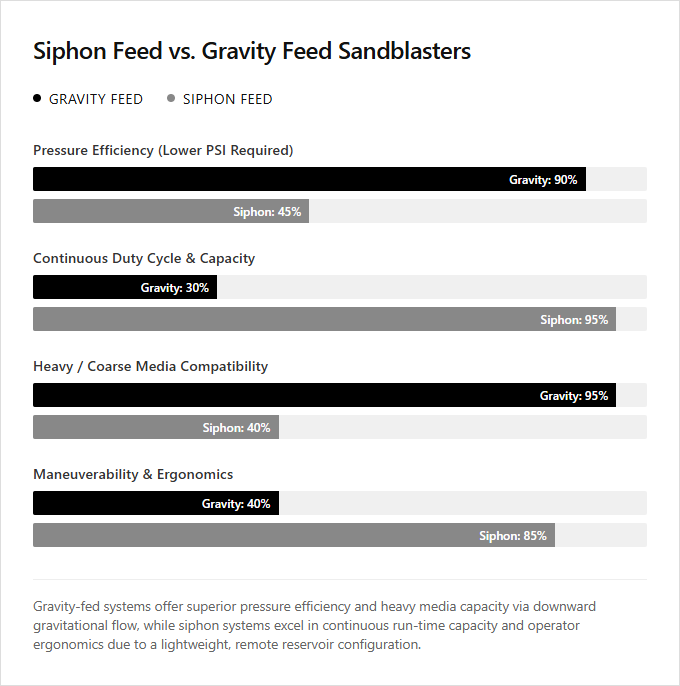
| Operating Pressure | Gravity feed blasters require lower PSI to initiate flow, whereas siphon feed systems rely on the Venturi effect, demanding higher CFM to draw abrasive media upward. |
| Abrasive Delivery Mechanism | Gravity feed utilizes downward gravitational pull to feed media directly into the blast nozzle, while siphon feed uses suction-induced pressure differentials to pull abrasive from a remote reservoir. |
| Reservoir Location | Gravity feed models feature a top-mounted hopper attached directly to the gun, whereas siphon feed units utilize a separate, floor-based container connected via a flexible suction hose. |
| Media Compatibility | Gravity feed is highly effective for heavy, coarse media like steel grit due to the assisted downward flow, while siphon feed is better suited for lighter abrasive media like glass beads to prevent clogging in the siphon tube. |
| Duty Cycle and Capacity | Siphon feed sandblasters allow for prolonged continuous operation with larger bulk abrasive capacities, whereas gravity feed guns have a limited reservoir volume requiring frequent refills that interrupt the work cycle. |
| Maneuverability and Ergonomics | Siphon guns offer superior maneuverability due to a lightweight hand unit tethered to a remote tank, while gravity feed guns are more fatiguing to operate because of the top-heavy integrated reservoir. |
How Siphon Feed Uses the Venturi Effect
Siphon feed sand blasters utilize a configuration where the abrasive media reservoir is located below the nozzle. This design relies on the Venturi effect, where high-velocity airflow creates a vacuum that draws the media upward through a delivery hose and into the blast stream. This mechanism allows for the use of large, external containers, facilitating continuous operation on extensive surfaces.
Gravity feed models position the media hopper directly on top of the gun. Gravity forces the abrasive downward into the air stream, ensuring a highly consistent flow rate that operates efficiently at lower air pressures. This direct feeding method minimizes physical resistance and reduces the likelihood of clogs during operation.
Siphon feed units are ideal for industrial operators undertaking large-scale restoration projects, whereas gravity feed systems are best suited for workshop hobbyists requiring precise control for detailed etching tasks.
How Gravity Feed Delivers Media
When selecting a sandblaster, understanding the distinction between siphon feed and gravity feed systems is essential for achieving optimal project outcomes. Siphon feed models operate via a vacuum mechanism, drawing abrasive media upward from a separate, lower reservoir through a fluid delivery hose. This configuration is highly effective for extended operations, as it allows the operator to draw from high-capacity external containers without the physical strain of supporting the media's weight.
In contrast, gravity feed sandblasters utilize gravitational pull within a top-mounted hopper to deliver media directly to the mixing chamber. This design eliminates the resistance associated with lifting the abrasive material, resulting in a highly consistent flow and requiring lower overall air pressure to operate effectively. Siphon feed systems are ideal for industrial contractors managing large-scale restoration projects, whereas gravity feed units are best suited for hobbyists and detail-oriented technicians performing precise, localized surface preparation.
Siphon Systems Require High CFM and PSI
When selecting a sand blaster, understanding the mechanical differences between siphon and gravity feed systems is essential. Gravity feed models utilize a top-mounted hopper that pulls media directly into the airflow, requiring less pneumatic power. This design operates efficiently with smaller compressors, making it highly effective for precise, localized tasks.
Conversely, siphon feed systems rely on a suction mechanism to draw media upward from a separate reservoir. This process demands significantly higher CFM and PSI to establish and maintain the necessary vacuum. A high-capacity air compressor is vital to prevent sputtering and ensure a consistent abrasive stream during extended use.
Gravity feed units are ideal for DIY hobbyists performing quick, detailed touch-ups, while siphon systems are best suited for industrial professionals requiring continuous, large-scale surface preparation.
Gravity Feed Ensures Consistent Dense Media Flow
When selecting a sand blaster, the choice between siphon feed and gravity feed configurations significantly impacts project efficiency. Gravity feed systems position the abrasive hopper directly above the nozzle, utilizing gravity to pull the media into the airflow. This design provides a highly consistent abrasive flow rate, making it exceptionally effective for dense, heavy media such as steel shot, which often resists the suction of alternative systems.
In contrast, siphon feed sand blasters rely on the Venturi effect, creating a vacuum to draw media upward from an external reservoir. While this allows for larger material capacities, it struggles to maintain consistency with heavier abrasives. Industrial professionals requiring high-precision profiling with heavy steel shot benefit most from gravity feed models, while DIY hobbyists performing light-duty rust removal or glass etching with lightweight media are better served by siphon feed systems.
Siphon Feed Energy Loss and Reduced Nozzle Velocity
When selecting a sand blaster, the abrasive delivery method significantly impacts overall efficiency. Gravity feed systems position the hopper above the gun, utilizing gravity to pull media directly into the airflow with minimal resistance. In contrast, siphon feed systems rely on the Venturi effect to draw media upward from a separate container. This mechanism suffers from greater energy loss and reduced velocity at the nozzle orifice, as a portion of the air pressure is expended solely on lifting the abrasive material.
This difference in velocity directly influences the tool's effectiveness on tough coatings and rust. Gravity-fed units are best suited for DIY hobbyists requiring high-velocity precision on localized restoration projects, while siphon-fed systems cater to workshop operators performing continuous, large-scale surface preparation where high-volume media capacity is preferred over maximum impact force.
Gravity feed minimizes media surge and sputtering during continuous operation.
When selecting a sandblaster, the delivery system significantly impacts performance. Siphon feed systems rely on a vacuum to pull abrasive media upward from a separate reservoir, which can introduce inconsistency. Gravity feed sandblasters position the hopper directly above the gun, utilizing gravity to ensure a steady, reliable flow of media into the air stream. This configuration minimizes media surge and sputtering during continuous operation, delivering a highly consistent finish.
The steady output of gravity-fed models makes them efficient for detailed, uninterrupted tasks, whereas siphon-feed units excel in larger-scale projects where a high-volume external reservoir is required. Hobbyists and automotive restorers requiring precision control benefit most from gravity-feed tools, while industrial contractors handling expansive surfaces are better suited for siphon-feed systems.
Siphon Feed: Detached Reservoirs Increase Capacity
Selecting the appropriate abrasive blasting system depends heavily on your project scale and material requirements. Siphon feed sandblasters utilize a separate hose to draw media from a detached container into the blast gun. Because the reservoir is not mounted directly on the tool, this design supports significantly larger media capacities, allowing for extended operation on expansive surfaces without the need for frequent refills.
In contrast, gravity feed models feature a hopper secured directly on top of the gun, relying on gravity to push the abrasive into the airflow. While this configuration offers highly consistent flow and excellent maneuverability, the integrated hopper limits total media capacity and increases hand fatigue during prolonged use.
Siphon feed systems are highly suitable for commercial contractors undertaking large-scale restoration projects, whereas gravity feed units are ideal for hobbyists requiring precision during localized spot cleaning and detailed etching tasks.
Leave a comment