
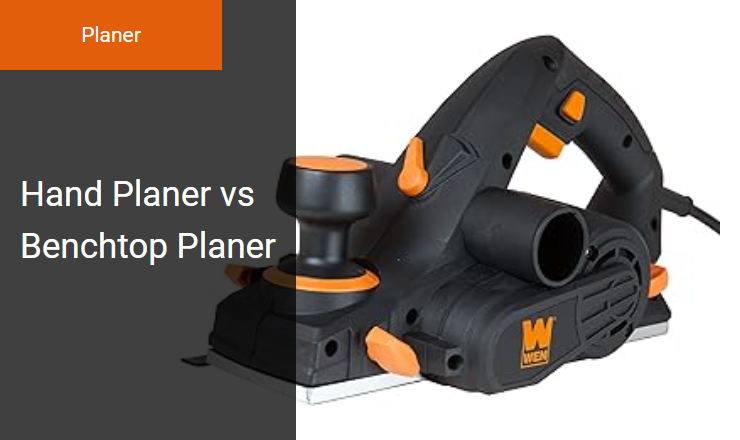
Achieving perfectly flat, dimensioned stock is a notorious bottleneck for woodworkers, often resulting in misaligned joints and wasted material. Traditionally, makers rely on purchasing expensive pre-surfaced S4S lumber or spending exhaustive hours hand-sanding, both of which inflate project budgets and limit design flexibility.
Integrating a dedicated planer into your shop grants you absolute control over your stock's thickness, transforming affordable, rough-sawn timber into pristine, custom-dimensioned boards. However, as an educational stipulation, one must remember that a planer operates on a reference face; it will copy existing warps rather than flatten a twisted board outright. For instance, when prepping rough-cut white oak for a tabletop, a flat reference face is crucial before thicknessing.
To help you navigate this equipment investment, this guide compares the versatility of the handheld power planer against the high-volume accuracy of the benchtop planer, helping you select the ideal tool for your workflow.

| Factor | Summary |
|---|---|
| Portability and Maneuverability | Hand planers offer exceptional portability for chamfering edges and smoothing fixed joists on-site, whereas stationary benchtop planers require a dedicated workshop footprint. |
| Material Capacity | Benchtop planers process wide lumber using an automatic feed rate mechanism, while hand planers are limited by a narrow cutting width shoe and require manual passes. |
| Depth Control and Precision | Benchtop planers utilize a calibrated thickness adjustment crank to prevent snipe across entire boards, whereas hand planers rely on manual depth adjustment dials for rapid, less precise shaving. |
| Cutterhead Technology | Benchtop planers often feature multi-knife helical cutterheads to produce a glassy finish on figured wood, while hand planers typically use one or two straight carbide blades. |
| Primary Application | Hand planers excel at trimming sticking doors and flattening high spots, whereas benchtop planers are essential for dimensioning rough-sawn lumber to a uniform thickness. |
Establishing a flat datum face prior to thicknessing
Before running timber through a thickness planer, establishing a flat reference or datum face is essential. An electric or manual hand planer allows woodworkers to selectively remove twists and high spots from warped boards. This tool offers the maneuverability needed to create a true reference plane on oversized or irregular stock that cannot safely feed through stationary machinery.
A benchtop planer cannot establish a flat datum face independently because its heavy feed rollers temporarily flatten warps during the cutting cycle, causing the wood to spring back afterward. Achieving a flat face with a benchtop model requires securing the workpiece to a flat sled with shims to prevent this deflection. Hand planers suit on-site carpenters and custom furniture makers requiring rapid, localized stock preparation, while benchtop planers are ideal for workshop-based makers and hobbyists processing high volumes of dimensioned lumber.
Mitigation of snipe using bed extensions versus manual pressure distribution
Benchtop planers are highly susceptible to snipe, the deeper gouging at a board's ends, due to slight downward workpiece deflection. Integrating rigid infeed and outfeed bed extensions effectively mitigates this issue by maintaining a perfectly flat, continuous reference plane as stock enters and leaves the cutter head.
In contrast, hand planers rely entirely on manual pressure distribution to prevent uneven cuts. Operators must skillfully shift downward force from the front shoe during entry to the rear shoe as the tool exits the board, requiring precise physical technique rather than mechanical support.
Stationary benchtop planers are best suited for production-oriented woodworkers processing large volumes of dimensional lumber, whereas hand planers are ideal for mobile carpenters and installers who require rapid, on-site stock removal and custom fitting.
Helical Cutterhead Shear vs. Hand Plane Bevel Geometry
Modern benchtop planers frequently utilize helical cutterheads, where small carbide inserts are positioned at an angle to produce a shearing cut. This shear action slices wood fibers progressively, significantly reducing tear-out on figured grain and requiring less horsepower. In contrast, traditional hand planers rely on a single wide plane iron, where the bevel-up or bevel-down angle geometry directly determines the cutting angle and chip clearance to control wood splitting.
While the helical benchtop planer excels at rapid, uniform thicknessing of rough stock, the hand planer offers unparalleled tactile feedback and precision micro-adjustments for fitting joints. High-volume furniture makers requiring efficiency benefit most from the benchtop helical planer, whereas custom woodworkers and luthier artisans seeking precision control prefer the hand planer.
Constant mechanical feed rate versus variable manual pass speed
Benchtop planers feature a motorized, constant mechanical feed rate. This system pulls timber through the cutterhead at a uniform speed, ensuring highly consistent thickness and a flat finish. By eliminating the variations of human movement, this automated process minimizes the risk of gouging and tear-out across long boards.
Hand planers rely entirely on variable manual pass speed. This manual control allows operators to adjust their pace dynamically based on wood grain resistance and specific high spots. However, achieving a uniform finish requires substantial physical control, as inconsistent speed and pressure can easily gouge the workpiece.
Benchtop planers are ideal for workshop woodworkers requiring precise, batch-dimensioned lumber, whereas hand planers best serve mobile carpenters and remodelers who need quick, portable material adjustment on site.
Chipbreaker adjustment versus high rotational speed RPM for tearout prevention
Preventing tearout on figured timber requires distinct mechanical approaches depending on the tool selected. Hand planers combat tearout through precise chipbreaker adjustment, positioning the breaker extremely close to the cutting edge to force wood fibers to bend and snap immediately. This physical deflection stops grain lifting at the source, offering unmatched control on reversing grain patterns.
Benchtop planers address the same issue through velocity rather than physical chip redirection. These machines utilize high rotational speeds, often exceeding 10,000 RPM, to deliver thousands of cuts per minute, cleanly shearing wood fibers before they have the opportunity to tear. This high-speed cutterhead action ensures a uniform thickness across long boards with minimal manual effort.
Hand planers are best suited for detail-oriented artisans who prioritize individual board customization and grain control, whereas benchtop planers are perfect for production-scale woodworkers requiring rapid, consistent dimensioning of bulk lumber.
Hand plane sole flatness calibration versus benchtop bed coplanarity
Achieving precise results with a handheld power planer requires careful calibration of the sole. The operator must ensure the front adjustable shoe and the rear fixed shoe are perfectly parallel to prevent snipe and uneven cuts. Manual flattening of these aluminum or cast-iron surfaces, often utilizing a reference plate, is essential for maintaining tool accuracy over time.
Benchtop thickness planers rely on bed coplanarity, where the infeed table, outfeed table, and center cutterhead bed must align on the exact same geometric plane. Misalignment across these larger surfaces leads to significant board snipe and thickness inconsistency. Adjusting these heavy tables involves precise measurements with dial indicators and structural bolt tuning.
Hand planers are ideal for mobile carpenters needing quick, on-site material fitting and beveling, while benchtop models suit workshop-based woodworkers requiring highly repeatable, precise thicknessing for furniture production.
Micro-adjustment thread pitch for precise incremental depth of cut
When comparing hand planers and benchtop thickness planers, the mechanism for depth control is a critical differentiator. Benchtop planers utilize a fine-thread elevation screw system, where a single crank rotation yields minute, highly predictable height adjustments across the cutterhead. This precise micro-adjustment thread pitch allows operators to dial in exact material removal, calibrated to fractions of a millimeter for uniform thickness.
Power hand planers feature a front-knob adjustment with a much coarser thread pitch. While this allows for rapid, macro-level stock removal, it lacks the microscopic precision needed for fine woodworking. Hand planers are best suited for mobile carpenters performing quick leveling tasks, while benchtop planers are ideal for stationary furniture makers demanding precise thickness tolerances.
Leave a comment