
Machinists and fabricators frequently struggle with vertical throat clearance constraints when pressing oversized workpieces, a bottleneck that routinely stalls production and compromises workpiece alignment. When seeking to resolve this issue, procurement teams often look to standard equipment capital budgets or traditional machinery funding sources to acquire larger, high-tonnage hydraulic systems.
However, optimizing your mechanical setup by selecting the correct arbor press frame grants operators exceptional spatial adaptability and precision without the steep overhead of hydraulic alternatives. This cost-effective efficiency is achievable, under the stipulation that shop managers carefully evaluate their workflow dimensions and tonnage requirements beforehand. For instance, high-volume automotive remanufacturers utilize adjustable bed presses to seamlessly transition between pressing long transmission shafts and compact bearing assemblies.
In this guide, we will compare the structural advantages of Fixed Base versus Adjustable Table designs, helping you identify the best arbor press configuration to maximize your vertical throat clearance and streamline your shop's operations.
| Factor | Summary |
|---|---|
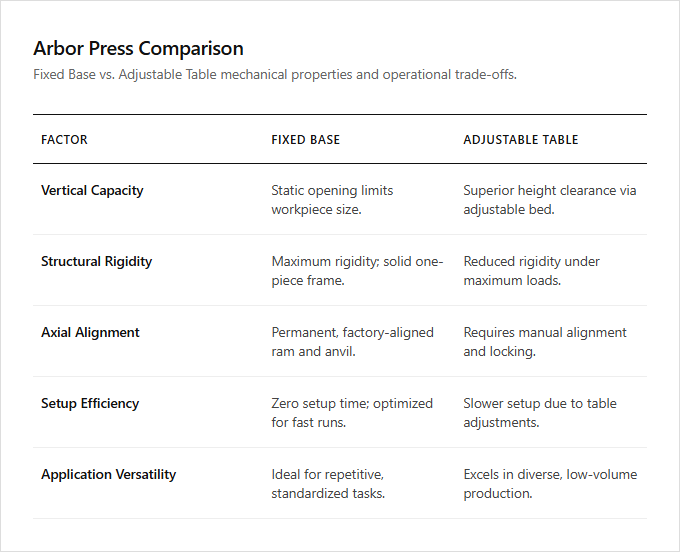
| Vertical Capacity | The Adjustable Table Arbor Press offers superior vertical capacity by allowing the operator to adjust the bed height, whereas the Fixed Base model has a static throat opening that limits workpiece size. |
| Structural Rigidity | Fixed Base Arbor Presses provide maximum structural rigidity because their solid, one-piece cast iron frame minimizes deflection under high force loads. |
| Axial Alignment | The Fixed Base design ensures permanent axial alignment between the ram and the anvil, whereas adjustable tables require precise locking to prevent angular misalignment during high-pressure pressing. |
| Setup Efficiency | Adjustable Table Arbor Presses require additional setup time to reposition and level the table for different parts, while Fixed Base models allow for faster cycle times on standardized, high-volume runs. |
| Application Versatility | Adjustable Table models excel in low-volume, high-mix manufacturing environments due to their ability to accommodate diverse workpiece geometries, whereas Fixed Base models are ideal for repetitive broaching and press-fitting. |
Adjustable tables maximize daylight dimensions compared to rigid fixed-base frames.
When selecting an arbor press, the primary differentiator lies in the frame design and its impact on vertical capacity. A fixed base arbor press features a rigid, non-adjustable frame that offers high stability but limits the maximum height of the workpiece. In contrast, an adjustable table arbor press allows operators to raise or lower the working surface. This adaptability maximizes the daylight dimensions-the vertical clearance between the ram and the table-enabling the machine to accommodate much larger or more oddly shaped components.
By eliminating the constraints of a rigid frame, adjustable models provide superior versatility for evolving workshop demands. Fixed base units remain highly efficient for repetitive, high-precision tasks of consistent dimensions. Production facilities focusing on standardized, small-part assembly benefit most from the stability of a fixed base, whereas custom fabricators and maintenance technicians requiring variable vertical clearance will find the adjustable table indispensable.
Fixed-Base Designs: Maximum Rigidity, Minimum Deflection
When selecting an arbor press, understanding the structural differences between fixed base and adjustable table designs is critical for operational success. Fixed base arbor presses are engineered for maximum stability, featuring a solid, non-movable bed integrated directly into the frame. This design offers superior frame rigidity and minimal deflection under peak tonnage, ensuring consistent alignment and precision during heavy-force applications.
Adjustable table models feature a movable work surface that accommodates varying workpiece heights, though this versatility introduces potential points of flex under maximum loads. Fixed base presses are ideal for high-precision fabricators requiring absolute alignment under heavy loads, whereas adjustable table models best serve versatile maintenance technicians handling diverse components.
Why Fixed Base Presses Need Longer Ram Strokes
When selecting an arbor press, the structural design of the base significantly impacts operational efficiency. A fixed base arbor press features a stationary bed, which creates a permanent vertical opening between the ram and the table. Because this clearance cannot be altered, operators must utilize presses with longer ram stroke lengths to bridge the vertical gap when working on smaller workpieces. This design requires careful calculation of stroke requirements to ensure the ram can reach the target area effectively.
An adjustable table arbor press allows users to raise or lower the work surface, minimizing the required stroke length and optimizing leverage. Fixed base models are ideal for high-volume production facilities handling uniform part sizes, while adjustable table models are best suited for custom fabrication shops and maintenance technicians who require versatility for diverse workpieces.
Shear Stress Risks in Adjustable Support Pins
Arbor presses serve as essential workshop tools, available in both fixed base and adjustable table configurations. While adjustable table models offer excellent versatility for varying workpiece sizes, their design introduces a critical structural vulnerability. These adjustable units rely on high-tensile support pins to hold the table in place, components that are inherently prone to shear stress when operating near the machine's maximum load capacity limits.
Fixed base arbor presses feature a solid, monolithic frame that distributes pressure directly through the casting, eliminating weak points and ensuring maximum rigidity during heavy-force applications. Heavy-duty industrial fabricators requiring uncompromising strength benefit most from fixed base models, while light-duty workshops prioritizing component clearance find the adjustable table variant more suitable.
Precision-Aligned Fixed Base Anvil Plates
Selecting the right arbor press depends heavily on the required alignment precision and workpiece clearance. Fixed base units feature integrated machined anvil plates that maintain precise perpendicularity to the ram axis, ensuring consistent, high-accuracy pressing operations without risk of table deflection. This rigid setup is engineered for highly repetitive, tight-tolerance manufacturing tasks.
Conversely, adjustable table arbor presses offer movable beds that accommodate a wider range of workpiece heights and shapes. While this adaptability increases overall shop versatility, it can introduce slight variances in alignment compared to solid, single-piece frame designs.
High-precision machinists requiring absolute alignment accuracy benefit most from the fixed base design, whereas general maintenance technicians and custom fabricators are better suited for the versatile adjustable table model.
How Adjustable Tables Affect Tool Alignment and Concentricity
Choosing between a fixed base and an adjustable table arbor press requires a careful evaluation of rigidity and alignment needs. Fixed base models offer a solid, single-frame construction that ensures permanent alignment between the ram and the anvil. In contrast, adjustable table presses feature moveable beds that provide vertical flexibility but introduce mechanical joints. These adjustable mechanisms can introduce lateral play, which directly affects throat depth alignment and compromises tooling concentricity during high-pressure operations.
For applications requiring absolute precision, the rigid nature of a fixed base prevents deflection under load. Adjustable tables accommodate a wider variety of workpiece heights and shapes, providing versatility for variable-capacity workshops. Fixed base presses are ideal for production-line machinists requiring repetitive high-tolerance assembly, while adjustable table models best suit maintenance technicians who value setup adaptability over extreme concentricity.
Heavy-Duty Rack-and-Pinion Throat Clearance Adjustment
Arbor presses are essential workshop tools, primarily categorized into fixed base and adjustable table designs. While fixed base models offer a rigid, non-negotiable workspace height for repetitive, high-precision tasks, adjustable table variants provide exceptional versatility. Heavy-duty adjustable models utilize a rack-and-pinion elevation system to safely modify vertical throat clearance, allowing operators to accommodate workpieces of varying heights without compromising structural integrity.
This mechanical adjustment ensures safe alignment and prevents sudden drops during setup. High-volume manufacturing specialists benefit most from the fast, uniform cycles of fixed base units, whereas maintenance technicians and custom fabrication shops require the adaptable clearance of adjustable table presses.
Leave a comment