
Achieving exact pressure in pneumatic applications is a persistent challenge for operators, where even a minor variance can lead to compromised performance or catastrophic equipment failure. When workshop managers seek to upgrade their pneumatic capabilities, they typically leverage standard capital equipment budgets or operational tool-funding sources to secure reliable machinery. Investing in advanced inflator technology grants operators unprecedented control, eliminating the guesswork of manual monitoring.
However, realizing these benefits is strictly stipulated on selecting the appropriate regulation mechanism for your specific workflow. For instance, servicing high-performance, low-profile tires requires a level of precision that standard utility inflators cannot safely guarantee.
In this article, we will analyze the technical differences between automatic and manual shut-off systems, evaluate their impact on operational efficiency, and outline key factors to help you determine the optimal configuration for your facility's pressure-regulation needs.
| Factor | Summary |
|---|---|
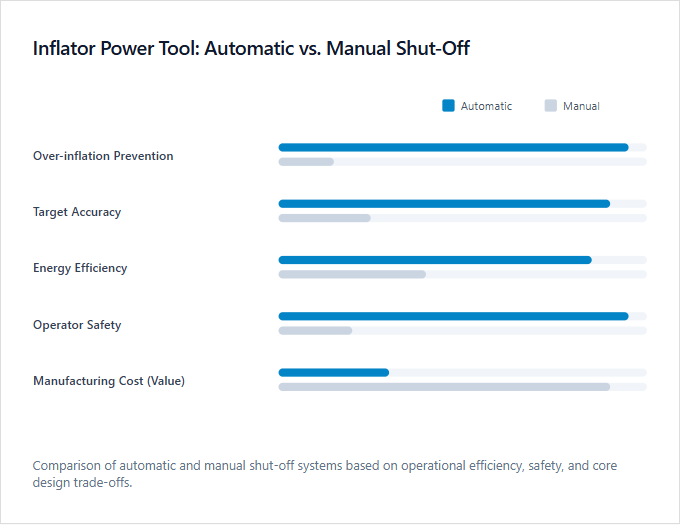
| Over-inflation Prevention | Automatic models utilize an integrated digital pressure transducer to stop inflation at a set limit, whereas manual models rely entirely on user vigilance to prevent structural failure of the inflatable. |
| Target Accuracy | An automatic shut-off system relies on a programmable microprocessor to achieve a precise target PSI, while manual tools depend on human reaction time and analog gauge calibration. |
| Energy Efficiency | Automatic shut-off optimizes lithium-ion battery duty cycles by instantly cutting power upon completion, unlike manual operation which can waste energy through overruns. |
| Operator Safety | The automated system significantly reduces the risk of motor thermal overload during prolonged use, whereas manual systems require constant physical monitoring to prevent overheating. |
| Manufacturing Cost | Manual shut-off devices employ simpler analog circuitry, resulting in lower retail costs and fewer potential points of electronic component failure. |
Closed-Loop Electronic vs. Manual Pressure Monitoring
Automatic inflator power tools utilize advanced closed-loop feedback systems driven by integrated electronic pressure transducers. These sensors continuously sample internal pressure, instantly halting the inflation cycle once the pre-programmed target setpoint is reached. This digital integration eliminates human error, protects equipment from over-inflation, and ensures highly repeatable accuracy.
Manual shut-off systems rely on operators visually monitoring analog Bourdon tube gauges and manually deactivating the tool. This mechanical approach offers simplicity and robust durability, though it demands undivided operator attention and is susceptible to reading parallax errors. Automatic models are ideal for high-volume commercial technicians requiring hands-free precision, whereas manual units are best suited for occasional DIY users seeking a cost-effective, durable tool for basic utility tasks.
Microcontroller-Triggered Solenoid Valve for Instant Pressure Shut-Off
Modern inflator power tools diverge significantly in pressure control mechanisms, primarily through automatic or manual shut-off systems. Automatic models utilize integrated microcontrollers that constantly monitor real-time pressure against user-defined setpoints. Upon reaching the target pressure, the microcontroller sends an electrical signal to actuate an internal solenoid valve, instantaneously terminating the airflow. This closed-loop feedback system prevents over-inflation and ensures precise pressure delivery without human intervention.
Conversely, manual shut-off inflators rely entirely on the operator to monitor a mechanical gauge and physically release the trigger to stop the flow. While manual units offer simplicity, they lack the millisecond-level precision of solenoid-driven termination. Automatic shut-off models are ideal for professionals requiring exact pressure calibration and hands-free multitasking, whereas manual inflators suit casual DIYers performing basic, infrequent inflation tasks.
Human Latency Causes Over-Pressurization in Manual Systems
Manual shut-off inflators rely entirely on human monitoring, which introduces unavoidable reaction time latency. The fraction of a second required for an operator to process a gauge reading and manually disengage the trigger often leads to over-pressurization. In applications governed by strict pressure tolerance limits, this brief delay can compromise structural integrity or cause component failure. Automatic shut-off systems mitigate this risk by utilizing digital sensors to cut power instantly when target pressures are achieved.
Selecting the appropriate tool depends on the required precision of the application. Automatic inflators are best suited for professionals maintaining high-tolerance equipment and sensitive tires, while manual models are appropriate for general operators undertaking basic inflation tasks where slight pressure variances are acceptable.
Hysteresis Compensation for Automatic Inflator Pressure Spikes
Manual inflators require constant operator monitoring, where users must visually track a gauge and manually cut power. In contrast, automatic shut-off inflators utilize advanced pressure-sensing technology to halt operation at a target setpoint. To ensure accuracy, high-end automatic units employ hysteresis compensation algorithms. These digital algorithms filter out transient dynamic pressure spikes caused by high-velocity airflow and turbulence inside the valve stem, preventing the tool from shutting off prematurely before the actual target pressure is achieved.
This algorithmic filtering ensures a stable, true pressure reading during the inflation cycle. Manual shut-off models are well-suited for occasional users who prioritize budget-friendly simplicity and direct physical control, while automatic inflators with hysteresis filtering are ideal for precision-driven automotive technicians and professionals requiring rapid, hands-free repeatability.
Dynamic Sensor Auto-Calibration in Variable Environments
When selecting an inflator power tool, the choice between automatic and manual shut-off systems often centers on pressure precision. Automatic shut-off models utilize digital sensors equipped with dynamic auto-calibration technology. This system continuously updates the sensor's baseline to neutralize the effects of fluctuating ambient temperatures and varying atmospheric pressures, maintaining strict reading accuracy. In contrast, manual shut-off tools depend entirely on human monitoring and standard gauges, which lack the ability to self-adjust for environmental shifts.
The ideal system depends on the user's specific application demands and environmental working conditions. Automatic models are best suited for commercial technicians requiring precise, hands-free inflation in changing climates, whereas manual inflators are ideal for budget-conscious homeowners performing quick, occasional tasks where absolute precision is not critical.
Precision Inflation Deceleration Using Proportional PWM
Inflator power tools differ significantly in their control mechanisms and precision. Manual shut-off models require continuous operator monitoring to prevent over-inflation. In contrast, advanced automatic shut-off systems utilize proportional flow control and pulse-width modulation (PWM) to manage airflow dynamically. As the pressure approaches the pre-selected target setpoint, the microprocessor-controlled PWM reduces duty cycles, decelerating the inflation speed to prevent pressure overshoot and protect the valve system.
This technological distinction directly impacts operational efficiency and safety. Manual inflators are ideal for budget-conscious users performing occasional, non-critical tasks, whereas automatic models with PWM-driven deceleration are best suited for high-precision professionals and multi-tasking operators who require exact pressure control.
Mechanical Relief Valves as Manual Inflation Safety Backups
Selecting the right inflator power tool involves weighing digital automation against mechanical reliability. Automatic shut-off models rely on electronic sensors and digital limit switches to halt operation at a precise target pressure. Manual inflation systems require operators to monitor the pressure gauge directly, demanding greater operator vigilance during use.
To prevent dangerous over-pressurization in the absence of digital controls, manual tools incorporate mechanical overpressure relief valves. These spring-loaded valves serve as critical redundant safety backups, automatically venting excess air if the operator fails to stop the tool. Automatic models are ideal for homeowners seeking hands-free convenience, while robust manual units with mechanical safety valves are best suited for industrial operators requiring extreme durability and fail-safe operation.
Leave a comment